

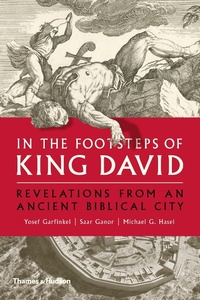
In the Footsteps of King David
Revelations from an Ancient Biblical City
Published on 7. June 2018
Book
Hardback
256 pages
978-0-500-05201-3 (ISBN)
Description
King David is a pivotal figure in the Bible, which provides stirring accounts of his deeds, including the slaying of the Philistine giant Goliath and the founding of his capital in Jerusalem. However, no certain archaeological finds from the period of his reign or of the united kingdom he ruled over have been uncovered - until now.
In this first-hand and highly readable account, the excavators of Khirbet Qeiyafa in the Valley of Elah, where the Bible says David fought Goliath, reveal how seven years of exhaustive investigation have uncovered a city dating to the time of David - the late 11th and early 10th century bc - surrounded by massive fortifications with impressive gates, a clear urban plan and an abundance of finds that tell us much about the inhabitants, including a pottery sherd with the earliest known Hebrew inscription. The authors clearly describe the methods of the excavation and the evidence they discovered, as well as how we interpret it. But more than just a simple excavation report, this book also explains the significance of these discoveries and how they shed new light on David's kingdom, as well as discussing the link between the Bible, archaeology and history. This topic is at the centre of a decades-long controversy, with some scholars disputing that the Bible contains a record of historical events and people, an approach that is convincingly challenged here.
In this first-hand and highly readable account, the excavators of Khirbet Qeiyafa in the Valley of Elah, where the Bible says David fought Goliath, reveal how seven years of exhaustive investigation have uncovered a city dating to the time of David - the late 11th and early 10th century bc - surrounded by massive fortifications with impressive gates, a clear urban plan and an abundance of finds that tell us much about the inhabitants, including a pottery sherd with the earliest known Hebrew inscription. The authors clearly describe the methods of the excavation and the evidence they discovered, as well as how we interpret it. But more than just a simple excavation report, this book also explains the significance of these discoveries and how they shed new light on David's kingdom, as well as discussing the link between the Bible, archaeology and history. This topic is at the centre of a decades-long controversy, with some scholars disputing that the Bible contains a record of historical events and people, an approach that is convincingly challenged here.
Reviews / Votes
'This study ... exhibits the virtues of committed scholarship in a land where anger and assertion frequently crowd out careful qualification and a willingness to consider varied arguments' - Diarmaid MacCulloch, London Review of Books 'It is a real pleasure to read an account of an excavation presented as a fascinating detective story and an intellectual adventure ... a well-considered and absorbing account' - Minerva 'A most interesting and instructive book ... a very readable, attractively produced work' - Methodist RecorderMore details
Language
English
Place of publication
London
United Kingdom
Illustrations
90 Illustrations, black and white; 17 Illustrations, color
Dimensions
Height: 236 mm
Width: 160 mm
Thickness: 25 mm
Weight
635 gr
ISBN-13
978-0-500-05201-3 (9780500052013)
Copyright in bibliographic data and cover images is held by Nielsen Book Services Limited or by the publishers or by their respective licensors: all rights reserved.
Schweitzer Classification
Persons
Yosef Garfinkel is Yigael Yadin Professor for the Archaeology of the Land of Israel, Biblical Archaeology Department of the Institute of Archaeology, Hebrew University of Jerusalem, Head of the Berman Center
for Biblical Archaeology. Saar Ganor was co-director of the excavations at Khirbel Qeiyafa. Michael G. Hasel is Professor of Near Eastern Studies and Archaeology at Southern Adventist University in Tennessee, USA.
for Biblical Archaeology. Saar Ganor was co-director of the excavations at Khirbel Qeiyafa. Michael G. Hasel is Professor of Near Eastern Studies and Archaeology at Southern Adventist University in Tennessee, USA.
Content
Part I. Introduction * 1. In King David's Footsteps: Bible, History and Archaeology * 2. The Curtain Rises on the Sorek and Elah Valleys Part II. The Story of the Khirbet Qeiyafa Excavations 3. The City during the Period of King David: Construction and Urban Planning * 4. The Finds: A City Frozen in Time * 5. Greetings from the Past: The Khirbet Qeiyafa Inscriptions * 6. Cult in Judah prior to the construction of Solomon's Temple Part III. What is the Significance of the Finds from Khirbet Qeiyafa? 7. Khirbet Qeiyafa: Biblical Shaaraim * 8. David's Kingdom * 9. Solomon's Palace and the First Temple * 10. Summary