

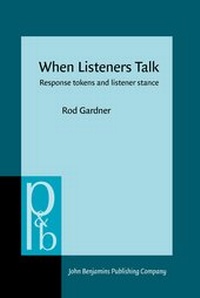
When Listeners Talk
Response tokens and listener stance
Published on 1. January 2001
Book
Hardback
289 pages
978-90-272-5111-4 (ISBN)
Description
Listeners are usually considered recipients in conversational interaction, whose main activity is to take in messages from other speakers. In this view, the listening activity is separate from speaking. Another view is that listeners and speakers are equal co-participants in conversations who construct the talk together. In support of this latter view, one finds a group of vocalisations which are quintessentially listener talk - little conversational objects such as uh-huh, oh, mm, yeah, right and mm-hm. These utterances do not have meanings in a conventional dictionary sense, but are nevertheless loaded with complex and subtle information about the stance listeners take to what they are hearing, information that is gleaned not only from their phonetic form, but also from their complex prosodic shape and their placement and timing within the flow of talk. This book summarises eight of these objects, and explores one, mm, in depth.
More details
Series
Language
English
Place of publication
Amsterdam
Netherlands
Target group
College/higher education
Professional and scholarly
Dimensions
Height: 225 mm
Width: 154 mm
Weight
530 gr
ISBN-13
978-90-272-5111-4 (9789027251114)
Copyright in bibliographic data and cover images is held by Nielsen Book Services Limited or by the publishers or by their respective licensors: all rights reserved.
Schweitzer Classification
Other editions
Additional editions
E-Book
01/2001
1st Edition
John Benjamins Publishing Company
€144.99
Available for download
Person
Content
1. Acknowledgements; 2. Transcription Notation; 3. 1. Introduction; 4. 2. A Review of Response Tokens; 5. 3. Five types of Mm: The non-response tokens; 6. 4. From continuer to acknowledgement token: Mm as a token between Mm hm and Yeah; 7. 5. The Weakness of Mm: Topic disalignment and zero projection; 8. 6. Intonation contour and the use of Mm; 9. 7. Summary and future directions; 10. Notes; 11. Bibliography