

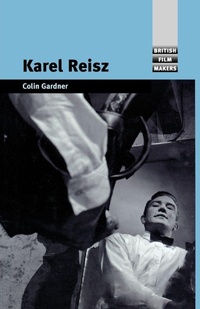
Karel Reisz
Published on 1. April 2011
Book
Paperback/Softback
316 pages
978-0-7190-8566-6 (ISBN)
Description
Czech-born refugee Karel Reisz (1926-2002) is widely regarded as one of the seminal figures in post-war British cinema. Along with Lindsay Anderson and Tony Richardson, Reisz was a founder member of the independent Free Cinema 'movement' which attacked the parochial middle-class values of home-grown studio product with a vigorous commitment to everyday working-class subject matter and a poetically charged film style. This was immediately recognisable in the aesthetic of the international success of Reisz's first feature, Saturday Night and Sunday Morning (1960).
As the import of Free Cinema rapidly dissipated during the 'Swinging London' era, Reisz confronted the changing cultural mores of the 1960s and 1970s with a series of ambivalent films that critique the anarchic free spirit of the times, including Morgan (1966), Isadora (1968), The Gambler (1974) and Dog Soldiers (1978).
Drawing on Reisz's early film criticism for Sequence and Sight and Sound, as well as interdisciplinary methodologies, this first career-length study explores Reisz's personal brand of character-based realism, offering the spectator a privileged insight into an artist's developing response to subjective and historical dislocation. The book should thus prove invaluable to film scholars, cultural historians and the Reisz aficionado. -- .
As the import of Free Cinema rapidly dissipated during the 'Swinging London' era, Reisz confronted the changing cultural mores of the 1960s and 1970s with a series of ambivalent films that critique the anarchic free spirit of the times, including Morgan (1966), Isadora (1968), The Gambler (1974) and Dog Soldiers (1978).
Drawing on Reisz's early film criticism for Sequence and Sight and Sound, as well as interdisciplinary methodologies, this first career-length study explores Reisz's personal brand of character-based realism, offering the spectator a privileged insight into an artist's developing response to subjective and historical dislocation. The book should thus prove invaluable to film scholars, cultural historians and the Reisz aficionado. -- .
More details
Series
Language
English
Place of publication
Manchester
United Kingdom
Target group
College/higher education
Professional and scholarly
Illustrations
Illustrations, black & white
Dimensions
Height: 216 mm
Width: 140 mm
Thickness: 18 mm
Weight
407 gr
ISBN-13
978-0-7190-8566-6 (9780719085666)
Copyright in bibliographic data and cover images is held by Nielsen Book Services Limited or by the publishers or by their respective licensors: all rights reserved.
Schweitzer Classification
Other editions
Additional editions
Colin Gardner
Karel Reisz
E-Book
01/2019
1st Edition
Manchester University Press
from
€36.99
Available for download
Person
Colin Gardner is Professor of Critical Theory and Interdisciplinary Media at the University of California, Santa Barbara. -- .
Content
List of figures
Series Editors' foreword
Acknowledgements
1. Introduction: Karel Reisz, 'The last great man in England'
2. Reisz the critic
3. Free Cinema and the New Left: Momma Don't Allow (1956), We Are The Lambeth Boys (1959)
and March to Aldermaston (1959)
4. 'Kitchen Sink' realism and the birth of the British 'New Wave': Saturday Night and Sunday
Morning (1960)
5. Keeping up with the Truffauts: Night Must Fall (1964)
6. Gorilla war: Morgan - A Suitable Case for Treatment (1966)
7. Life into art - Reisz and the 'bio-pic': Isadora (1968) and Sweet Dreams (1985)
8. Reisz in Hollywood: deconstructing existentialism and the counterculture in The Gambler (1974) and Dog Soldiers/Who'll Stop The Rain (1978)
9. A sentimental education: The French Lieutenant's Woman (1981)
10. Theatre of the absurd: Arthur Miller's Everybody Wins (1990) and Samuel Beckett's Act Without Words I (2000)
11. Conclusion
Appendix
Theatre credits and filmography
Bibliography -- .
Series Editors' foreword
Acknowledgements
1. Introduction: Karel Reisz, 'The last great man in England'
2. Reisz the critic
3. Free Cinema and the New Left: Momma Don't Allow (1956), We Are The Lambeth Boys (1959)
and March to Aldermaston (1959)
4. 'Kitchen Sink' realism and the birth of the British 'New Wave': Saturday Night and Sunday
Morning (1960)
5. Keeping up with the Truffauts: Night Must Fall (1964)
6. Gorilla war: Morgan - A Suitable Case for Treatment (1966)
7. Life into art - Reisz and the 'bio-pic': Isadora (1968) and Sweet Dreams (1985)
8. Reisz in Hollywood: deconstructing existentialism and the counterculture in The Gambler (1974) and Dog Soldiers/Who'll Stop The Rain (1978)
9. A sentimental education: The French Lieutenant's Woman (1981)
10. Theatre of the absurd: Arthur Miller's Everybody Wins (1990) and Samuel Beckett's Act Without Words I (2000)
11. Conclusion
Appendix
Theatre credits and filmography
Bibliography -- .