

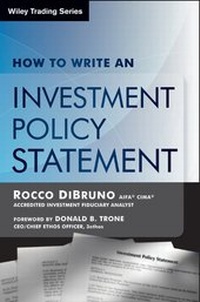
How to Write an Investment Policy Statement
1st Edition
Published on 19. April 2004
Book
Paperback/Softback
80 pages
978-1-59280-098-8 (ISBN)
Description
An indispensable resource for every financial service professionals developing an IPS
The Investment Policy Statement (IPS) is one of the most critical documents fiduciaries must draft. For years, ERISA and other industry regulations have governed the guidelines all fiduciaries must comply with when drafting one. But the current climate of corporate scandal and the 2008 global banking crisis have led to increased scrutiny by regulators, prompting firms to take a closer look at the quality and integrity of their IPSs and to take steps to have a rigorous formal process in place for drafting them. Endorsed by the Foundation of Fiduciary Studies, this concise guide provides a rigorous framework and the expert insight, information and guidance you need to guarantee that your IPS is in complete compliance with all ERISA-directed requirements.
* Provides a step-by-step plan for creating a uniform IPS that every advisor in the office can follow
* Defines the duties and responsibilities of all parties involved, while clarifying diversification guidelines and providing methods for keeping costs under control
* Packed with ready-to-use templates, sample forms, letters and other documents, diagrams and other valuable tools, including sample Policy Statement downloadable at the companion website
* Designed to get you quickly up to speed on what you need to know to confidently serve your clients with the highest standards of care and protection
The Investment Policy Statement (IPS) is one of the most critical documents fiduciaries must draft. For years, ERISA and other industry regulations have governed the guidelines all fiduciaries must comply with when drafting one. But the current climate of corporate scandal and the 2008 global banking crisis have led to increased scrutiny by regulators, prompting firms to take a closer look at the quality and integrity of their IPSs and to take steps to have a rigorous formal process in place for drafting them. Endorsed by the Foundation of Fiduciary Studies, this concise guide provides a rigorous framework and the expert insight, information and guidance you need to guarantee that your IPS is in complete compliance with all ERISA-directed requirements.
* Provides a step-by-step plan for creating a uniform IPS that every advisor in the office can follow
* Defines the duties and responsibilities of all parties involved, while clarifying diversification guidelines and providing methods for keeping costs under control
* Packed with ready-to-use templates, sample forms, letters and other documents, diagrams and other valuable tools, including sample Policy Statement downloadable at the companion website
* Designed to get you quickly up to speed on what you need to know to confidently serve your clients with the highest standards of care and protection
More details
Series
Edition
1., Auflage
Language
English
Place of publication
United States
Publishing group
John Wiley & Sons Inc
Product notice
Paperback (trade)
Illustrations
black & white illustrations
Dimensions
Height: 25 cm
Width: 15 cm
Thickness: 15 mm
Weight
666 gr
ISBN-13
978-1-59280-098-8 (9781592800988)
Schweitzer Classification
Other editions
New editions
Rocco Dibruno
How to Write an Investment Policy Statement
Book
08/2013
2nd Edition
Wiley
€19.00
Shipment within 15-20 days
Persons
Content
Foreword by Don Trone 13
SECTION ONE: Why Plan Sponsors and All Fiduciaries Need a Formal Process for Writing Their Investment Policy Statement
Chapter 1 ERISA AND THE CHALLENGE OF FIDUCIARY RESPONSIBILITY 19
Writing an Investment Policy 19
What Is a Fiduciary? 20
Fiduciary Liability 21
Chapter 2 YOUR FIDUCIARY RESPONSIBILITIES AND LIABILITIES UNDER ERISA 23
Five Fiduciary Responsibilities 23
Fiduciary's Personal Liability 24
A Fiduciary's Primary Role Is to Manage the Process 25
Chapter 3 WHAT IS AN INVESTMENT POLICY STATEMENT AND WHAT ARE THE BENEFITS? 27
Risk Management 27
Monitor Investments 28
Summary 29
Chapter 4 UTILIZE THE "SAFE HARBOR" PROVISIONS PROVIDED BY ERISA 31
Prudent Experts 31
Five Recognized "Safe Harbor" Rules 31
Chapter 5 COMPLYING WITH ERISA SECTION 404(c) 33
SECTION TWO: How to Get Started and Steps to Formalize the Process
Chapter 6. ASSEMBLING THE DOCUMENTATION 37
Chapter 7 STEPS TO FORMALIZE THE PROCESS 39
STEP 1: Decide on Plan Goals, Objectives, and Strategies 39
STEP 2: Decide on Strategy for Managing Risk 39
STEP 3: Determine the Risk Tolerance of the Plan 40
STEP 4: Set Forth Guidelines for Asset Classes 41
STEP 5: Implement an Asset-Allocation Policy 41
STEP 6: Mutual Funds Recommendations 41
STEP 7: Delegate Investment Management Responsibility 42
STEP 8: Investment Monitoring and Reporting 42
SECTION THREE: The Template IPS
Chapter 8 SAMPLE IPS TEMPLATES 45
Two Distinct IPS Samples 45
Organization of Templates 45
Chapter 9 SAMPLE IPS TEMPLATE #1: For Participant-Directed 401(k) That Intends to Comply with ERISA Section 404(c) 47
STEP 1. Executive Summary and Background 47
STEP 2. Purpose of the Investment Policy Statement 48
STEP 3. Duties and Responsibilities 50
STEP 4. Asset Class Guidelines 52
STEP 5. Investment Manager Selection 54
STEP 6. Monitoring the Investment Managers 55
STEP 7. Controlling and Accounting for Investment. Expenses 57
STEP 8. Investment Policy Review and Monitoring 58
Chapter 10 SAMPLE IPS TEMPLATE #2: For High-Net-Worth Individual Setting Up a Family Trust 59
Executive Summary 60
PART I--Purpose 61
PART II--Investment Management Objectives 61
PART III--Roles and Responsibilities 62
PART IV--Investment Manager Selection 63
PART V--Investment Monitoring and Review 65
PART VI--Manager Termination 67
PART VII--Additional Provisions (optional) 67
Conclusion
MESSAGE TO PLAN SPONSORS 69
Glossary 71
The Firm Profile 79
About the Author 87
SECTION ONE: Why Plan Sponsors and All Fiduciaries Need a Formal Process for Writing Their Investment Policy Statement
Chapter 1 ERISA AND THE CHALLENGE OF FIDUCIARY RESPONSIBILITY 19
Writing an Investment Policy 19
What Is a Fiduciary? 20
Fiduciary Liability 21
Chapter 2 YOUR FIDUCIARY RESPONSIBILITIES AND LIABILITIES UNDER ERISA 23
Five Fiduciary Responsibilities 23
Fiduciary's Personal Liability 24
A Fiduciary's Primary Role Is to Manage the Process 25
Chapter 3 WHAT IS AN INVESTMENT POLICY STATEMENT AND WHAT ARE THE BENEFITS? 27
Risk Management 27
Monitor Investments 28
Summary 29
Chapter 4 UTILIZE THE "SAFE HARBOR" PROVISIONS PROVIDED BY ERISA 31
Prudent Experts 31
Five Recognized "Safe Harbor" Rules 31
Chapter 5 COMPLYING WITH ERISA SECTION 404(c) 33
SECTION TWO: How to Get Started and Steps to Formalize the Process
Chapter 6. ASSEMBLING THE DOCUMENTATION 37
Chapter 7 STEPS TO FORMALIZE THE PROCESS 39
STEP 1: Decide on Plan Goals, Objectives, and Strategies 39
STEP 2: Decide on Strategy for Managing Risk 39
STEP 3: Determine the Risk Tolerance of the Plan 40
STEP 4: Set Forth Guidelines for Asset Classes 41
STEP 5: Implement an Asset-Allocation Policy 41
STEP 6: Mutual Funds Recommendations 41
STEP 7: Delegate Investment Management Responsibility 42
STEP 8: Investment Monitoring and Reporting 42
SECTION THREE: The Template IPS
Chapter 8 SAMPLE IPS TEMPLATES 45
Two Distinct IPS Samples 45
Organization of Templates 45
Chapter 9 SAMPLE IPS TEMPLATE #1: For Participant-Directed 401(k) That Intends to Comply with ERISA Section 404(c) 47
STEP 1. Executive Summary and Background 47
STEP 2. Purpose of the Investment Policy Statement 48
STEP 3. Duties and Responsibilities 50
STEP 4. Asset Class Guidelines 52
STEP 5. Investment Manager Selection 54
STEP 6. Monitoring the Investment Managers 55
STEP 7. Controlling and Accounting for Investment. Expenses 57
STEP 8. Investment Policy Review and Monitoring 58
Chapter 10 SAMPLE IPS TEMPLATE #2: For High-Net-Worth Individual Setting Up a Family Trust 59
Executive Summary 60
PART I--Purpose 61
PART II--Investment Management Objectives 61
PART III--Roles and Responsibilities 62
PART IV--Investment Manager Selection 63
PART V--Investment Monitoring and Review 65
PART VI--Manager Termination 67
PART VII--Additional Provisions (optional) 67
Conclusion
MESSAGE TO PLAN SPONSORS 69
Glossary 71
The Firm Profile 79
About the Author 87