

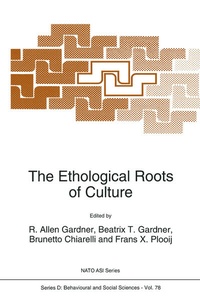
The Ethological Roots of Culture
Published on 20. October 2012
Book
Paperback/Softback
VII, 477 pages
978-94-010-4433-2 (ISBN)
Description
Can the concept of culture be applied validly to another species? This paper first reports (as a case study) a kind of grooming shown by wild chimpanzees which seems to be a truly social custom. The example serves to introduce the practical pitfalls and potentials of seeking to answer the question posed. Next, the paper focuses on a type of tool-use, hammer-and-anvil, which varies across populations and has important archaeological implications. Broadening further, an exhaustive catalogue of habitual tool-use across all known field-studies is presented. Finally, the evidence of regional and local patterns of tool use by wild chimpanzees is assessed. The paper then turns to mechanisms of cultural processes, especially innovation, before ending with responses to recent criticisms by the "anti-culturalists". If concepts such as culture are to help us understand the behavior of our nearest relations, we must avoid simplistic and sloppy extrapolation. Two long-term field studies of wild chimpanzees have proceeded in parallel in western Tanzania, and most of the published knowledge of the natural behavior of individual chimpanzees comes from these. Goodall's (1986) research group in the Gombe National Park has focussed on the Kasakela community of chimpanzees. The project begun by the African Primate Expedition at Kasoje in the Mahale Mountains, initially under the direction of Itani and later of Nishida (1968, 1990), focussed first on K Group, then later on M Group.
More details
Series
Edition
Softcover reprint of the original 1st ed. 1994
Language
English
Place of publication
Dordrecht
Netherlands
Target group
Professional and scholarly
Research
Illustrations
VII, 477 p.
Dimensions
Height: 240 mm
Width: 160 mm
Thickness: 27 mm
Weight
772 gr
ISBN-13
978-94-010-4433-2 (9789401044332)
DOI
10.1007/978-94-011-0998-7
Schweitzer Classification
Other editions
Additional editions
R.A. Gardner | Brunetto Chiarelli | Frans C. Plooij
The Ethological Roots of Culture
Proceedings of the NATO Advanced Science Institute, Corona, Italy, June 21-July 3, 1992
Book
10/1994
1st Edition
Kluwer Academic Publishers
€96.00
Article exhausted; check different version
Content
Studying the ethological roots of culture.- I. Field Studies.- Evidence of structure in macaque communication.- The central-peripheral structure of the Tanaxpillo colony of stumptail macaques.- Cultural implications of differences between populations of free ranging chimpanzees in Africa.- Precultural behavior of Japanese macaques: Longitudinal studies of the Koshima troops.- Bird song learning: A model of cultural transmission?.- Swarm intelligence and the emergence of cultural swarm patterns.- II. Laboratory Studies.- Mother-pup transmission of a feeding technique in the golden hamster.- A study of social, genetic, and environmental determinants of cultural transmission in the House mouse.- Can chimpanzees use tools by observational learning?.- Social transmission of stimulus recognition by birds, fish and mollusks.- III. Cross-Fostered Chimpanzees.- Ethological roots of language.- Development of phrases in the utterances of children and cross-fostered chimpanzees.- Transmission of human gestural language in a chimpanzee mother-infant relationship.- The use of remote video recordings to study the use of American Sign Language by chimpanzees when no humans are present.- IV. Infant Development.- Is there prenatal culture?.- The earliness and complexity of the interaction skills and social behaviors of the child with its peers.- Learning by instincts, developmental transitions and the roots of culture in infancy.- V. Ethnographic and Historical Patterns.- An ethological perspective on human handedness.- Culture and olfactory communication.- Cultural evolution in man of postures, gestures, and unverbalised social relations.- VI. Paleoanthropological Patterns.- The evolutionary bases of intelligence.- Evolution of human culture: A composite pattern.- Culture and its biological origins: A view from ethology, epigenesis and design.- Causes of our complete dependence on culture.- List of contributors.