

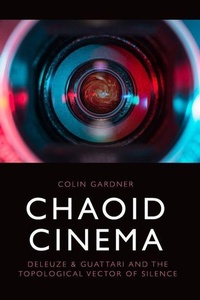
Chaoid Cinema
Deleuze & Guattari and the Topological Vector of Silence
Published on 18. October 2021
Book
Hardback
376 pages
978-1-4744-9402-1 (ISBN)
Description
Expanding on a burgeoning area in contemporary film studies that explores visual and aural absences and interstices in film narrative, this book explores silences in the soundtrack - not ambient silence or so-called 'room tone' but complete sound drop-outs, as if the film projector had broken down, thereby jolting the audience out of their passive relationship to the screen, forcing them to become aware of their surroundings and the material apparatus of film as a mechanical device.
Drawing on Deleuze and Guattari's concept of Chaoids, which are various organizations of chaos through the different disciplines of science, philosophy and art, this book uses silence to pursue a variety of vectors that open up the surface plane of art (in this case cinema) to discover different philosophical (and by extension, political) singularities and multiplicities.
Drawing on Deleuze and Guattari's concept of Chaoids, which are various organizations of chaos through the different disciplines of science, philosophy and art, this book uses silence to pursue a variety of vectors that open up the surface plane of art (in this case cinema) to discover different philosophical (and by extension, political) singularities and multiplicities.
Reviews / Votes
Gardner's pioneering work turns up the theoretical and philosophical volume on what is typically disregarded by critics and dismissed by directors in sound films: silence. Drawing on the ecosophical dimension of Deleuze and Guattari's thought and building on an impressive range of examples from 1931 to 2009, Gardner performs a virtuosic recital of sonic dropouts, pregnant pauses, and zones of silence in cinema. This visionary book will serve as an ideal companion to emergent works of scholarship on visual absence and darkness in film studies and film-philosophy. * Tanya Shilina-Conte, SUNY at Buffalo *More details
Language
English
Place of publication
Edinburgh
United Kingdom
Target group
Professional and scholarly
Illustrations
3 black and white illustrations
Dimensions
Height: 164 mm
Width: 244 mm
Thickness: 27 mm
Weight
696 gr
ISBN-13
978-1-4744-9402-1 (9781474494021)
Copyright in bibliographic data and cover images is held by Nielsen Book Services Limited or by the publishers or by their respective licensors: all rights reserved.
Schweitzer Classification
Other editions
Additional editions
E-Book
10/2021
1st Edition
Edinburgh University Press
€32.99
Available for download
E-Book
10/2021
1st Edition
Edinburgh University Press
€32.99
Available for download
Person
Colin Gardner is Professor of Critical Theory and Integrative Studies in the departments of Art, Film and Media Studies, the History of Art and Architecture, and Comparative Literature at the University of California, Santa Barbara. He is the author of Beckett, Deleuze and the Televisual Event: Peephole Art (Palgrave Macmillan, 2012), Karel Reisz (Manchester University Press, 2007) and Joseph Losey (Manchester University Press, 2004).
Content
Introduction: 'Stratigraphic Silence': Chaoid Cinema and Its Centripetal/Centrifugal Functions.
1: 'The Multiplicity is Among Us': Silence and the Machinic Phylum in Fritz Lang's M (1931).
2: Ecosophical Chaoids: Towards an 'Infinite Cinema' with Hollis Frampton's Zorn's Lemma (1970) and Gloria! (1979).
3: 'There is no film. Let us proceed to the debates!': Immanence as 'Syncinema' in Maurice Lemaitre's Le film est deja commence (1951) and Guy Debord's Hurlements en Faveur de Sade (1952).
4: The Children of Barthes and Paris Match: Godard, Prostitution and the Rhetoric of the Image.
5: 'Tricontinental Tropicalism': The Convulsive Carnival of a Syncretic Populism in Glauber Rocha's Terra em Transe (1967), Der Leone Have Sept Cabecas (1970) and I Idada da Terra (1980).
6: 'See You at Mao': the '60s Left Returns to Zero with the Dziga Vertov Group.
7: Silencing Interpellation: Gorin, Althusser and the Ideological State Apparatus.
8: 'We're Projectorists!': Concrete Duration and the Spectacle of Attractions in Malcolm Le Grice's Little Dog for Roger (1967); Threshold (1972); and After Lumiere - L'Arroseur Arrose (1974).
9: On Truth and Lie in an Extra-Formal Sense: Silence as Resistant Punctum in Abbas Kiarostami's Chorus (1982), Homework (1989) and Close-Up (1990).
Conclusion: 'The Abyss Also Looks Into You': From Syncinema to 'Sin' Cinema in Mike Figgis's Leaving Las Vegas (1995) and Harmony Korine's Trash Humpers (2009).
1: 'The Multiplicity is Among Us': Silence and the Machinic Phylum in Fritz Lang's M (1931).
2: Ecosophical Chaoids: Towards an 'Infinite Cinema' with Hollis Frampton's Zorn's Lemma (1970) and Gloria! (1979).
3: 'There is no film. Let us proceed to the debates!': Immanence as 'Syncinema' in Maurice Lemaitre's Le film est deja commence (1951) and Guy Debord's Hurlements en Faveur de Sade (1952).
4: The Children of Barthes and Paris Match: Godard, Prostitution and the Rhetoric of the Image.
5: 'Tricontinental Tropicalism': The Convulsive Carnival of a Syncretic Populism in Glauber Rocha's Terra em Transe (1967), Der Leone Have Sept Cabecas (1970) and I Idada da Terra (1980).
6: 'See You at Mao': the '60s Left Returns to Zero with the Dziga Vertov Group.
7: Silencing Interpellation: Gorin, Althusser and the Ideological State Apparatus.
8: 'We're Projectorists!': Concrete Duration and the Spectacle of Attractions in Malcolm Le Grice's Little Dog for Roger (1967); Threshold (1972); and After Lumiere - L'Arroseur Arrose (1974).
9: On Truth and Lie in an Extra-Formal Sense: Silence as Resistant Punctum in Abbas Kiarostami's Chorus (1982), Homework (1989) and Close-Up (1990).
Conclusion: 'The Abyss Also Looks Into You': From Syncinema to 'Sin' Cinema in Mike Figgis's Leaving Las Vegas (1995) and Harmony Korine's Trash Humpers (2009).