

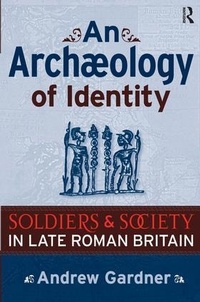
An Archaeology of Identity
Soldiers and Society in Late Roman Britain
1st Edition
Published on 15. August 2007
Book
Paperback/Softback
312 pages
978-1-59874-227-5 (ISBN)
Description
What happened to Roman soldiers in Britain during the decline of the empire in the 4th and 5th centuries? Did they withdraw, defect, or go native? More than a question of military history, this is the starting point for Andrew Gardner's incisive exploration of social identity in Roman Britain, in the Roman Empire, and in ancient society. Drawing on the sociological theories of Anthony Giddens and others, Gardner shapes an approach that focuses on the central role of practice in the creation and maintenance of identities-nationalist, gendered, class, and ethnic. This theory is then tested against the material remains of Roman soldiers in Britain to show how patterning of stratigraphy, architecture, and artifacts supports his theoretical construct. The result is a retelling of the story of late Roman Britain sharply at odds with the traditional text-driven histories and a theory of human action that offers much to current debates across the social sciences.
Reviews / Votes
'Identity in Roman Britain was not simple and it was not set in stone. One notable example was that of the Roman soldier during the decline of the Empire in the fourth and fifth centuries. As lines of authority collapsed and he became less and less relevant, the Roman solider had a number of available options, including withdrawing, defecting to another armed force, or going native. Gardner (archaeology of the Roman Empire, University College, London) makes good use of the theories of Giddens and others to examine how people create and maintain their identities in terms of nationality, gender, class and ethnicity. He then compares these theories to practice as expressed by portable and architectural material culture and texts. The result is quite different than we expected about the fates of these complex identities and serves as a model for more comparisons of identity with artifacts.' Book News, Inc.More details
Series
Language
English
Place of publication
Walnut Creek
United States
Target group
College/higher education
Product notice
Paperback (trade)
Unsewn / adhesive bound
Illustrations
illustrations
Dimensions
Height: 228 mm
Width: 161 mm
Thickness: 14 mm
Weight
417 gr
ISBN-13
978-1-59874-227-5 (9781598742275)
Copyright in bibliographic data and cover images is held by Nielsen Book Services Limited or by the publishers or by their respective licensors: all rights reserved.
Schweitzer Classification
Other editions
Additional editions
E-Book
09/2016
Routledge
€65.99
Available for download
E-Book
09/2016
Routledge
€65.99
Available for download
Book
11/2007
1st Edition
Left Coast Press Inc
€245.53
Shipment within 3-4 weeks
Person
Dr. Andrew Gardner is currently Lecturer in Roman Archaeology at Cardiff University. His previous publications include the edited volume Agency Uncovered: archaeological perspectives on social agency, power and being human (UCL Press), and his research interests include the social dynamics of Roman imperialism and the role of material culture in the expression of identity. From September 2005 he will be Lecturer in the Archaeology of the Roman Empire at University College London.
Content
Introduction: the Roman empire in the 21st century; Points of departure: The practice of identity; Identity of doing: artefacts and contexts; Identities of dwelling: structures and spaces; Worlds within worlds: the wider empire; Points of return: social stories; Epilogue: Whose Roman Britain?