

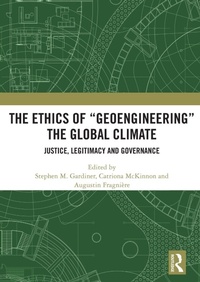
The Ethics of "Geoengineering" the Global Climate
Justice, Legitimacy and Governance
1st Edition
Published on 30. July 2020
Book
Paperback/Softback
254 pages
978-0-367-50154-9 (ISBN)
Description
In the face of limited time and escalating impacts, some scientists and politicians are talking about attempting "grand technological interventions" into the Earth's basic physical and biological systems ("geoengineering") to combat global warming. Early ideas include spraying particles into the stratosphere to block some incoming sunlight, or "enhancing" natural biological systems to withdraw carbon dioxide from the atmosphere at a higher rate. Such technologies are highly speculative and scientific development of them has barely begun.
Nevertheless, it is widely recognized that geoengineering raises critical questions about who will control planetary interventions, and what responsibilities they will have. Central to these questions are issues of justice and political legitimacy. For instance, while some claim that climate risks are so severe that geoengineering must be attempted, others insist that the current global order is so unjust that interventions are highly likely to be illegitimate and exacerbate injustice. Such concerns are rarely discussed in the policy arena in any depth, or with academic rigor. Hence, this book gathers contributions from leading voices and rising stars in political philosophy to respond. It is essential reading for anyone puzzled about how geoengineering might promote or thwart the ends of justice in a dramatically changing world.
The chapters in this book were originally published in the journals: Ethics, Policy & the Environment and Critical Review of International Social and Political Philosophy.
Nevertheless, it is widely recognized that geoengineering raises critical questions about who will control planetary interventions, and what responsibilities they will have. Central to these questions are issues of justice and political legitimacy. For instance, while some claim that climate risks are so severe that geoengineering must be attempted, others insist that the current global order is so unjust that interventions are highly likely to be illegitimate and exacerbate injustice. Such concerns are rarely discussed in the policy arena in any depth, or with academic rigor. Hence, this book gathers contributions from leading voices and rising stars in political philosophy to respond. It is essential reading for anyone puzzled about how geoengineering might promote or thwart the ends of justice in a dramatically changing world.
The chapters in this book were originally published in the journals: Ethics, Policy & the Environment and Critical Review of International Social and Political Philosophy.
More details
Language
English
Place of publication
London
United Kingdom
Publishing group
Taylor & Francis Ltd
Target group
College/higher education
Dimensions
Height: 246 mm
Width: 174 mm
Thickness: 14 mm
Weight
480 gr
ISBN-13
978-0-367-50154-9 (9780367501549)
Copyright in bibliographic data and cover images is held by Nielsen Book Services Limited or by the publishers or by their respective licensors: all rights reserved.
Schweitzer Classification
Other editions
Additional editions
Stephen M. Gardiner | Catriona McKinnon | Augustin Fragniere
The Ethics of "Geoengineering" the Global Climate
Justice, Legitimacy and Governance
Book
01/2024
1st Edition
Routledge
€65.50
Shipment within 15-20 days
Stephen M. Gardiner | Catriona McKinnon | Augustin Fragniere
The Ethics of "Geoengineering" the Global Climate
Justice, Legitimacy and Governance
E-Book
09/2020
1st Edition
Routledge
€59.49
Available for download
Stephen M. Gardiner | Catriona McKinnon | Augustin Fragniere
The Ethics of "Geoengineering" the Global Climate
Justice, Legitimacy and Governance
E-Book
09/2020
1st Edition
Routledge
€59.49
Available for download
Persons
Stephen M. Gardiner is Professor of Philosophy at the University of Washington, Seattle, and is author of A Perfect Moral Storm: the Ethical Challenge of Climate Change and Debating Climate Ethics, as well as many articles on climate justice and the ethics of geoengineering.
Catriona McKinnon is Professor of Political Theory at the University of Exeter, author of Climate Change and Future Justice and numerous articles on climate ethics and justice.
Augustin Fragniere is a trained philosopher and environmental scientist, who has published on climate ethics, geoengineering and sustainability theory.
Catriona McKinnon is Professor of Political Theory at the University of Exeter, author of Climate Change and Future Justice and numerous articles on climate ethics and justice.
Augustin Fragniere is a trained philosopher and environmental scientist, who has published on climate ethics, geoengineering and sustainability theory.
Content
Introduction: Geoengineering, Political Legitimacy and Justice
1. The Tollgate Principles for the Governance of Geoengineering: Moving Beyond the Oxford Principles to an Ethically More Robust Approach
2. Climate Change, Climate Engineering, and the "Global Poor": What Does Justice Require?
3. Indigeneity in Geoengineering Discourses: Some Considerations
4. Recognitional Justice, Climate Engineering, and the Care Approach
5. Institutional Legitimacy and Geoengineering Governance
6. Legitimacy and Non-Domination in Solar Radiation Management Research
7. Toward Legitimate Governance of Solar Geoengineering Research: A Role for Sub-State Actors
8. Fighting risk with risk: solar radiation management, regulatory drift, and minimal justice
9. The Panglossian politics of the geoclique
10. Democratic authority to geoengineer
11. A mission-driven research program on solar geoengineering could promote justice andlegitimacy
12. Geoengineering the climate and ethical challenges: what we can learn from moral emotions and art
1. The Tollgate Principles for the Governance of Geoengineering: Moving Beyond the Oxford Principles to an Ethically More Robust Approach
2. Climate Change, Climate Engineering, and the "Global Poor": What Does Justice Require?
3. Indigeneity in Geoengineering Discourses: Some Considerations
4. Recognitional Justice, Climate Engineering, and the Care Approach
5. Institutional Legitimacy and Geoengineering Governance
6. Legitimacy and Non-Domination in Solar Radiation Management Research
7. Toward Legitimate Governance of Solar Geoengineering Research: A Role for Sub-State Actors
8. Fighting risk with risk: solar radiation management, regulatory drift, and minimal justice
9. The Panglossian politics of the geoclique
10. Democratic authority to geoengineer
11. A mission-driven research program on solar geoengineering could promote justice andlegitimacy
12. Geoengineering the climate and ethical challenges: what we can learn from moral emotions and art