

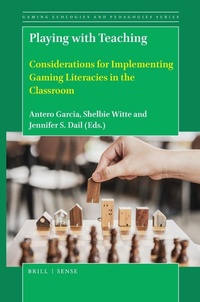
Playing with Teaching
Considerations for Implementing Gaming Literacies in the Classroom
Published on 13. February 2020
Book
Paperback/Softback
122 pages
978-90-04-42230-8 (ISBN)
Description
The possibilities of gaming for transformative and equity-driven instructional teaching practice are more robust than ever before. And yet, support for designing playful learning opportunities are too often not addressed or taught in professional development or teacher education programs. Considering the complex demands in public schools today and the niche pockets of extracurricular engagement in which youth find themselves, Playing with Teaching serves as a hands-on resource for teachers and teacher educators. Particularly focused on how games - both digital and non-digital - can shape unique learning and literacy experiences for young people today, this book's chapters look at numerous examples that educators can bring into their classrooms today.
By exploring how teachers can support literacy practices through gaming, this volume provides specific strategies for heightening literacy learning and playful experiences in classrooms. The classroom examples of gameful teaching described in each chapter not only provide practical examples of games and learning, but offer critical perspectives on why games in literacy classrooms matter today.
Through depictions of cutting-edge of powerful and playful pedagogy, this book is not a how-to manual. Rather, Playing with Teaching fills a much-needed space demonstrating how games are applied in classrooms today. It is an invitation to reimagine classrooms as spaces to newly investigate playful approaches to teaching and learning with adolescents. Roll the dice and give playful literacy instruction a try.
Contributors are: Jill Bidenwald, Jennifer S. Dail, Elizabeth DeBoeser, Antero Garcia, Kip Glazer, Emily Howell, Lindy L. Johnson, Rachel Kaminski Sanders, Jon Ostenson, Chad Sansing, and Shelbie Witte.
By exploring how teachers can support literacy practices through gaming, this volume provides specific strategies for heightening literacy learning and playful experiences in classrooms. The classroom examples of gameful teaching described in each chapter not only provide practical examples of games and learning, but offer critical perspectives on why games in literacy classrooms matter today.
Through depictions of cutting-edge of powerful and playful pedagogy, this book is not a how-to manual. Rather, Playing with Teaching fills a much-needed space demonstrating how games are applied in classrooms today. It is an invitation to reimagine classrooms as spaces to newly investigate playful approaches to teaching and learning with adolescents. Roll the dice and give playful literacy instruction a try.
Contributors are: Jill Bidenwald, Jennifer S. Dail, Elizabeth DeBoeser, Antero Garcia, Kip Glazer, Emily Howell, Lindy L. Johnson, Rachel Kaminski Sanders, Jon Ostenson, Chad Sansing, and Shelbie Witte.
More details
Series
Language
English
Place of publication
Leiden
Netherlands
Target group
Professional and scholarly
Product notice
Paperback (trade)
Unsewn / adhesive bound
Dimensions
Height: 231 mm
Width: 155 mm
Thickness: 8 mm
Weight
204 gr
ISBN-13
978-90-04-42230-8 (9789004422308)
Copyright in bibliographic data and cover images is held by Nielsen Book Services Limited or by the publishers or by their respective licensors: all rights reserved.
Schweitzer Classification
Other editions
Additional editions
Antero Garcia | Jennifer S. Dail | Shelbie Witte
Playing with Teaching
Considerations for Implementing Gaming Literacies in the Classroom
Book
02/2020
Brill
€145.50
Shipment within 10-20 days
Persons
Antero Garcia is an Assistant Professor in the Graduate School of Education at Stanford University. Prior to completing his Ph.D., Antero was an English teacher at a public high school in South Central Los Angeles.
Shelbie Witte, Ph.D. (2008), Kansas State University, is the Watson Endowed Chair and Professor of Adolescent Literacy and English Education at Oklahoma State University, where she directs the OSU Writing Project and the Initiative for 21st Century Literacies Research. She has published extensively on the intersections of pedagogy and technology.
Jennifer S. Dail, Kennesaw State University, is a Professor of English Education and directs the Kennesaw Mountain Writing Project. She has published multiple articles and co-edited two books, including Young Adult Literature and the Digital World: Textual Engagement through Visual Literacy (Rowman & Littlefield, 2018).
Shelbie Witte, Ph.D. (2008), Kansas State University, is the Watson Endowed Chair and Professor of Adolescent Literacy and English Education at Oklahoma State University, where she directs the OSU Writing Project and the Initiative for 21st Century Literacies Research. She has published extensively on the intersections of pedagogy and technology.
Jennifer S. Dail, Kennesaw State University, is a Professor of English Education and directs the Kennesaw Mountain Writing Project. She has published multiple articles and co-edited two books, including Young Adult Literature and the Digital World: Textual Engagement through Visual Literacy (Rowman & Littlefield, 2018).
Content
Foreword
?Ken Lindblom
List of Figures and Tables
Notes on Contributors
Introduction: Taking Literacies of Play Seriously
?Antero Garcia, Jennifer S. Dail and Shelbie Witte
PART 1: Writing and Text-Based Models of Play
Introduction to Part 1: Writing and Text-Based Models of Play
?Antero Garcia, Shelbie Witte and Jennifer S. Dail
1 Writing through Gaming: A Youth Writing Camp Perspective
?Emily Howell and Rachel Kaminski Sanders
2 Time to Level Up: Learning through Play in a Writing Classroom
?Rachel Kaminski Sanders
3 Gaming the System: Engaging Students in the Imaginative Worlds of Young Adult Literature through Role-Playing Games
?Lindy l. Johnson and Elizabeth Deboeser
4 Imparting Empathy with Gaming Experiences: A Conversation with the Developers of Thorny Games
?Shelbie Witte and Jill Bindewald (with Oklahoma State University English Education Students)
PART 2: Videogames and Critical Literacies in ELA Classrooms
Introduction to Part 2: Videogames and Critical Literacies in ELA Classrooms
?Antero Garcia, Shelbie Witte and Jennifer S. Dail
5 A Critical Examination of Adolescence through Video Games
?Jon Ostenson
6 Video Game Creation as an Instructional Strategy: A New Way to Apply the Tpack Framework in K-12 Education
?Kip Glazer
7 Practical Advice for Teaching and Learning with Games: Foster Agency and Ownership with an Intentional Approach to Games
?Chad Sansing
Index
?Ken Lindblom
List of Figures and Tables
Notes on Contributors
Introduction: Taking Literacies of Play Seriously
?Antero Garcia, Jennifer S. Dail and Shelbie Witte
PART 1: Writing and Text-Based Models of Play
Introduction to Part 1: Writing and Text-Based Models of Play
?Antero Garcia, Shelbie Witte and Jennifer S. Dail
1 Writing through Gaming: A Youth Writing Camp Perspective
?Emily Howell and Rachel Kaminski Sanders
2 Time to Level Up: Learning through Play in a Writing Classroom
?Rachel Kaminski Sanders
3 Gaming the System: Engaging Students in the Imaginative Worlds of Young Adult Literature through Role-Playing Games
?Lindy l. Johnson and Elizabeth Deboeser
4 Imparting Empathy with Gaming Experiences: A Conversation with the Developers of Thorny Games
?Shelbie Witte and Jill Bindewald (with Oklahoma State University English Education Students)
PART 2: Videogames and Critical Literacies in ELA Classrooms
Introduction to Part 2: Videogames and Critical Literacies in ELA Classrooms
?Antero Garcia, Shelbie Witte and Jennifer S. Dail
5 A Critical Examination of Adolescence through Video Games
?Jon Ostenson
6 Video Game Creation as an Instructional Strategy: A New Way to Apply the Tpack Framework in K-12 Education
?Kip Glazer
7 Practical Advice for Teaching and Learning with Games: Foster Agency and Ownership with an Intentional Approach to Games
?Chad Sansing
Index