

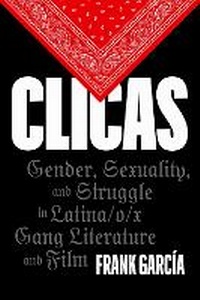
Clicas
Gender, Sexuality, and Struggle in Latina/o/x Gang Literature and Film
Published on 23. July 2024
Book
Hardback
256 pages
978-1-4773-2942-9 (ISBN)
Description
How Latina/o/x gang literature and film represent women and gay gang members' challenges to gendered, sexual, racial, and class oppression.
Clicas examines Latina/o/x literature and film by and/or about gay and women gang members. Through close readings of literature and film, Frank GarcIa reimagines the typical narratives describing gang membership and culture, amplifying and complicating critical gang studies in the social sciences and humanities and looking at gangs across racial, ethnic, and national identities. Analyzing how the autobiographical poetry of Ana Castillo presents gang fashion, culture, and violence to the outside world, the effects of women performing female masculinity in the novel Locas, and gay gang members' experiences of community in the documentary Homeboy, GarcIa complicates the dialogue regarding hypermasculine gang cultures. He shows how they are accessible not only to straight men but also to women and gay men who can appropriate them in complicated ways, which can be harming and also, at times, emancipating. Reading gang members as (de)colonial agents who contest the power relations, inequalities, oppressions, and hierarchies of the United States, Clicas considers how women and gay gang members resist materially and psychologically within a milieu shaped by the intersection of race, gender, sexuality, and class.
Clicas examines Latina/o/x literature and film by and/or about gay and women gang members. Through close readings of literature and film, Frank GarcIa reimagines the typical narratives describing gang membership and culture, amplifying and complicating critical gang studies in the social sciences and humanities and looking at gangs across racial, ethnic, and national identities. Analyzing how the autobiographical poetry of Ana Castillo presents gang fashion, culture, and violence to the outside world, the effects of women performing female masculinity in the novel Locas, and gay gang members' experiences of community in the documentary Homeboy, GarcIa complicates the dialogue regarding hypermasculine gang cultures. He shows how they are accessible not only to straight men but also to women and gay men who can appropriate them in complicated ways, which can be harming and also, at times, emancipating. Reading gang members as (de)colonial agents who contest the power relations, inequalities, oppressions, and hierarchies of the United States, Clicas considers how women and gay gang members resist materially and psychologically within a milieu shaped by the intersection of race, gender, sexuality, and class.
Reviews / Votes
[This book's] greatest contribution is its humane analysis of Latina/o/x gang representation in a selection of literary works and films...[It] will be a valuable contribution to specialists and general audiences interested in serious studies of gang cultures in the United States. (Hispania)More details
Series
Language
English
Place of publication
Austin, TX
United States
Target group
Professional and scholarly
Illustrations
7 b-w photos
Dimensions
Height: 229 mm
Width: 152 mm
Weight
454 gr
ISBN-13
978-1-4773-2942-9 (9781477329429)
Copyright in bibliographic data and cover images is held by Nielsen Book Services Limited or by the publishers or by their respective licensors: all rights reserved.
Schweitzer Classification
Person
Frank GarcIa is an assistant professor of English and an affiliate of the department of Africana studies and the program in American studies at Rutgers University, Newark.
Content
Acknowledgments
Chapter 1: Gang Subcultures as (De)colonial Praxis
Chapter 2: The Shared Experience of (De)colonial Gang Life
Chapter 3: The Toxified Female Masculinities of (De)colonial Gang Girls
Chapter 4: (De)colonial Gay Locos, Disidentifications, and Counterpublics
Chapter 5: The Queer Utopian Futurity of Failed Gang Members
Afterword: The Immigrant/Gang Member Binary in Latina/o/x Gang Literature and Film
Filmography
Notes
References
Index
Chapter 1: Gang Subcultures as (De)colonial Praxis
Chapter 2: The Shared Experience of (De)colonial Gang Life
Chapter 3: The Toxified Female Masculinities of (De)colonial Gang Girls
Chapter 4: (De)colonial Gay Locos, Disidentifications, and Counterpublics
Chapter 5: The Queer Utopian Futurity of Failed Gang Members
Afterword: The Immigrant/Gang Member Binary in Latina/o/x Gang Literature and Film
Filmography
Notes
References
Index