

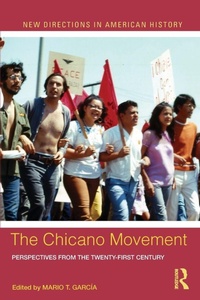
The Chicano Movement
Perspectives from the Twenty-First Century
1st Edition
Published on 7. April 2014
Book
Paperback/Softback
266 pages
978-0-415-83309-7 (ISBN)
Description
The largest social movement by people of Mexican descent in the U.S. to date, the Chicano Movement of the 1960s and 70s linked civil rights activism with a new, assertive ethnic identity: Chicano Power! Beginning with the farmworkers' struggle led by Cesar Chavez and Dolores Huerta, the Movement expanded to urban areas throughout the Southwest, Midwest and Pacific Northwest, as a generation of self-proclaimed Chicanos fought to empower their communities. Recently, a new generation of historians has produced an explosion of interesting work on the Movement.
The Chicano Movement: Perspectives from the Twenty-First Century collects the various strands of this research into one readable collection, exploring the contours of the Movement while disputing the idea of it being one monolithic group. Bringing the story up through the 1980s, The Chicano Movement introduces students to the impact of the Movement, and enables them to expand their understanding of what it means to be an activist, a Chicano, and an American.
The Chicano Movement: Perspectives from the Twenty-First Century collects the various strands of this research into one readable collection, exploring the contours of the Movement while disputing the idea of it being one monolithic group. Bringing the story up through the 1980s, The Chicano Movement introduces students to the impact of the Movement, and enables them to expand their understanding of what it means to be an activist, a Chicano, and an American.
Reviews / Votes
In The Chicano Movement: Perspectives from the 21st Century, Mario Garcia gathers the newest scholarship on this important series of events. What emerges is a broader view of the Chicano movement that allows us to see its limits and reach. This book offers a fresh take on the Chicano movement from young, promising scholars, who will shape our understanding of this phenomenon for years to come. Anyone interested in Latino life and culture in the present, must read this book about the recent past, which challenges us to envision a more emancipatory future.- Ernesto Chavez, author of !Mi Raza Primero! (My People First): Nationalism, Identity, and Insurgency in the Chicano Movement in Los Angeles, 1966-1978
The authors in this volume offer new insights on the impact of Chicano Movement activism on localized struggles. Fresh perspectives on the Movement's legacy emerge from case studies of Chicano/a advocacy for electoral power and the rights of immigrant women, students, welfare mothers, and laborers in rural and urban settings.
- Christine Marie Sierra, co-editor of Chicana Voices: Intersections of Class, Race, and Gender
This work increases our knowledge of lesser-known but important individuals, organizations and peripheral communities that proved critical to the expansion of the Chicano Movement's activism. It also introduces us to previously ignored topics in Movement studies. A must-read book for those interested in Chicano civil rights.
- Ignacio M. Garcia, author of Chicanismo: The Forging of a Militant Ethos Among Mexican Americans
More details
Series
Language
English
Place of publication
London
United Kingdom
Publishing group
Taylor & Francis Ltd
Target group
College/higher education
Dimensions
Height: 229 mm
Width: 152 mm
Thickness: 16 mm
Weight
427 gr
ISBN-13
978-0-415-83309-7 (9780415833097)
Copyright in bibliographic data and cover images is held by Nielsen Book Services Limited or by the publishers or by their respective licensors: all rights reserved.
Schweitzer Classification
Other editions
Additional editions
Book
04/2014
1st Edition
Routledge
€242.20
Shipment within 15-20 days
E-Book
03/2014
1st Edition
Routledge
€69.99
Available for download
E-Book
03/2014
1st Edition
Routledge
€69.99
Available for download
Person
Mario T. Garcia is Professor of Chicano Studies and History at the University of California, Santa Barbara.
Content
Acknowledgements
Foreword: The Chicano Movement: Does Anyone Care about What Happened 40 Years Ago?
Jorge Mariscal
Introduction: The Chicano Movement and Chicano Historiography
Mario T. Garcia
Part One: Community Struggles
1. "All I Want is that He Be Punished": Border Patrol Violence, Women's Voices and Chicano Activism in Early 1970s San Diego
Jimmy Patino
2. Reinscribing the Voices of La Gente in the Narrative of the Chicano Movement
Lorena V. Marquez
3. "Hoo-ray Gonzales!" Civil Rights Protest and Chicano Politics in Bakersfield, 1965-1974
Oliver Rosales
4. Alicia Escalante, The Chicana Welfare Rights Organization, and the Chicano Movement
Rosie Bermudez
5. Chicana/o Movement Grassroots Leftists and Radical Electoral Politics in Los Angeles, 1970-1980
Jose G. Moreno
6. !Ya Basta! The Struggle for Justice and Equality: The Chicano Power Movement in Oxnard, California
Luis H. Moreno
Part Two: The Student Movement
7. The Ideological Struggle for Chicana/o Unity and Power: A Short History of California M.E.Ch.A.
Gustavo Licon
8. Understanding the Role of Conflict, Factionalism, and Schism in the Development of the Chicano Student Movement: The Mexican American Student Association and La Vida Nueva at East Los Angeles College
Marisol Moreno
Part Three: Geographic Diversity and the Chicano Movement
9. San Antonio Chicano Organizers (SACO): Labor Activists and El Movimiento
Max Krochmal
10. "We Are a Distinct People": Defending Difference in Schools through the Chicano Movement in Michigan, 1966-1980
Nora Salas
11. Sin Fronteras: An Oral History of a Chicana Activist in Oregon during the Chicano Movement
Norma Cardenas
Contributor Biographies
Index
Foreword: The Chicano Movement: Does Anyone Care about What Happened 40 Years Ago?
Jorge Mariscal
Introduction: The Chicano Movement and Chicano Historiography
Mario T. Garcia
Part One: Community Struggles
1. "All I Want is that He Be Punished": Border Patrol Violence, Women's Voices and Chicano Activism in Early 1970s San Diego
Jimmy Patino
2. Reinscribing the Voices of La Gente in the Narrative of the Chicano Movement
Lorena V. Marquez
3. "Hoo-ray Gonzales!" Civil Rights Protest and Chicano Politics in Bakersfield, 1965-1974
Oliver Rosales
4. Alicia Escalante, The Chicana Welfare Rights Organization, and the Chicano Movement
Rosie Bermudez
5. Chicana/o Movement Grassroots Leftists and Radical Electoral Politics in Los Angeles, 1970-1980
Jose G. Moreno
6. !Ya Basta! The Struggle for Justice and Equality: The Chicano Power Movement in Oxnard, California
Luis H. Moreno
Part Two: The Student Movement
7. The Ideological Struggle for Chicana/o Unity and Power: A Short History of California M.E.Ch.A.
Gustavo Licon
8. Understanding the Role of Conflict, Factionalism, and Schism in the Development of the Chicano Student Movement: The Mexican American Student Association and La Vida Nueva at East Los Angeles College
Marisol Moreno
Part Three: Geographic Diversity and the Chicano Movement
9. San Antonio Chicano Organizers (SACO): Labor Activists and El Movimiento
Max Krochmal
10. "We Are a Distinct People": Defending Difference in Schools through the Chicano Movement in Michigan, 1966-1980
Nora Salas
11. Sin Fronteras: An Oral History of a Chicana Activist in Oregon during the Chicano Movement
Norma Cardenas
Contributor Biographies
Index