

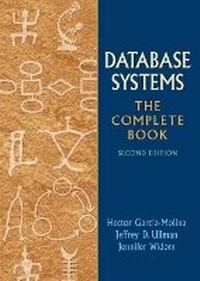
Database Systems
The Complete Book
2nd Edition
Published on 11. September 2008
Book
Hardback
1248 pages
978-0-13-187325-4 (ISBN)
Description
Database Systems: The Complete Book is ideal for Database Systems and Database Design and Application courses offered at the junior, senior and graduate levels in Computer Science departments. A basic understanding of algebraic expressions and laws, logic, basic data structure, OOP concepts, and programming environments is implied.
Written by well-known computer scientists, this introduction to database systems offers a comprehensive approach, focusing on database design, database use, and implementation of database applications and database management systems.
The first half of the book provides in-depth coverage of databases from the point of view of the database designer, user, and application programmer. It covers the latest database standards SQL:1999, SQL/PSM, SQL/CLI, JDBC, ODL, and XML, with broader coverage of SQL than most other texts. The second half of the book provides in-depth coverage of databases from the point of view of the DBMS implementor. It focuses on storage structures, query processing, and transaction management. The book covers the main techniques in these areas with broader coverage of query optimization than most other texts, along with advanced topics including multidimensional and bitmap indexes, distributed transactions, and information integration techniques.
Written by well-known computer scientists, this introduction to database systems offers a comprehensive approach, focusing on database design, database use, and implementation of database applications and database management systems.
The first half of the book provides in-depth coverage of databases from the point of view of the database designer, user, and application programmer. It covers the latest database standards SQL:1999, SQL/PSM, SQL/CLI, JDBC, ODL, and XML, with broader coverage of SQL than most other texts. The second half of the book provides in-depth coverage of databases from the point of view of the DBMS implementor. It focuses on storage structures, query processing, and transaction management. The book covers the main techniques in these areas with broader coverage of query optimization than most other texts, along with advanced topics including multidimensional and bitmap indexes, distributed transactions, and information integration techniques.
More details
Edition
2nd edition
Language
English
Place of publication
United States
Publishing group
Pearson Education (US)
Target group
College/higher education
Dimensions
Height: 10 mm
Width: 10 mm
Thickness: 10 mm
Weight
1860 gr
ISBN-13
978-0-13-187325-4 (9780131873254)
Copyright in bibliographic data and cover images is held by Nielsen Book Services Limited or by the publishers or by their respective licensors: all rights reserved.
Schweitzer Classification
Other editions
Previous edition
Hector Garcia-Molina | Jeffrey D. Ullman | Jennifer D. Widom
Database Systems
The Complete Book: United States Edition
Book
10/2001
Pearson
€87.89
Article exhausted; check for reprint
Persons
Hector Garcia-Molina is the L. Bosack and S. Lerner Professor of Computer Science and Electrical Engineering at Stanford University. His research interests include digital libraries, information integration, and database applications on the Internet. He was a recipient of the SIGMOD Innovations Award and a member of PITAC (President's Information-Technology Advisory Council). He currently serves on the Board of Directors of Oracle Corp.
Jeffrey D. Ullman is the Stanford W. Ascherman Professor of Computer Science (emeritus) at Stanford University. He is the author or co-author of 16 books, including Elements of ML Programming (Prentice Hall 1998). His research interests include data mining, information integration, and electronic education. He is a member of the National Academy of Engineering, and recipient of a Guggenheim Fellowship, the Karl V. Karlstom Outstanding Educator Award, the SIGMOD Contributions and Edgar F. Codd Innovations Awards, and the Knuth Prize.
Jennifer Widom is Professor of Computer Science and Electrical Engineering at Stanford University. Her research interests span many aspects of nontraditional data management. She is an ACM Fellow and a member of the National Academy of Engineering, she received the ACM SIGMOD Edgar F. Codd Innovations award in 2007 and was a Guggenheim Fellow in 2000, and she has served on a variety of program committees, advisory boards, and editorial boards.
Jeffrey D. Ullman is the Stanford W. Ascherman Professor of Computer Science (emeritus) at Stanford University. He is the author or co-author of 16 books, including Elements of ML Programming (Prentice Hall 1998). His research interests include data mining, information integration, and electronic education. He is a member of the National Academy of Engineering, and recipient of a Guggenheim Fellowship, the Karl V. Karlstom Outstanding Educator Award, the SIGMOD Contributions and Edgar F. Codd Innovations Awards, and the Knuth Prize.
Jennifer Widom is Professor of Computer Science and Electrical Engineering at Stanford University. Her research interests span many aspects of nontraditional data management. She is an ACM Fellow and a member of the National Academy of Engineering, she received the ACM SIGMOD Edgar F. Codd Innovations award in 2007 and was a Guggenheim Fellow in 2000, and she has served on a variety of program committees, advisory boards, and editorial boards.
Content
1 The Worlds of Database Systems
2 The Relational Model of Data
3 Design Theory for Relational Databases
4 High-Level Database Models
5 Algebraic and Logical Query Languages
6 The Database Language SQL
7 Constraints and Triggers
8 Views and Indexes
9 SQL in a Server Environment
10 Advanced Topics in Relational Databases
11 The Semistructured-Data Model
12 Programming Languages for XML
13 Secondary Storage Management
14 Index Structures
15 Query Execution
16 The Query Compiler
17 Coping With System Failures
18 Concurrency Control
19 More About Transaction Management
20 Parallel and Distributed Databases
21 Information Integration
22 Data Mining
23 Database Systems and the Internet
2 The Relational Model of Data
3 Design Theory for Relational Databases
4 High-Level Database Models
5 Algebraic and Logical Query Languages
6 The Database Language SQL
7 Constraints and Triggers
8 Views and Indexes
9 SQL in a Server Environment
10 Advanced Topics in Relational Databases
11 The Semistructured-Data Model
12 Programming Languages for XML
13 Secondary Storage Management
14 Index Structures
15 Query Execution
16 The Query Compiler
17 Coping With System Failures
18 Concurrency Control
19 More About Transaction Management
20 Parallel and Distributed Databases
21 Information Integration
22 Data Mining
23 Database Systems and the Internet