

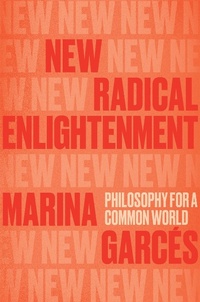
New Radical Enlightenment
Philosophy for a Common World
Published on 4. June 2024
Book
Paperback/Softback
160 pages
978-1-83976-298-7 (ISBN)
Description
Philosophy was born out of discussion, out of the rivalry between world views. From the philosophical ferment of the Enlightenment arose the idea of emancipation, a conflictual perspective which Marina Garces would have us rethink. New Radical Enlightenment lays out the need for critical dissent as a new beginning for the humanities in apocalyptic times. The productive dissent she envisions is established on the inclusion of multiple perspectives attending to common problems.
Our societies are faced with the urgency of combating dogmatism in all its forms. Fundamentalism, authoritarianism, and the struggle of the rich against the poor are returning. We also see dogmatic ways of dealing with science, data, and technology emerging. In the face of this, unfinished philosophy is a bid to make thought exciting once again. It is not a question of nurturing sterile theories. Today's young people need powerful tools for a critical imagination. Leaping out of historicism, the new radical enlightenment arrives to address anew the central problems of contemporary philosophy and place them in a planetary, postcolonial, and feminist framework: a philosophy for a common world.
Our societies are faced with the urgency of combating dogmatism in all its forms. Fundamentalism, authoritarianism, and the struggle of the rich against the poor are returning. We also see dogmatic ways of dealing with science, data, and technology emerging. In the face of this, unfinished philosophy is a bid to make thought exciting once again. It is not a question of nurturing sterile theories. Today's young people need powerful tools for a critical imagination. Leaping out of historicism, the new radical enlightenment arrives to address anew the central problems of contemporary philosophy and place them in a planetary, postcolonial, and feminist framework: a philosophy for a common world.
Reviews / Votes
What remains of the human subject in an age when reason is carried out by and through information machines and technologies of calculation? Who will set the boundaries that distinguish between the calculable and the incalculable? What will it take to turn instruments of calculation into instruments of liberation? This wonderfully readable book is also a work of profound scholarship by one of the most powerful thinkers working today. -- Achille Mbembe, author of <i>Brutalism</i> (Duke University Press, 2024) What is redeemable from the Enlightenment? Garces argues that is a question that remains unanswered: she puts forward the idea of composition between knowledge and emancipation. So, radicalizing the enlightenment (in dialogue with those who tried to do the same with modernity) implies the confrontation of the colonial project, which bound knowledge with domination and exploitation. -- Veronica Gago, author of <i>Feminist International</i> In her thought-provoking essay, Garces launches a radical critique of our "enlightened illiteracy". This is what an enlightened radicalism is about: to redefine the notion of emancipation in the sense of a collective struggle for liveable lives. -- Stephan Lessenich, director, Institute of Social Research, Frankfurt On the basis of an inventive reading of the history and conceptuality of enlightenment, Marina Garces arrives at new concepts of knowledge, intelligence and philosophy. Against what she describes as today's "posthumous condition", an age of anti-enlightenment between apocalypse and solutionism, the Catalan philosopher calls for a "radical enlightenment". This concept does not only acutalize Kantian ideas from 250 years ago, but radically multiplies enlightenment thought both in space and in time. As there is a chain of enlightenments in different phases of history, radical enlightenment does not originate only in Europe, but comes from many places, as a work of rebellious weavers from all over the world, with a guerilla philosophy spreading and appearing wherever we least expect it. Listening to the silenced voices of distant places and minor histories, Marina Garces creates a starting point for future philosophy, a philosophy without a specific territory or origin, a philosophy without dominion. -- Gerald Raunig, author of <i>Art and Revolution: Transversal Activism in the Long Twentieth Century</i> A liveable life, a liveable time, a liveable world: life and the human capacity to live it in sustainable, egalitarian, and open ways is at the center of Marina Garces' philosophical work. In this book, she harks back to the project of radical Enlightenment to forge weapons for the struggle against the catastrophes of modernization. Garces reinvents philosophy as a practice of encounter and creation, that takes shared vulnerability as a basis to appropriate common life. -- Sandro Mezzadra, University of Bologna, author of <i>In The Marxian Workshops</i> Marina Garces is a leading voice of the current debates on the shapes of a New Enlightenment. Her radical investigation focuses on the human not so much as a given ground for claims to universal validity, but rather as an open process, historically situated and accessible only from multiple points of view. Her contribution to the New Enlightenment discourse is one of multiperspectivity, including the temporal dimension of social change. The book is a must read for anybody interested in how one cannot only defend the Enlightenment project against the usual charges, but carry it forward in light of recent moral and epistemic progresses in the fields of thinkers of humans as gendered, temporally located animals who are nevertheless capable of achieving progress under fragile circumstances. In this context, Garces also opens new avenues for understanding the contribution of the humanities and social sciences in their interdisciplinary effort to ground value judgment, not to merely relativize it. -- Markus Gabriel, University of Bonn A book that shines indomitably. -- Manuel Rivas * El Pais * Books like this one encourage the reader to grow up in unexpected ways. -- Vicenc Pages Jorda * El Periodico * Marina Garces insists on demonstrating through her acts the ideas she supports intellectually: philosophy is a transformative and endless power, a way of living. -- Eudald Espluga * PlayGround * How frightening, we are losing our enlightenment. The loss of reason is sending us back to before the Age of Enlightenment. The most effective response to overcome this crisis of civilization, according to Spanish philosopher Marian Garces, is the promotion of a new radical enlightenment, the title of her agile essay-manifesto. A necessary operation "to reaffirm the freedom and dignity of human experience". Against all induced fear, the fuse of dictatorial and securitarian temptations. -- Gigi Riva * Il Venerdi di Repubblica * Garces' ambition is thus the return to an imaginary collective enlightenment, in which anonymous clandestine manuscripts are presumably replaced by the militant online samizdat: "Being able to say 'we don't believe you' is the most egalitarian expression of the common power of thought. -- Antonio Gurrado * El Foglio Quotidiano * Marina Garces and her books do not offer formulas or recipes. They argue that philosophy is necessary for the concrete life of each of us and for our societies in crisis. There are those who think that philosophy should be protected and defended as if it were a museum piece or an endangered species. Marina Garces emphasizes the opposite "philosophy cannot be preserved, it must be practiced and exposed." Garces proposes to open ourselves to the present of an unfinished philosophy for a world that shows symptoms of exhaustion. -- Oriol Puig * El Diario * Marina Garces, the rebellious philosopher. Marina Garces is the thinker of insubordination and social movements. She has taken philosophy beyond the academic world. -- Matias Nespolo * El Mundo * "We know everything but can do nothing:" In her thought-provoking essay, Marina Garces launches a radical critique of our "enlightened illiteracy." Living on the verge of collapse, but sedating ourselves with the belief in "sustainability," we would need to engage in a battle of thought against established knowledge and its authorities. This is what an enlightened radicalism is about: to redefine the notion of emancipation in the sense of a collective struggle for liveable lives. "We have lost the future, but we cannot keep wasting time." -- Stephan Lessenich, Director of the Institute for Social Research in FrankfurtMore details
Language
English
Place of publication
London
United Kingdom
Product notice
Paperback (trade)
Unsewn / adhesive bound
Dimensions
Height: 199 mm
Width: 135 mm
Thickness: 13 mm
Weight
166 gr
ISBN-13
978-1-83976-298-7 (9781839762987)
Copyright in bibliographic data and cover images is held by Nielsen Book Services Limited or by the publishers or by their respective licensors: all rights reserved.
Schweitzer Classification
Other editions
Additional editions
E-Book
06/2024
Verso Books
€24.49
Available for download
Persons
Marina Garces is a philosopher, activist and teacher from Barcelona. In her work, she focuses on politics and critical thinking. She expresses the need for a philosophical voice capable of challenging and commitment. She rethinks the relation of humans to the world and points out how easily humanity accepts forms of oppression instead of striving for dignity. Some of her most famous books are Filosofia inacabada, Nova illustracio radical y Escuela de aprendices.
Content
Preface
Part 1: New Radical Enlightenment
1. Our Posthumous Condition
Unsustainability
After Postmodernity
The Catastrophe of Time
2. Enlightened Radicalism
Cultural Servitude
Enlightened Illiteracy
Neutralising Criticism
Delegated Intelligence
3. Humanities in Transition
Part 2: Philosophy for a Common World
1. How Not to Philosophise
2. From Infinite Universe to Exhausted Planet
3. Philosophy Had a History
4. Doing Away with Philosophy
5. 'Europe Is Indefensible'
6. The Places of Philosophy
7. Standardising Thought
8. To Write Is to Be Transformed
9. Learning to Think
10. University without Surrender
11. The New Alliances
12. End of the 'Great Men'
13. Body and Thought
14. From Suspicion to Trust
Part 1: New Radical Enlightenment
1. Our Posthumous Condition
Unsustainability
After Postmodernity
The Catastrophe of Time
2. Enlightened Radicalism
Cultural Servitude
Enlightened Illiteracy
Neutralising Criticism
Delegated Intelligence
3. Humanities in Transition
Part 2: Philosophy for a Common World
1. How Not to Philosophise
2. From Infinite Universe to Exhausted Planet
3. Philosophy Had a History
4. Doing Away with Philosophy
5. 'Europe Is Indefensible'
6. The Places of Philosophy
7. Standardising Thought
8. To Write Is to Be Transformed
9. Learning to Think
10. University without Surrender
11. The New Alliances
12. End of the 'Great Men'
13. Body and Thought
14. From Suspicion to Trust