

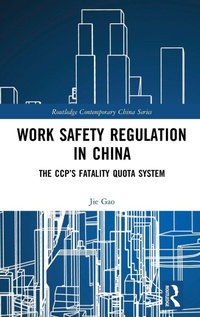
Work Safety Regulation in China
The CCP's Fatality Quota System
1st Edition
Published on 1. April 2022
Book
Hardback
248 pages
978-1-138-18244-8 (ISBN)
Description
Fatality quotas implemented in China's industrial section and local governments are being used to promote work safety and therefore, reducing the number of work-related deaths. Given the controversial nature of this policy, Gao analyzes how the fatality quotas are functioning to aid the country in balancing economic growth and social stability. The book also examines significant implications caused of this policy's implementation in the local regions, and reveals how local officials attempt to handle these problems.
This is the first book to systematically examine the role of death indicators in work safety improvement in contemporary China, revealing insight into Beijing's quota-oriented approach to policy-making.
This is the first book to systematically examine the role of death indicators in work safety improvement in contemporary China, revealing insight into Beijing's quota-oriented approach to policy-making.
Reviews / Votes
"In this important book, Jie Gao presents a masterful analysis of how the Chinese state has used the target management system to greatly improve its country's work safety record, by instituting "quotas" of fatalities that local officials are not allowed to exceed. She convincingly examines both the successes and the limitations of the target-oriented mode of governance, reaching broader conclusions beyond this particular case. In doing so, the book makes major contributions to the literature on China's state capacity and authoritarian resilience. Her work will therefore be a "must-read" for political scientists and those interested in public administration, as well as for scholars of work safety."---Tim Wright, Emeritus Professor of Chinese Studies, University of Sheffield"Gao's study is a useful contribution to understanding the practice of public administration in China and, more generally, the party-state's response to governance challenges. She concludes with reflections on how the case of work safety pertains to current debates about the resilience of China's political arrangements. But the study also contributes to our broader understanding ofthe significance of the Chinese case for the comparative study of worker safety and risk management." ---Richard P. Suttmeier, University of Oregon, Eugene, USA in The China Quarterly (2023), 1-2 doi:10.1017/S0305741023000140
"This is a fascinating and detailed study of work safety regulation in China, a study that also provides important insights into how the Communist Party of China has adjusted its policies and administrative processes to survive economic liberalization and not decay or collapse... the book makes an important contribution to the literature on China's governance and on the CCP's strategies and resilience in the context of the country's huge economic and social transformation. This is in addition to the book's considerable contribution to knowledge about work safety management in China. In an era when performance measurement and management have become such a dominant theme in government reforms, this study also provides a valuable analysis of how such systems function in dealing with major governance challenges during China's economic rise."---Andrew S. Podger, Research School of Social Sciences, Australian National University, in Public Admnistration doi:10.1111/padm.12882
More details
Series
Language
English
Place of publication
London
United Kingdom
Publishing group
Taylor & Francis Ltd
Target group
College/higher education
Professional and scholarly
Illustrations
28 s/w Abbildungen, 28 s/w Zeichnungen, 21 s/w Tabellen
21 Tables, black and white; 28 Line drawings, black and white; 28 Illustrations, black and white
Dimensions
Height: 240 mm
Width: 161 mm
Thickness: 19 mm
Weight
564 gr
ISBN-13
978-1-138-18244-8 (9781138182448)
Copyright in bibliographic data and cover images is held by Nielsen Book Services Limited or by the publishers or by their respective licensors: all rights reserved.
Schweitzer Classification
Other editions
Additional editions
Book
01/2024
1st Edition
Routledge
€65.50
Shipment within 10-20 days
E-Book
03/2022
1st Edition
Routledge
€59.49
Available for download
E-Book
03/2022
1st Edition
Routledge
€59.49
Available for download
Person
Jie Gao is an assistant professor at the Department of Political Science, National University of Singapore. Her research focuses on China's political and administrative reforms, particularly in the areas of performance management, work safety regulation and cadre management.
Content
1. Introduction 2. Blood-Soaked GDP? 3. China's Work Safety Management System 4. A Pony Too Small for the Big Cart 5. The Fatality Quota System 6. Why the Fatality Quotas? 7. Has Work Safety Improved? 8. Conclusion