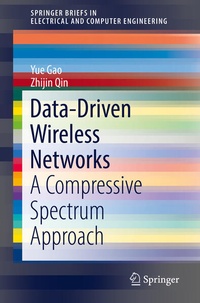
This SpringerBrief discusses the applications of spare representation in wireless communications, with a particular focus on the most recent developed compressive sensing (CS) enabled approaches. With the help of sparsity property, sub-Nyquist sampling can be achieved in wideband cognitive radio networks by adopting compressive sensing, which is illustrated in this brief, and it starts with a comprehensive overview of compressive sensing principles. Subsequently, the authors present a complete framework for data-driven compressive spectrum sensing in cognitive radio networks, which guarantees robustness, low-complexity, and security.
Particularly, robust compressive spectrum sensing, low-complexity compressive spectrum sensing, and secure compressive sensing based malicious user detection are proposed to address the various issues in wideband cognitive radio networks. Correspondingly, the real-world signals and data collected by experiments carried out during TV white space pilot trial enables data-driven compressive spectrum sensing. The collected data are analysed and used to verify our designs and provide significant insights on the potential of applying compressive sensing to wideband spectrum sensing.
This SpringerBrief provides readers a clear picture on how to exploit the compressive sensing to process wireless signals in wideband cognitive radio networks. Students, professors, researchers, scientists, practitioners, and engineers working in the fields of compressive sensing in wireless communications will find this SpringerBrief very useful as a short reference or study guide book. Industry managers, and government research agency employees also working in the fields of compressive sensing in wireless communications will find this SpringerBrief useful as well.
Series
Edition
Language
Place of publication
Publishing group
Springer International Publishing
Target group
Primary & secondary/elementary & high school
Illustrations
35 farbige Abbildungen
XIX, 93 p. 35 illus. in color.
Dimensions
Height: 235 mm
Width: 155 mm
Thickness: 7 mm
Weight
ISBN-13
978-3-030-00289-3 (9783030002893)
DOI
10.1007/978-3-030-00290-9
Schweitzer Classification
Yue Gao is an Associate Professor of School of Software at Tsinghua University. His main research interests focus on Artificial Intelligence, Computer Vision and Brain Science. He has published over 200 papers in the areas of Artificial Intelligence, 3D Vision, Multimedia, and Medical Image Analysis. Prof. Gao has authored the books " View-based 3-D Object Retrieval" (2014) and " Learning-Based Local Visual Representation and Indexing" (2015). He has been an associate editor for prestigious journals such as IEEE Transactions on Signal and Information Processing over Networks, Journal of Visual Communication and Image Representation, and IEEE Signal Processing Letters. He is a Senior Member of IEEE. He was listed as the Web of Science Highly Cited Researcher and Elsevier Highly Cited Chinese Researchers.
Qionghai Dai is a Professor and the Dean of School of Information at Tsinghua University. He is the member of Chinese Academy of Engineering. His main research interests focus on Artificial Intelligence, Computational Imaging and Brain Science. He has published over 400 papers at Cell, Nature Photonics, Nature Biotechnology, IEEE TPAMI, etc. Prof. Dai has authored the books " View-based 3-D Object Retrieval" (2014), " Learning-Based Local Visual Representation and Indexing" (2015), "3D Video Processing and Communication" (in Chinese, 2016), "Multidimensional Signal Processing: Fast Transform, Sparse Representation and Low-Rank Analysis" (in Chinese, 2016), and "Computational photography: Computational Capture of Plenoptic Visual Information" (in Chinese, 2016). He has been an associate editor for prestigious journals such as IEEE Transactions on Image Processing and IEEE Transactions on Neural Networks and Learning Systems. He is the President of Chinese Association for Artificial Intelligence, a Fellow of CAAI and CAA, and recipient of numerous awards, including the National Natural Science Award of China (three times). He was listed as the Web of Science Highly Cited Researcher.