

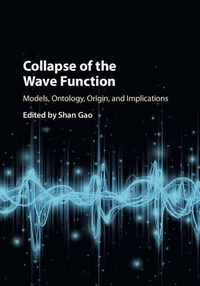
Collapse of the Wave Function
Models, Ontology, Origin, and Implications
Published on 26. April 2018
Book
Hardback
358 pages
978-1-108-42898-9 (ISBN)
Description
This is the first single volume about the collapse theories of quantum mechanics, which is becoming a very active field of research in both physics and philosophy. In standard quantum mechanics, it is postulated that when the wave function of a quantum system is measured, it no longer follows the Schroedinger equation, but instantaneously and randomly collapses to one of the wave functions that correspond to definite measurement results. However, why and how a definite measurement result appears is unknown. A promising solution to this problem are collapse theories in which the collapse of the wave function is spontaneous and dynamical. Chapters written by distinguished physicists and philosophers of physics discuss the origin and implications of wave-function collapse, the controversies around collapse models and their ontologies, and new arguments for the reality of wave function collapse. This is an invaluable resource for students and researchers interested in the philosophy of physics and foundations of quantum mechanics.
Reviews / Votes
'Collapse models are now moving from conferences on philosophy and physics to the experimental arena, and this volume assembled by Shan Gao is a timely collection of essays by leading practitioners which views collapse theories from multiple vantage points. It's valuable reading for theorists, experimenters, and philosophers of physics alike.' Stephen L. Adler, Institute for Advanced Study, Princeton, New JerseyMore details
Language
English
Place of publication
Cambridge
United Kingdom
Target group
Professional and scholarly
Illustrations
Worked examples or Exercises; 1 Halftones, black and white; 7 Line drawings, black and white
Dimensions
Height: 250 mm
Width: 175 mm
Thickness: 24 mm
Weight
804 gr
ISBN-13
978-1-108-42898-9 (9781108428989)
Copyright in bibliographic data and cover images is held by Nielsen Book Services Limited or by the publishers or by their respective licensors: all rights reserved.
Schweitzer Classification
Other editions
Additional editions
E-Book
04/2018
Cambridge University Press
€118.99
Available for download
E-Book
04/2018
Cambridge University Press
€142.99
Available for download
Person
Shan Gao is Professor of Philosophy at the Research Center for Philosophy of Science and Technology at Shanxi University. He is the founder and managing editor of the International Journal of Quantum Foundations, and is the author of several books including the recent monograph The Meaning of the Wave Function: In Search of the Ontology of Quantum Mechanics (Cambridge, 2017). His research focuses on the philosophy of physics and foundations of quantum mechanics. He is also interested in the philosophy of mind and the philosophy of science.
Content
List of contributors; Preface; Part I. Models: 1. How to teach and think about spontaneous wave function collapse theories: not like before Lajos Diosi; 2. What really matters in Hilbert-space stochastic processes Giancarlo Ghirardi, Oreste Nicrosini and Alberto Rimini; 3. Dynamical collapse for photons Philip Pearle; 4. Quantum state reduction Dorje C. Brody and Lane P. Hughston; 5. Collapse models and spacetime symmetries Daniel J. Bedingham; Part II. Ontology: 6. Ontology for collapse theories Wayne C. Myrvold; 7. Properties and the born rule in GRW Theory Roman Frigg; 8. Paradoxes and primitive ontology in collapse theories of quantum mechanics Roderich Tumulka; 9. On the status of primitive ontology Peter J. Lewis; 10. Collapse or no collapse? What is the best ontology of quantum mechanics in the primitive ontology framework? Michael Esfeld; Part III. Origin: 11. Quantum state reduction via gravity, and possible tests using Bose-Einstein condensates Ivette Fuentes and Roger Penrose; 12. Collapse. What else? Nicolas Gisin; 13. Three arguments for the reality of wave-function collapse Shan Gao; Part IV. Implications: 14. Could inelastic interactions induce quantum probabilistic transitions? Nicholas Maxwell; 15. How the Schroedinger Equation would predict collapse: an explicit mechanism Roland Omnes; 16. Wave function collapse, non-locality, and space-time structure Tejinder P. Singh; 17. The weight of collapse: dynamical reduction models in general relativistic contexts Elias Okon and Daniel Sudarsky; Index.