

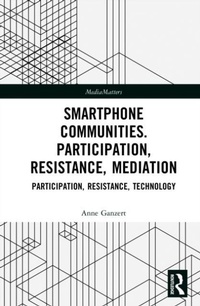
Smartphone Communities
Participation, Resistance, Mediation
1st Edition
Will be published approx. on 29. October 2026
Book
Hardback
312 pages
978-94-6372-868-3 (ISBN)
Description
Smartphone Communities places the smartphone - our most personal and ubiquitous medium - at the centre of an in-depth exploration of contemporary community formation. The book ground-breaking contribution lies in theorizing the smartphone not merely as a device, but as a dynamic social infrastructure through which communities are continuously assembled, negotiated, and contested.
Conceptualizing the smartphone user as a mobile, permanently networked subject, the book advances a multi-directional media-theoretical framework that bridges participation theory, fan studies, and visual culture. Focusing primarily on Western, platform-capitalist contexts from the 2010s to the mid-2020s, Anne Ganzert analyzes topical and widely recognizable case studies, including TikTok, Pokemon Go, Tinder, and Habitica. These platforms serve as lenses through which social, economic, and political power relations become visible, from algorithmic governance and data extraction to practices of play, intimacy, self-optimization, and resistance.
Readers will gain a comprehensive understanding of smartphone-based communities through a blend of media theory and empirical analysis. Addressed to undergraduates, postgraduates, scholars of media and cultural studies, as well as non-specialist readers such as librarians and booksellers, the book offers an accessible yet theoretically ambitious account of smartphone-based communities.
Conceptualizing the smartphone user as a mobile, permanently networked subject, the book advances a multi-directional media-theoretical framework that bridges participation theory, fan studies, and visual culture. Focusing primarily on Western, platform-capitalist contexts from the 2010s to the mid-2020s, Anne Ganzert analyzes topical and widely recognizable case studies, including TikTok, Pokemon Go, Tinder, and Habitica. These platforms serve as lenses through which social, economic, and political power relations become visible, from algorithmic governance and data extraction to practices of play, intimacy, self-optimization, and resistance.
Readers will gain a comprehensive understanding of smartphone-based communities through a blend of media theory and empirical analysis. Addressed to undergraduates, postgraduates, scholars of media and cultural studies, as well as non-specialist readers such as librarians and booksellers, the book offers an accessible yet theoretically ambitious account of smartphone-based communities.
More details
Series
Language
English
Place of publication
Amsterdam
Netherlands
Target group
Professional and scholarly
Academic
Illustrations
5 s/w Photographien bzw. Rasterbilder, 5 s/w Abbildungen
5 Halftones, black and white; 5 Illustrations, black and white
Dimensions
Height: 234 mm
Width: 156 mm
ISBN-13
978-94-6372-868-3 (9789463728683)
Copyright in bibliographic data and cover images is held by Nielsen Book Services Limited or by the publishers or by their respective licensors: all rights reserved.
Schweitzer Classification
Other editions
Additional editions

E-Book
approx. 10/2026
Taylor & Francis
€61.99
Not yet available
E-Book
approx. 10/2026
Taylor & Francis
€61.99
Not yet available
Person
Dr. Anne Ganzert is head of the research group Web Sleuthing. Media Practices of Crime-Related Online Investigations (DFG) at Philipps-Universitaet Marburg, Germany. Her research focuses on media phenomena, fan studies, crime, gender, participation, and visual culture. Key publications are Serial Pinboarding (2020) and Following (2023).
Content
Table of Contents
Introduction: Smartphone Participation in Formation
Smartphone Practices, Formations, and Communities
Participation, Resistance, and Smartphone Mediation
Tracking: Datafied Selves, Shared Metrics, and Emergent Collectives
Storytelling: Narratives, Visibility, and Situated Participation
Gaming: Mobility, Play, and Deferred Community
Dating: Intimacy, Proximity, and Relational Assemblages
Debating: Political Expression, Affective Publics, and Contested Participation
Protesting: Mobilisation, Witnessing, and Resistance-in-Motion
Conclusion: Smartphone Communities in Motion
Introduction: Smartphone Participation in Formation
Smartphone Practices, Formations, and Communities
Participation, Resistance, and Smartphone Mediation
Tracking: Datafied Selves, Shared Metrics, and Emergent Collectives
Storytelling: Narratives, Visibility, and Situated Participation
Gaming: Mobility, Play, and Deferred Community
Dating: Intimacy, Proximity, and Relational Assemblages
Debating: Political Expression, Affective Publics, and Contested Participation
Protesting: Mobilisation, Witnessing, and Resistance-in-Motion
Conclusion: Smartphone Communities in Motion