

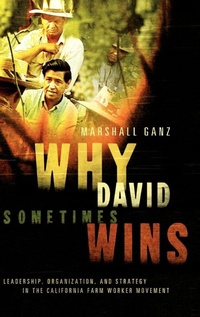
Why David Sometimes Wins
Leadership, Strategy and the Organization in the California Farm Worker Movement
Published on 7. May 2009
Book
Hardback
368 pages
978-0-19-516201-1 (ISBN)
Description
On April 10, 1966, a crowd of 10,000 farm workers and supporters gathered at the California state capitol to celebrate victory in one of the most significant strikes in American history--one that made Cesar Chavez famous as leader of the National Farm Workers Association, which later became the United Farm Workers (UFW).
In Why David Sometimes Wins, Marshall Ganz tells the story of the UFW's ground-breaking victory, drawing out larger lessons from this dramatic tale. A longtime leader in the movement and current lecturer in public policy at Harvard, he offers unique insight. Since the 1900s, large-scale agricultural enterprises had relied on migrant labor--a cheap, unorganized, and powerless workforce. In 1965, after successive waves of attempts at organizing this large and growing population, the AFL-CIO, the Teamsters, and the three-year-old NFWA all found themselves on the ground, recruiting members. That year, some 800 Filipino grape workers began a strike, under the aegis of the AFL-CIO. The UFW soon joined the action with some 2,000 Mexican workers. The UFW's leaders turned the strike into a kind of civil rights struggle; they engaged in civil disobedience, mobilized support from churches and students, boycotted growers, and transformed itself into La Causa, a farm workers' movement that eventually triumphed over the grape industry's Goliath. Why did they succeed? How can the powerless challenge the powerful successfully? Ganz points to three elements: the greater motivation of its leaders, their ties to the community and access to grass-roots knowledge, and their open and deliberative decision-making process. In total, the ability to devise good strategy and turn short-term advantages into long-term gains.
As both an insider and scholar, Ganz provides insight unavailable anywhere else. Authoritative in scholarship and magisterial in scope, this book constitutes a seminal contribution to the movement's struggles and ultimate success.
In Why David Sometimes Wins, Marshall Ganz tells the story of the UFW's ground-breaking victory, drawing out larger lessons from this dramatic tale. A longtime leader in the movement and current lecturer in public policy at Harvard, he offers unique insight. Since the 1900s, large-scale agricultural enterprises had relied on migrant labor--a cheap, unorganized, and powerless workforce. In 1965, after successive waves of attempts at organizing this large and growing population, the AFL-CIO, the Teamsters, and the three-year-old NFWA all found themselves on the ground, recruiting members. That year, some 800 Filipino grape workers began a strike, under the aegis of the AFL-CIO. The UFW soon joined the action with some 2,000 Mexican workers. The UFW's leaders turned the strike into a kind of civil rights struggle; they engaged in civil disobedience, mobilized support from churches and students, boycotted growers, and transformed itself into La Causa, a farm workers' movement that eventually triumphed over the grape industry's Goliath. Why did they succeed? How can the powerless challenge the powerful successfully? Ganz points to three elements: the greater motivation of its leaders, their ties to the community and access to grass-roots knowledge, and their open and deliberative decision-making process. In total, the ability to devise good strategy and turn short-term advantages into long-term gains.
As both an insider and scholar, Ganz provides insight unavailable anywhere else. Authoritative in scholarship and magisterial in scope, this book constitutes a seminal contribution to the movement's struggles and ultimate success.
Reviews / Votes
This throughly documented account is support by insights and evidence from Marshall's personal experience, and many will read it as much for its exciting story of the farm workers' struggle as for its contribution to the theory of social movements.... Recommended. * Social & Behaviorial Science * In Why David Sometimes Wins, Ganz demonstrates his own marvelous story telling skill in his narration of the farm workers' movement in America... It's about organizing and tactics that work. Ganz describes them in a unique and interesting manner from his own vantage point within the farm workers' movement. WHy David Sometimes Wins is a valuable resource for teachers and students of community organizing, labor history and the dynamics of social change. * Journal of Sociology & Social Welfare * A brilliant new book. * The Nation * Why David Sometimes Wins is an exceptional book that will be of widespread interest to scholars and activists alike. * American Journal of Sociology * This book is a must read for organizers. The analysis of how a small and poor, but motivated, group of workers triggered a social movement provides invaluable lessons on what to do and not do as we struggle with the challenges of the 21st century. * Andy Stern, President, Service Employees International Union *More details
Language
English
Place of publication
New York
United States
Target group
College/higher education
Professional and scholarly
Illustrations
17 black and white halftone illustrations, 5 line illustrations
Dimensions
Height: 240 mm
Width: 161 mm
Thickness: 24 mm
Weight
710 gr
ISBN-13
978-0-19-516201-1 (9780195162011)
Copyright in bibliographic data and cover images is held by Nielsen Book Services Limited or by the publishers or by their respective licensors: all rights reserved.
Schweitzer Classification
Other editions
Additional editions
Marshall Ganz
Why David Sometimes Wins
Leadership, Organization, and Strategy in the California Farm Worker Movement
Book
09/2010
Oxford University Press Inc
€52.30
Shipment within 15-20 days
Marshall Ganz
Why David Sometimes Wins
Leadership, Organization, and Strategy in the California Farm Worker Movement
E-Book
05/2009
1st Edition
OUP eBook
€23.99
Available for download
Marshall Ganz
Why David Sometimes Wins
Leadership, Organization, and Strategy in the California Farm Worker Movement
E-Book
05/2009
1st Edition
OUP eBook
€23.99
Available for download
Person
In 1965, Marshall Ganz began a sixteen-year career with the United Farm Workers, where he became Director of Organizing. He is now Lecturer in Public Policy at the Kennedy School of Government, Harvard University.
Content
Preface ; 1. Introduction: How David Beat Goliath ; 2. Beginnings: Immigrants, Radicals, and the AFL (1900-1959) ; 3. New Opportunities, New Initiatives: (1959-1962) ; 4. A Storm Gathers: Two Responses (1963-1965) ; 5. The Great Delano Grape Strike (1965-1966) ; 6. Meeting the Counter-Attack (1966) ; 7. Launching a New Union (1966-1967) ; Epilogue ; Appendix ; Notes ; References ; Index