

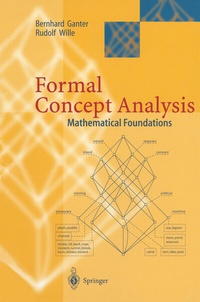
Formal Concept Analysis
Mathematical Foundations
Published on 4. December 1998
Book
Paperback/Softback
X, 284 pages
978-3-540-62771-5 (ISBN)
Description
Formal Concept AllalY.5is is a field of applied mathematics based on the math ematization of concept and conceptual hierarchy. It thereby activates math ematical thinking for conceptual data analysis and knowledge processing. The underlying notion of "concept" evolved early in the philosophical theory of concepts and still has effects today. For example, it has left its mark in the German standards DIN 2:)30 and DIN 2;3:)1. In mathematics it played a special role during the emergence of mathematical logic in the 19th century. Subsequently, however, it had virtually no impact on mathematical thinking. It was not until 1979 that the topic was revisited and treated more thoroughly. Since then, through a large number of contributions, Formal Concept Analysis has obtained such breadth that a systematic presentation is urgently needed, but can no longer be realized in one volume. Therefore, the present book foruse:':! on the mathematical foundations of Formal Concept Analysis, which ran be regarded chiefly as a branch of ap plied lattice theory. A series of examples serves to demonstrate the utility of the lnathematical definitions and results; in particular, to show how Formal Concept Analysis can be used for the conceptual unfolding of data contexts. These examples do not play the role of case studies in data analysis. A is intended for a comprehensive treatment of methods of separate volume conceptual data and knowledge processing. The general foundations of For mal Concept Analysis will also be treated separately.
More details
Edition
Softcover reprint of the original 1st ed. 1999
Language
English
Place of publication
Heidelberg
Germany
Publishing group
Springer Berlin
Target group
College/higher education
Professional and scholarly
Lower undergraduate
Illustrations
X, 284 p.
Dimensions
Height: 23.5 cm
Width: 15.5 cm
Weight
460 gr
ISBN-13
978-3-540-62771-5 (9783540627715)
DOI
10.1007/978-3-642-59830-2
Schweitzer Classification
Other editions
New editions
Book
07/2024
2nd Edition
Springer
€69.54
Shipment within 15-20 days
Additional editions
E-Book
12/2012
Springer
€85.59
Available for download
Persons
Content
0. Order-theoretic Foundations.- 0.1 Ordered Sets.- 0.2 Complete Lattices.- 0.3 Closure Operators.- 0.4 Galois Connections.- 0.5 Hints and References.- 1. Concept Lattices of Contexts.- 1.1 Context and Concept.- 1.2 Context and Concept Lattice.- 1.3 Many-valued Contexts.- 1.4 Context Constructions and Standard Scales.- 1.5 Hints and References.- 2. Determination and Representation.- 2.1 All Concepts of a Context.- 2.2 Diagrams.- 2.3 Implications between Attributes.- 2.4 Dependencies between Attributes.- 2.5 Hints and References.- 3. Parts and Factors.- 3.1 Subcontexts.- 3.2 Complete Congruences.- 3.3 Closed Subrelations.- 3.4 Block Relations and Tolerances.- 3.5 Hints and References.- 4. Decompositions of Concept Lattices.- 4.1 Subdirect Decompositions.- 4.2 Atlas-decompositions.- 4.3 Substitution.- 4.4 Tensorial Decompositions.- 4.5 Hints and References.- 5. Constructions of Concept Lattices.- 5.1 Subdirect Product Constructions.- 5.2 Gluings.- 5.3 Local Doubling.- 5.4 Tensorial Constructions.- 5.5 Hints and References.- 6. Properties of Concept Lattices.- 6.1 Distributivity.- 6.2 Semimodularity and Modularity.- 6.3 Semidistributivity and Local Distributivity.- 6.4 Dimension.- 6.5 Hints and References.- 7. Context Comparison and Conceptual Measurability.- 7.1 Automorphisms of Contexts.- 7.2 Morphisms and Bonds.- 7.3 Scale Measures.- 7.4 Measurability Theorems.- 7.5 Hints and References.- References.