

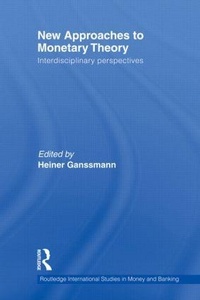
New Approaches to Monetary Theory
Interdisciplinary Perspectives
1st Edition
Published on 21. March 2011
Book
Hardback
292 pages
978-0-415-59525-4 (ISBN)
Description
Everybody uses money every day, but we rarely stop to think about how money works. In this book, scholars from different disciplines seek to answer that question; from historians to economists, sociologists, a philosopher and a physicist. Money works as a social construction because we have mutual expectations that support its use - despite the seeming irrationality of trading valuable things or doing strenuous work for pieces of paper or numbers in accounts.
Recently, there has been a revival of interest in monetary theory, not least because the impacts of globalizing markets and of new communication and information technologies have changed the forms of money. The deep crisis of the financial system has demonstrated the importance of a functioning monetary system and although renewed interest in this has led to significant contributions in various fields, it remains true that no social science discipline on its own is sufficiently equipped to explain the basic workings of monetary systems, their rapid innovation and their effects on social, economic and political structures.
The contributors to this book report on their latest research on the origins of money, on the nature of monetary transactions, on money and the state, and on the role of money and finance in the recent global crisis. They show how established theories of money and the policies guided by these theories went wrong. This collection will be a valuable resource for students and researchers seeking a deeper understanding of money.
Recently, there has been a revival of interest in monetary theory, not least because the impacts of globalizing markets and of new communication and information technologies have changed the forms of money. The deep crisis of the financial system has demonstrated the importance of a functioning monetary system and although renewed interest in this has led to significant contributions in various fields, it remains true that no social science discipline on its own is sufficiently equipped to explain the basic workings of monetary systems, their rapid innovation and their effects on social, economic and political structures.
The contributors to this book report on their latest research on the origins of money, on the nature of monetary transactions, on money and the state, and on the role of money and finance in the recent global crisis. They show how established theories of money and the policies guided by these theories went wrong. This collection will be a valuable resource for students and researchers seeking a deeper understanding of money.
More details
Series
Language
English
Place of publication
London
United Kingdom
Publishing group
Taylor & Francis Ltd
Target group
College/higher education
Product notice
Unsewn / adhesive bound
Paper over boards
Illustrations
8 s/w Zeichnungen, 1 s/w Tabelle
1 Tables, black and white; 8 Line drawings, black and white
Dimensions
Height: 257 mm
Width: 178 mm
Thickness: 33 mm
Weight
1157 gr
ISBN-13
978-0-415-59525-4 (9780415595254)
Copyright in bibliographic data and cover images is held by Nielsen Book Services Limited or by the publishers or by their respective licensors: all rights reserved.
Schweitzer Classification
Other editions
Additional editions
Book
11/2013
1st Edition
Routledge
€77.03
Shipment within 15-20 days
E-Book
03/2012
1st Edition
Routledge
€64.49
Available for download
E-Book
03/2012
1st Edition
Routledge
€64.49
Available for download
Person
Heiner Ganssmann is Professor Emeritus at the Department of Sociology at the Free University of Berlin, Germany.
Content
1. Introduction Heiner Ganssmann 2. The Role and the Place of Money and Credit in the Economy of Ancient Mesopotamia Johannes Renger 3. The Greek Invention of Money Richard Seaford 4. Explaining the Origin of Money: Interdisciplinary Perspectives N. Emrah Aydinonat 5. Weber's 'Last Theory of Capitalism' and Heterodox Approaches to Money and Finance John Smithin 6. Money and Sovereignty: A Comparison between Hobbes and Modern Money Theory Jean Cartelier 7. Statistical Mechanics Approach to the Probability Distribution of Money Victor M. Yakovenko 8. Money, Credit and the Structures of Social Action Heiner Ganssmann 9. Money, Liquidity and Price Bruce G. Carruthers 10. Understanding Modern Money: How A Sovereign Currency Works L. Randall Wray 11. Monetary Equivalence and Functionalism: Implications for Central Banking Dick Bryan and Mike Rafferty 12. From Marx to Minsky: The Universal Equivalent, Finance to Production and the Deepening of the Real Subsumption of Labour under Capital Riccardo Bellofiore 13. Money, Expectations, Physics and Financial Markets: Paradigmatic Alternatives in Economic Thinking Hansjoerg Herr 14. The Second End of Laissez-Faire: The Bootstrapping Nature of Money and the Inherent Instability of Capitalism Katsuhito Iwai