

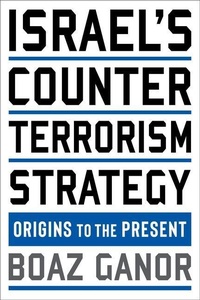
Israel's Counterterrorism Strategy
Origins to the Present
Published on 13. July 2021
Book
Paperback/Softback
424 pages
978-0-231-19923-0 (ISBN)
Description
Since declaring independence in 1948, Israel has been involved in an intractable conflict with the Palestinians and its neighbors. While violence has ebbed and flowed over the years, the threat of terrorism has remained a constant factor, shaping Israeli security policy in a unique way.
Boaz Ganor provides an authoritative analysis of Israel's approach to counterterrorism throughout its existence. Drawing on unprecedented access to Israeli leaders, he offers a comprehensive insider's account of the decision-making processes, challenges, and dilemmas at the core of counterterror activities. Beginning with infiltration attacks from neighboring states immediately after independence and proceeding through the formation of organized Palestinian terror organizations up to the present day, this book details distinct eras of terrorism and how the Israeli state has counteracted them. Ganor also highlights the dynamic nature of both terrorism and counterterrorism: Just as waves of terror rise, fall, and evolve, so too do the measures employed to respond to them. He distills the lessons of Israel's experience into key tenets for other countries facing the challenge of terrorism.
The book features revelatory personal testimony from senior Israeli decision makers who have played pivotal roles in counterterrorism strategy, including prime ministers, defense ministers, Israeli Defense Forces chiefs of staff, and directors of Mossad and Shin Bet. Israel's Counterterrorism Strategy is indispensable reading for students, scholars, and practitioners alike.
Boaz Ganor provides an authoritative analysis of Israel's approach to counterterrorism throughout its existence. Drawing on unprecedented access to Israeli leaders, he offers a comprehensive insider's account of the decision-making processes, challenges, and dilemmas at the core of counterterror activities. Beginning with infiltration attacks from neighboring states immediately after independence and proceeding through the formation of organized Palestinian terror organizations up to the present day, this book details distinct eras of terrorism and how the Israeli state has counteracted them. Ganor also highlights the dynamic nature of both terrorism and counterterrorism: Just as waves of terror rise, fall, and evolve, so too do the measures employed to respond to them. He distills the lessons of Israel's experience into key tenets for other countries facing the challenge of terrorism.
The book features revelatory personal testimony from senior Israeli decision makers who have played pivotal roles in counterterrorism strategy, including prime ministers, defense ministers, Israeli Defense Forces chiefs of staff, and directors of Mossad and Shin Bet. Israel's Counterterrorism Strategy is indispensable reading for students, scholars, and practitioners alike.
Reviews / Votes
Israel's Counterterrorism Policy is an important contribution to counterterrorism and security literature. Through unparalleled access to decision makers, prime ministers, ministers of defense, and heads of security and intelligence services, Boaz Ganor provides a comprehensive overview of Israel's counterterrorism policy over the years and analyzes the key dilemmas and challenges. A must-read for leaders, security practitioners, students, and journalists alike. -- Shabtai Shavit, former head of Mossad, 1989-1996 In Israel's Counterterrorism Strategy, Boaz Ganor provides a unique viewpoint on Israel's most critical counterterrorism challenges. Through interviews with the people in charge of devising and implementing Israel's counterterrorism policy, he presents a remarkable account of the threats that Israel has faced since its independence and how its decision makers have responded. -- Yaakov Perry, former director of the Israeli Security Agency; former minister and member of Parliament This book is a tour de force. Boaz Ganor expertly traces the history of Israel's efforts to protect itself against successive waves of terrorism while seeking to uphold its liberal democratic values. -- Ambassador Nathan Sales, former U.S. undersecretary of state (acting) and coordinator for counterterrorism In Israel's Counterterrorism Policy, the scholar-practitioner Boaz Ganor provides a balanced, considered, and meticulous master course on the history of Israeli counterterrorism and the lessons learned. He offers a much-needed strategic perspective on a tactical challenge, making a strong contribution to counterterrorism studies. -- Matthew Levitt, author of <i>Hezbollah: The Global Footprint of Lebanon's Party of God</i> Israel's Counterterrorism Strategy, by the preeminent authority Boaz Ganor, will be viewed as the definitive history of the country's long and varied experience with a mode of conflict that became the challenge of our age. The revelations of its leaders are fascinating. To understand the policy and ethical complexities of counterterrorism, start here. -- Brian Michael Jenkins, author of <i>Paths to Destruction: A Group Portrait of America's Jihadists-Comparing Jihadist Travelers with Domestic Plotters</i> Ganor's book will likely become a worthwhile component of the syllabi of courses related to the Arab-Israeli conflict and the peace process. * Israel Journal of Foreign Affairs *More details
Series
Language
English
Place of publication
New York
United States
Target group
Professional and scholarly
Product notice
Paperback (trade)
Dimensions
Height: 226 mm
Width: 151 mm
Thickness: 23 mm
Weight
584 gr
ISBN-13
978-0-231-19923-0 (9780231199230)
Copyright in bibliographic data and cover images is held by Nielsen Book Services Limited or by the publishers or by their respective licensors: all rights reserved.
Schweitzer Classification
Other editions
Additional editions
E-Book
10/2021
1st Edition
Columbia University Press
€38.99
Available for download
Person
Boaz Ganor is the founder and executive director of the International Institute for Counter-Terrorism (ICT), the Ronald Lauder Chair for Counter-Terrorism, and the former dean of the Lauder School of Government, Diplomacy, and Strategy at the Interdisciplinary Center (IDC) Herzliya. He has served as an advisor to the Israeli Counter-Terrorism Bureau, the Israeli National Security Council, and the Israeli Ministry of Defense. His books include Global Alert: The Rationality of Modern Islamist Terrorism and the Challenge to the Liberal Democratic World (Columbia, 2015).
Content
Acknowledgments
Chronology: Prime Ministers of Israel and Timeline of Major Events, 1948-2018
Introduction
1. The Israeli Counterterrorism Strategy and Decision-Making Process Conceptual Models
2. The "Fedayeen Phenomenon": The David Ben-Gurion and Moshe Sharett Administrations, 1948-63
3. Palestinian National Terrorism After the Six-Day War: The Levi Eshkol and Golda Meir Administrations, 1963-73
4. Cross-Border Terrorism After the Yom Kippur War: The Yitzhak Rabin Administration, 1974-76
5. Terrorism Against the Backdrop of the Lebanon War: The Menachem Begin, Yitzhak Shamir, and Shimon Peres Administrations, 1977-86
6. The First Intifada and Activities of the Palestinian Islamist Organizations: The Yitzhak Shamir Administration, 1987-91
7. Countering Terrorism During the Peace Process: The Yitzhak Rabin Administration, 1992-96
8. A Prime Minister's Assassination and Shifting Counterterrorism Strategies: The Benjamin Netanyahu Administration, 1996-99
9. Confronting the al-Aqsa Intifada: The Ehud Barak and Ariel Sharon Administrations, 1999-2004
10. Disengagement from Gaza and Its Ramifications: The End of the Sharon Administration and the Ehud Olmert Administration, 2005-2008
11. Changes in the Greater Middle East: The Netanyahu Administration, 2009-2018
12. Israel's Counterterrorism Policy from the Perspective of Israeli Decision Makers
Conclusion: The Art of Israeli Counterterrorism
Appendix: List of Interviewees and Selected Newspapers
Notes
Selected Bibliography
Index
Chronology: Prime Ministers of Israel and Timeline of Major Events, 1948-2018
Introduction
1. The Israeli Counterterrorism Strategy and Decision-Making Process Conceptual Models
2. The "Fedayeen Phenomenon": The David Ben-Gurion and Moshe Sharett Administrations, 1948-63
3. Palestinian National Terrorism After the Six-Day War: The Levi Eshkol and Golda Meir Administrations, 1963-73
4. Cross-Border Terrorism After the Yom Kippur War: The Yitzhak Rabin Administration, 1974-76
5. Terrorism Against the Backdrop of the Lebanon War: The Menachem Begin, Yitzhak Shamir, and Shimon Peres Administrations, 1977-86
6. The First Intifada and Activities of the Palestinian Islamist Organizations: The Yitzhak Shamir Administration, 1987-91
7. Countering Terrorism During the Peace Process: The Yitzhak Rabin Administration, 1992-96
8. A Prime Minister's Assassination and Shifting Counterterrorism Strategies: The Benjamin Netanyahu Administration, 1996-99
9. Confronting the al-Aqsa Intifada: The Ehud Barak and Ariel Sharon Administrations, 1999-2004
10. Disengagement from Gaza and Its Ramifications: The End of the Sharon Administration and the Ehud Olmert Administration, 2005-2008
11. Changes in the Greater Middle East: The Netanyahu Administration, 2009-2018
12. Israel's Counterterrorism Policy from the Perspective of Israeli Decision Makers
Conclusion: The Art of Israeli Counterterrorism
Appendix: List of Interviewees and Selected Newspapers
Notes
Selected Bibliography
Index