

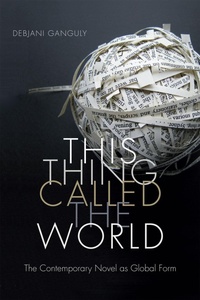
This Thing Called the World
The Contemporary Novel As Global Form
Published on 12. August 2016
Book
Hardback
312 pages
978-0-8223-6137-4 (ISBN)
Description
In This Thing Called the World Debjani Ganguly theorizes the contemporary global novel and the social and historical conditions that shaped it. Ganguly contends that global literature coalesced into its current form in 1989, an event marked by the convergence of three major trends: the consolidation of the information age, the arrival of a perpetual state of global war, and the expanding focus on humanitarianism. Ganguly analyzes a trove of novels from authors including Salman Rushdie, Don DeLillo, Michael Ondaatje, and Art Spiegelman, who address wars in Iraq, Afghanistan, and Sri Lanka, the Palestinian and Kashmiri crises, the Rwandan genocide, and post9/11 terrorism. These novels exist in a context in which suffering's presence in everyday life is mediated through digital images and where authors integrate visual forms into their storytelling. In showing how the evolution of the contemporary global novel is analogous to the European novel's emergence in the eighteenth century, when society and the development of capitalism faced similar monumental ruptures, Ganguly provides both a theory of the contemporary moment and a reminder of the novel's power.
Reviews / Votes
"A dense, learned, and important study of the emergence of "this thing called the world" as its inhabitants pass from spectatorship to witnessing of trauma under the prevailing conditions of intensified mediation, remediation, and hypermediation. . . . A rich resource that will be mined by many. . . . Highly recommended. Graduate students, researchers, faculty."- K. Toeloelyan (Choice) "This is a brave book, a valiant and valuable book, that seeks to characterize post-1989 fiction as ekphrastically humanitarian." - Eugene Eoyang (World Literature Today) "This Thing Called the World both models and theorizes a grounded approach to modern world literature, urging its critics, despite our habit to look beyond the horizon, not to forget the dirt beneath our own feet." - Christopher McVey (Studies in the Novel) "Against the grain of much contemporary criticism, which has jettisoned the notion of imaginative sympathy from literary discourse, Ganguly seizes on exactly this as critical to the post-1989 experience: 'the information technology revolution has radically transformed our threshold of responsibility to our distant others and has perforce brought worlds of untold suffering into our intimate spaces.'" - Michael LaPointe (TLS) "Ganguly's disentangling of the terms 'postcolonial,' 'global,' and 'world' in the introduction is much needed and persuasive. . . . A brave and important book." - Claire Chambers (Modern Fiction Studies) "Beautifully connects the sentimental novels of the eighteenth century to their contemporary equivalent . . . Ganguly remains true to the real-world voices of the novelists throughout her work, marrying aesthetics and ethics. . . . She also maintains a refreshing level of detail within the texts themselves, sweeping readers into the heart-wrenching and critical foci of the novels' collectivity while maintaining a thorough, accessible argument outlining specific interventions into our global understanding." - Beth Miller (Comparatist) "The strength of this monograph is undoubtedly the rich, largely unpretentious description of so many contemporary works, which many would aspire to read and few actually do. . . . The book is a truly remarkable first attempt at capturing the complexity of our times through novels. . . . Those readers interested in both the form and content of the contemporary novel, especially colleagues in English and Comparative Literature, will find much to think about as they pore over Ganguly's book." - Evan Torner (Studies in 20th & 21st Century Literature)
More details
Language
English
Place of publication
North Carolina
United States
Target group
Professional and scholarly
Product notice
Cloth over boards
Illustrations
5 illustrations
Dimensions
Height: 234 mm
Width: 157 mm
Thickness: 23 mm
Weight
567 gr
ISBN-13
978-0-8223-6137-4 (9780822361374)
Copyright in bibliographic data and cover images is held by Nielsen Book Services Limited or by the publishers or by their respective licensors: all rights reserved.
Schweitzer Classification
Other editions
Additional editions
E-Book
07/2016
1st Edition
De Gruyter
€208.99
Available for download
Person
Debjani Ganguly is Professor of English and Director of the Institute of the Humanities and Global Cultures at the University of Virginia. She is the author of Caste and Dalit Lifeworlds: Postcolonial Perspectives.
Content
Acknowledgments ix
Introduction 1
1. Real Virtualities and the Undead Genre 39
Part I. World
2. World-Making and Possible Worlds 69
3. Spectral Worlds, Networked Novel 87
4. From Midnight's Child to Clown Assassin 110
Part II. War
5. Visualizing Wartime: A Literary Genealogy 135
6. The Sky Is Falling: The Narrative Screen of Terror 157
Part III. Witness
7. This I Saw: Graphic Suffering 175
8. Forensic Witnessing: The (Non)Evidence of Bones 192
9. Affective Witnessing: Orphic Netherworlds 219
Coda 249
Notes 261
Bibliography 279
Index 293
Introduction 1
1. Real Virtualities and the Undead Genre 39
Part I. World
2. World-Making and Possible Worlds 69
3. Spectral Worlds, Networked Novel 87
4. From Midnight's Child to Clown Assassin 110
Part II. War
5. Visualizing Wartime: A Literary Genealogy 135
6. The Sky Is Falling: The Narrative Screen of Terror 157
Part III. Witness
7. This I Saw: Graphic Suffering 175
8. Forensic Witnessing: The (Non)Evidence of Bones 192
9. Affective Witnessing: Orphic Netherworlds 219
Coda 249
Notes 261
Bibliography 279
Index 293