

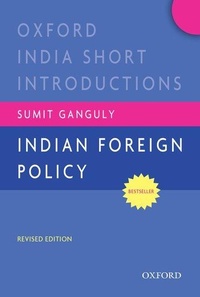
Indian Foreign Policy (Revised Edition)
Oxford India Short Introductions
Published on 28. March 2019
Book
Paperback/Softback
220 pages
978-0-19-949426-2 (ISBN)
Description
Updated and revised, this short introduction has become a go-to source for its clarity and succinct account of the evolution of Indian foreign policy over seven decades of India's decolonization. It explains how the three approaches to the study of international politics-decision-making, national/domestic, and systemic/global-have helped in formulating and implementing India's foreign policies.
The five chapters cover the ideational period, starting immediately after Independence and ending with the Sino-Indian border war of 1962; the period between 1962 and the end of the Cold War; India's greater acceptance of the importance of material capabilities following the end of the Cold War; current trends and debates in Indian foreign policy, including analysis on Narendra Modi's regime; and bookending the introduction by discussing challenges and the possible way ahead.
The five chapters cover the ideational period, starting immediately after Independence and ending with the Sino-Indian border war of 1962; the period between 1962 and the end of the Cold War; India's greater acceptance of the importance of material capabilities following the end of the Cold War; current trends and debates in Indian foreign policy, including analysis on Narendra Modi's regime; and bookending the introduction by discussing challenges and the possible way ahead.
Reviews / Votes
'Fluid and crystal clear. Its analytical acuity and elegance of drafting particularly distinguish it. Its apposite reference evince a deep grasp of the topic.'- David Malone, Rector of the United Nations University, Under-Secretary-General of
the United Nations 'Expertly delivered by one of the doyens of Indian foreign policy analysis, this volume produces a highly erudite, accessible and timely overview of the challenges India's leaders will need to confront if their country is to truly become a 21st century great power.'
- Chris Ogden, senior lecturer in Asian Security, School of International Relations,
University of St Andrews 'This timely work places the contemporary challenges and opportunities in Indian foreign policy in historical context, while highlighting the domestic and external constraints that prevent India from making significant progress with two of its neighbours, Pakistan and
China. It will be essential reading for those seeking to understand the domestic imperatives behind India's engagement with the rest of the world.'
- Katharine Adeney Adeney, professor and director, Institute of Asia and Pacifi c Studies, University of Nottingham 'Ganguly's analysis will provide much food for thought both to the general reader and the specialist. The former will benefit from the historical narrative that helps follow the unfolding of India's foreign policy. For the latter, the real bonus lies in the cache of interviews conducted with the diplomatic corps and high-ranking military officers, who have been part of the story that he tells. One finds insights in these narratives that help us understand turns of events that normally remain shrouded in mystery.'
- Subrata K. Mitra, Professor of Political Science, Heidelberg University
More details
Series
Edition
Revised edition
Language
English
Place of publication
New Delhi
India
Target group
College/higher education
Edition type
Revised edition
Product notice
Paperback (trade)
Unsewn / adhesive bound
Dimensions
Height: 185 mm
Width: 130 mm
Thickness: 15 mm
Weight
181 gr
ISBN-13
978-0-19-949426-2 (9780199494262)
Copyright in bibliographic data and cover images is held by Nielsen Book Services Limited or by the publishers or by their respective licensors: all rights reserved.
Schweitzer Classification
Person
Sumit Ganguly is Distinguished Professor of political
science and holds the Rabindranath Tagore Chair in
Indian Cultures and Civilizations at Indiana University,
Bloomington, Indiana. He is a member of the Council
on Foreign Relations and a fellow of the American
Academy of Arts and Sciences.
science and holds the Rabindranath Tagore Chair in
Indian Cultures and Civilizations at Indiana University,
Bloomington, Indiana. He is a member of the Council
on Foreign Relations and a fellow of the American
Academy of Arts and Sciences.
Content
- Acknowledgements
- 1: Organization and Structure
- 2: The Palimpsest of the Past
- 3: The Fate of Non-alignment
- 4: Coping with the Cold War's End
- 5: Forging a New Consensus?
- Notes
- Bibliography
- Index
- About the Author