

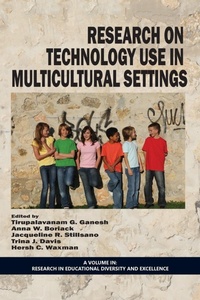
Research on Technology Use in Multicultural Settings
Published on 15. October 2014
Book
Paperback/Softback
252 pages
978-1-62396-825-0 (ISBN)
Description
This book is the third volume in the series on Research in Educational Diversity and Excellence. The goal of this series is to bring issues of diversity and educational risk to the forefront of national attention in order to assist the nation's diverse students at risk of failure to achieve academic excellence. This series focuses on critical issues in the education of linguistic and cultural minority students and those placed at risk by factors of race, poverty, and geographic location.
The purpose of the present book is to summarize and discuss recent perspectives, research, and practices related to the use of educational technology in multicultural settings. Technology that is already ubiquitous in our daily lives brings a myriad of issues to the area of education. Although educational systems should be geared to address challenges appropriately, the systems should be designed and developed to provide opportunities to take advantage of technology use. This book is noteworthy in that it presents a variety of theoretical and practical considerations for technology use in diverse multicultural contexts. Consisting of 12 chapters, the book (a) proposes theoretical concerns for understanding technological learning environments today and envisions the potential impact of future technology use and (b) examines technology tools and models that have been used for interventions, programs, and projects and measures and documents specific outcomes and challenges involving complex interactions within low-income and languageminority families and students.
The purpose of the present book is to summarize and discuss recent perspectives, research, and practices related to the use of educational technology in multicultural settings. Technology that is already ubiquitous in our daily lives brings a myriad of issues to the area of education. Although educational systems should be geared to address challenges appropriately, the systems should be designed and developed to provide opportunities to take advantage of technology use. This book is noteworthy in that it presents a variety of theoretical and practical considerations for technology use in diverse multicultural contexts. Consisting of 12 chapters, the book (a) proposes theoretical concerns for understanding technological learning environments today and envisions the potential impact of future technology use and (b) examines technology tools and models that have been used for interventions, programs, and projects and measures and documents specific outcomes and challenges involving complex interactions within low-income and languageminority families and students.
More details
Series
Language
English
Place of publication
Charlotte
United States
Publishing group
Emerald Publishing Inc
Target group
Professional and scholarly
College/higher education
Dimensions
Height: 234 mm
Width: 156 mm
Thickness: 14 mm
Weight
389 gr
ISBN-13
978-1-62396-825-0 (9781623968250)
Copyright in bibliographic data and cover images is held by Nielsen Book Services Limited or by the publishers or by their respective licensors: all rights reserved.
Schweitzer Classification
Other editions
Additional editions
Tirupalavanam Ganesh
Research on Technology Use in Multicultural Settings
E-Book
01/2014
1st Edition
Information Age Publishing
from
€62.33
Available for download
Persons
Tirupalavanam G. Ganesh, Arizona State University, USA.
Anna W. Boriack, Texas A&M University, USA.
Jacqueline R. Stillisano, Texas A&M University, USA.
Trina J. Davis, Texas A&M University, USA.
Hersh C. Waxman, Texas A&M University, USA.
Yolanda N. Padron, Texas A&M University, USA.
Anna W. Boriack, Texas A&M University, USA.
Jacqueline R. Stillisano, Texas A&M University, USA.
Trina J. Davis, Texas A&M University, USA.
Hersh C. Waxman, Texas A&M University, USA.
Yolanda N. Padron, Texas A&M University, USA.
Content
Preface.
Introduction and Overview, Anna W. Boriack and Hersh C. Waxman.
Chapter 1. Interactive and Traditional Books: Literacy Beliefs and Practices in Latino Families, Deanne R. Perez-Granados and Lynne C. Huffman.
Chapter 2. Integrating and Adapting an Inquiry Technology-Rich Curriculum in the Context of a Latin American Science Methods Course, M. Elizabeth Gonzalez and Barbara Hug.
Chapter 3. Integrating Flexible Language Supports within Online Science Learning Environments, Douglas Clark, Brian Nelson, Robert Atkinson, Frank Ramirez-Marin, and William Medina-Jerez.
Chapter 4. Case Studies of Online Testing in Multicultural School Districts, Brooke Kandel-Cisco, Jacqueline R. Stillisano, Trina J. Davis, and Hersh C. Waxman.
Chapter 5. Deconstructing the Digital Divide in Research: Moving From a View of the Poor as Other to the Poor as Us, Cecelia Merkel.
Chapter 6. Supporting Reading-to-Learn in Science: The Application of Summarization Technology in Multicultural Urban High School Classrooms, Kimberley Gomez, Samuel Kwon, Louis Gomez, and Jennifer Sherer.
Chapter 7. Building Capacity in Community Context: Studying the Impact of Technology on Low-Income Immigrant Spanish-Speaking Families, Hector H. Rivera and David J. Francis.
Chapter 8. Strategies to Engage Female and Hispanic Youth in Robotics in the Southwestern United States, Tirupalavanam G. Ganesh.
Chapter 9. Understanding the Shape of Learning in the Context of Technological Innovation, Finbarr Sloane, Jennifer Oloff-Lewis, and Anthony E. Kelly.
Chapter 10. Alternative Models for Evaluating Technology Use in Schools, Jacqueline R. Stillisano, Danielle B. Brown, and Hersh C. Waxman.
Chapter 11. Future Directions for Improving Technology Use in Multicultural Settings, Anna W. Boriack, Tirupalavanam G. Ganesh, and Hersh C. Waxman.
Editor and Author Biographies.
Introduction and Overview, Anna W. Boriack and Hersh C. Waxman.
Chapter 1. Interactive and Traditional Books: Literacy Beliefs and Practices in Latino Families, Deanne R. Perez-Granados and Lynne C. Huffman.
Chapter 2. Integrating and Adapting an Inquiry Technology-Rich Curriculum in the Context of a Latin American Science Methods Course, M. Elizabeth Gonzalez and Barbara Hug.
Chapter 3. Integrating Flexible Language Supports within Online Science Learning Environments, Douglas Clark, Brian Nelson, Robert Atkinson, Frank Ramirez-Marin, and William Medina-Jerez.
Chapter 4. Case Studies of Online Testing in Multicultural School Districts, Brooke Kandel-Cisco, Jacqueline R. Stillisano, Trina J. Davis, and Hersh C. Waxman.
Chapter 5. Deconstructing the Digital Divide in Research: Moving From a View of the Poor as Other to the Poor as Us, Cecelia Merkel.
Chapter 6. Supporting Reading-to-Learn in Science: The Application of Summarization Technology in Multicultural Urban High School Classrooms, Kimberley Gomez, Samuel Kwon, Louis Gomez, and Jennifer Sherer.
Chapter 7. Building Capacity in Community Context: Studying the Impact of Technology on Low-Income Immigrant Spanish-Speaking Families, Hector H. Rivera and David J. Francis.
Chapter 8. Strategies to Engage Female and Hispanic Youth in Robotics in the Southwestern United States, Tirupalavanam G. Ganesh.
Chapter 9. Understanding the Shape of Learning in the Context of Technological Innovation, Finbarr Sloane, Jennifer Oloff-Lewis, and Anthony E. Kelly.
Chapter 10. Alternative Models for Evaluating Technology Use in Schools, Jacqueline R. Stillisano, Danielle B. Brown, and Hersh C. Waxman.
Chapter 11. Future Directions for Improving Technology Use in Multicultural Settings, Anna W. Boriack, Tirupalavanam G. Ganesh, and Hersh C. Waxman.
Editor and Author Biographies.