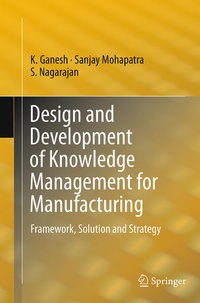
This book examines the modules/elements required before implementing knowledge management solutions in typical manufacturing and service industry. The objective is to develop a framework, design and model suitable for all requirements and a strategy to properly implement. Related case studies from organizations are included, with the results provided to use as a solution to problems experienced when implementing knowledge management in the industry.
Implementing a knowledge management system can be complex and dynamic, no matter how well planned and developed. Inevitably a degree of organizational inertia is focused on the current state rather than the new. Within an enterprise, personal and group involvement and interests process status and technology landscape can deflect the commitment needed to successfully implement such a system. Cumulative evidence from past research in knowledge management suggests that effective implementation of KM solution in any organization requires a robust designs and models for various critical elements of process, people and technology. Using the techniques provided in this book, readers should be able to design knowledge management strategies, to align objectives of the KM initiatives with their business goals.
Edition
Softcover reprint of the original 1st ed. 2014
Language
Place of publication
Publishing group
Springer International Publishing
Target group
Professional and scholarly
Illustrations
8 farbige Abbildungen, 85 s/w Abbildungen
XIX, 194 p. 93 illus., 8 illus. in color.
Dimensions
Height: 235 mm
Width: 155 mm
Thickness: 12 mm
Weight
ISBN-13
978-3-319-35211-4 (9783319352114)
DOI
10.1007/978-3-319-02892-7
Schweitzer Classification
Ramya Ravi currently works in Caterpillar India Private Limited at Chennai, India. She completed Bachelor of Engineering in Electrical and Electronics Engineering at Sri Chandrasekharendra Saraswati Viswa Mahavidhyala University in 2008. She completed Master of Engineering in Industrial Engineering at Thiagarajar College of Engineering, Madurai (Anna University) in 2011. Thereafter, she received Ph.D. in Operations Management from IIT Madras in 2017. Her research interests include Supply Chain Management, Inventory Optimization, Production Planning and Scheduling, and Analytics. She has a publication in International Journal of Production Research, and she has attended international conferences, both in India and abroad.
Chandrasekharan Rajendran is a Professor in the Department of Management Studies at IIT Madras, India. He holds RAGS Family Foundation Institute Chair in IIT Madras. He has been serving on the faculty of IIT Madras since 1987. His research interests include Operations and Supply Chain Management, Logistics and Distribution Management, Scheduling in Manufacturing and Service Systems, Optimization and Heuristic Techniques, Simulation Modeling, and Quality Management. He is a recipient of Alexander von Humboldt Research Fellowship of Germany and he is also a Visiting Professor in University of Passau, Germany. He has been conferred Dr. rer. pol. h.c. (Doctor of Business Administration and Economics (Honoris Causa)) by University of Passau for his outstanding achievements and contributions to research. He has been ranked among the best researchers, both in India and world-wide, in Operations Management.
Hans Ziegler has his Diploma from University of Karlsruhe (TH) (now called Karlsruhe Institute of Technology), and PhD and Post-doctoral Habilitation from University of Paderborn. He had been on the faculty of Universities of Paderborn and Darmstadt, before moving to University of Passau where he holds the Chair for Production, Operations and Logistics Management (since 1991). He has research interests in Operations Research, Production and Operations Management, Supply Chain and Logistics Management, Scheduling in Manufacturing and Service Systems, and Inventory Management. Prof. Ziegler has publications in many renowned international journals such as Computers and Industrial Engineering, Computers and Operations Research, Engineering Costs and Production Economics, European Journal of Operational Research, International Journal of Advanced Manufacturing and Technology, International Journal of Production Research, Production Planning and Control, Operations Research Letters, OR Spektrum, and Zeitschrift fuer Operations Research.
Sanjay Mohapatra received his B.E. from NIT Rourkela, M.Tech from IIT Madras, PGDBM XIMB, India and has finished his Ph.D. from Utkal University, India under Management Department. At present, heis an Associate Professor in Information Systems in XIMB, India. Professor Mohapatra has more than 21 years of industry experience. He has worked in various capacities in organizations like Hindustan Aeronautics Limited, Larsen & Toubro, PricewaterHouse, Infosys, Polaris & J&B Software. His teaching interests are in IT Strategy and Management Information Systems and research interests are in the area of IT enabled processes. He has authored/co-authored nine books and more than twenty papers in peer reviewed international journals.
Dr. K.Ganesh is Senior Knowledge Expert and Global Lead of "supply chain management center of competence" at McKinsey & Company, Chennai, India. He has graduated in Production Engineering from Annamalai University with the university first rank. He pursued his Masters' degree in Industrial Engineering at NIT Trichy and secured college first. He then moved to IIT Madras where he obtained his doctoral degree in Supply Chain. He is having total 14 years of research and consult
Introduction.- Literature Review.- Readiness Assessment for Knowledge Management Solution Implementation.- Behavior Assessment for Knowledge Management Solutions Implementation.- Taxonomy and Technology Architecture for Knowledge Management Solution Implementation.- Process Design for Knowledge Management Solution Implementation.- Learning Design for Knowledge Management Solution Implementation.- Balance Scorecard Framework for Knowledge Management Solution Implementation.- Vendor Management Framework for Knowledge Management Solution Implementation. Conclusions.