

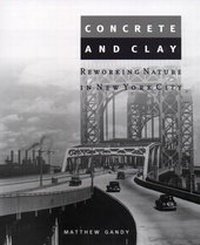
Concrete and Clay
Reworking Nature in New York City
Published on 15. March 2002
Book
Hardback
358 pages
978-0-262-07224-3 (ISBN)
Description
In this innovative account of the urbanization of nature in New York
City, Matthew Gandy explores how the raw materials of nature have been reworked to
produce a "metropolitan nature" distinct from the forms of nature experienced by
early settlers. The book traces five broad developments: the expansion and
redefinition of public space, the construction of landscaped highways, the creation
of a modern water supply system, the radical environmental politics of the barrio in
the late 1960s and early 1970s, and the contemporary politics of the environmental
justice movement.Drawing on political economy, environmental studies, social theory,
cultural theory, and architecture, Gandy shows how New York's environmental history
is bound up not only with the upstate landscapes that stretch beyond the city's
political boundaries but also with more distant places that reflect the nation's
colonial and imperial legacies. Using the shifting meaning of nature under
urbanization as a framework, he looks at how modern nature has been produced through
interrelated transformations ranging from new water technologies to changing
fashions in landscape design. Throughout, he considers the economic and ideological
forces that underlie phenomena as diverse as the location of parks and the social
stigma of dirty neighborhoods.
City, Matthew Gandy explores how the raw materials of nature have been reworked to
produce a "metropolitan nature" distinct from the forms of nature experienced by
early settlers. The book traces five broad developments: the expansion and
redefinition of public space, the construction of landscaped highways, the creation
of a modern water supply system, the radical environmental politics of the barrio in
the late 1960s and early 1970s, and the contemporary politics of the environmental
justice movement.Drawing on political economy, environmental studies, social theory,
cultural theory, and architecture, Gandy shows how New York's environmental history
is bound up not only with the upstate landscapes that stretch beyond the city's
political boundaries but also with more distant places that reflect the nation's
colonial and imperial legacies. Using the shifting meaning of nature under
urbanization as a framework, he looks at how modern nature has been produced through
interrelated transformations ranging from new water technologies to changing
fashions in landscape design. Throughout, he considers the economic and ideological
forces that underlie phenomena as diverse as the location of parks and the social
stigma of dirty neighborhoods.
More details
Series
Language
English
Place of publication
Cambridge, Mass.
United States
Publishing group
MIT Press Ltd
Target group
College/higher education
Professional and scholarly
Illustrations
40 illus.
Dimensions
Height: 229 mm
Width: 178 mm
Thickness: 25 mm
Weight
957 gr
ISBN-13
978-0-262-07224-3 (9780262072243)
Copyright in bibliographic data and cover images is held by Nielsen Book Services Limited or by the publishers or by their respective licensors: all rights reserved.
Schweitzer Classification
Other editions
Additional editions
E-Book
08/2003
MIT Press
€35.49
Available for download
Person
Matthew Gandy teaches geography and urban studies in the Faculty of
Social and Historical Sciences at University College London. He has been a visiting
scholar in the Graduate School of Architecture, Planning, and Preservation at
Columbia University.
Social and Historical Sciences at University College London. He has been a visiting
scholar in the Graduate School of Architecture, Planning, and Preservation at
Columbia University.