

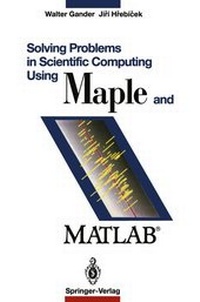
Solving Problems in Scientific Computing Using Maple and Matlab®
Using MAPLE and MATLAB
Published on 6. December 1993
Book
Paperback/Softback
XIII, 268 pages
978-3-540-57329-6 (ISBN)
Description
Modern computing tools like
Maple
(symbolic computation) and
Matlab
(a numeric computation and visualization program) make it possible to easily solve realistic nontrivial problems in scientific computing. In education, traditionally, complicated problems were avoided, since the amount of work for obtaining the solutions was not feasible for the students. This situation has changed now, and the students can be taught real-life problems that they can actually solve using the new powerful software. The reader will improve his knowledge through learning by examples and he will learn how both systems, MATLAB and MAPLE, may be used to solve problems interactively in an elegant way. Readers will learn to solve similar problems by understanding and applying the techniques presented in the book. All programs used in the book are available to the reader in electronic form.
More details
Language
English
Place of publication
Heidelberg
Germany
Publishing group
Springer Berlin
Target group
College/higher education
Professional and scholarly
Illustrations
97figs.7tabs.
Dimensions
Height: 23.5 cm
Width: 15.5 cm
Weight
430 gr
ISBN-13
978-3-540-57329-6 (9783540573296)
DOI
10.1007/978-3-642-97533-2
Schweitzer Classification
Other editions
New editions
Walter Gander | Jiri Hrebicek
Solving Problems in Scientific Computing Using Maple and MATLAB®
Book
06/2004
4th Edition
Springer
€53.49
Shipment within 10-15 days
Walter Gander | Jirí Hrebícek
Solving Problems in Scientific Computing. Using MAPLE and MATLAB
Using MAPLE and MATLAB
Book
1995
2nd Edition
Springer
€36.53
Article exhausted; check for reprint
Additional editions
Walter Gander | Jiri Hrebicek
Solving Problems in Scientific Computing Using Maple and Matlab®
E-Book
12/2012
Springer
€82.38
Available for download
Content
1. The Tractrix and Similar Curves.- 1.1 Introduction.- 1.2 The Classical Tractrix.- 1.3 The Child and the Toy.- 1.4 The Jogger and the Dog.- 1.5 Showing the Movements with Matlab.- References.- 2. Trajectory of a Spinning Tennis Bali.- 2.1 Introduction.- 2.2 Maple Solution.- 2.3 Matlab Solution.- References.- 3. The Illumination Problem.- 3.1 Introduction.- 3.2 Finding the Minimal Illumination Point on a Road.- 3.3 Varying h2 to Maximize the Illumination.- 3.4 Optimal Illumination.- 3.5 Conclusion.- References.- 4. Orbits in the Planar Three-Body Problem.- 4.1 Introduction.- 4.2 Equations of Motion in Physical Coordinates.- 4.3 Global Regularization.- 4.4 The Pythagorean Three-Body Problem.- 4.5 Conclusions.- References.- 5. The Internal Field in Semiconductors.- 5.1 Introduction.- 5.2 Solving a Nonlinear Poisson Equation Using Maple.- 5.3 Matlab Solution.- References.- 6. Some Least Squares Problems.- 6.1 Introduction.- 6.2 Fitting Lines, Rectangles and Squares in the Plane.- 6.3 Fitting Hyperplanes.- References.- 7. The Generalized Billiard Problem.- 7.1 Introduction.- 7.2 The Generalized Reflection Method.- 7.2.1 Line and Curve Reflection.- 7.2.2 Mathematical Description.- 7.2.3 Maple Solution.- 7.3 The Shortest Trajectory Method.- 7.3.1 Maple Solution.- 7.4 Examples.- 7.4.1 The Circular Billiard Table.- 7.4.2 The Elliptical Billiard Table.- 7.4.3 The Snail Billiard Table.- 7.4.4 The Star Billiard Table.- 7.5 Conclusions.- References.- 8. Mirror Curves.- 8.1 The Interesting Waste.- 8.2 The Mirror Curves Created by Maple.- 8.3 The Inverse Problem.- 8.3.1 Outflanking Manoeuvre.- 8.3.2 Geometrical Construction of a Point on the Pattern Curve.- 8.3.3 Maple Solution.- 8.3.4 Analytic Solution.- 8.4 Examples.- 8.4.1 The Circle as the Mirror Curve.- 8.4.2 The Line as the Mirror Curve.- 8.5 Conclusions.- References.- 9. Smoothing Filters.- 9.1 Introduction.- 9.2 Savitzky-Golay Filter.- 9.2.1 Filter Coefficients.- 9.2.2 Results.- 9.3 Least Squares Filter.- 9.3.1 Lagrange Equations.- 9.3.2 Zero Finder.- 9.3.3 Evaluation of the Secular Function.- 9.3.4 MEX-Files.- 9.3.5 Results.- References.- 10. The Radar Problem.- 10.1 Introduction.- 10.2 Converting Degrees into Radians.- 10.3 Transformation of Geographical into Geocentric Coordinates.- 10.4 The Transformations.- 10.5 Final Algorithm.- 10.6 Practical Example.- References.- 11. Conformal Mapping of a Circle.- 11.1 Introduction.- 11.2 Problem Outline.- 11.3 Maple Solution.- References.- 12. The Spinning Top.- 12.1 Introduction.- 12.2 Formulation and Basic Analysis of the Solution.- 12.3 The Numerical Solution.- References.- 13. The Calibration Problem.- 13.1 Introduction.- 13.2 The Physical Model Description.- 13.3 Approximation by Splitting the Solution.- 13.4 Conclusions.- References.- 14. Heat Flow Problems.- 14.1 Introduction.- 14.2 Heat Flow through a Spherical Wall.- 14.2.1 A Steady State Heat Flow Model.- 14.2.2 Fourier Model for Steady State.- 14.2.3 Maple Plots.- 14.3 Non Stationary Heat Flow through an AgricultureField.- 14.3.1 Maple Plots.- References.- 15. Penetration of a Long Rod into a Semiinfinite Target.- 15.1 Introduction.- 15.2 Short Description of the Penetration Theory.- 15.3 Numerical Example.- 15.4 Conclusions.- References.- 16. Heat Capacity of System of Bose Particles.- 16.1 Introduction.- 16.2 Maple Solution.- References.- 17. Compression of a Metal Disk.- 17.1 Introduction.- 17.2 Mathematical and Physical Model.- 17.3 Parabolic Perimeter.- 17.4 Maple Solution.- 17.5 Base Radius as Function of Friction.- 17.6 Simplification.- 17.7 Graphics.- 17.8 Conclusions.- References.- 18. Gauss Quadrature.- 18.1 Introduction.- 18.2 Orthogonal Polynomials.- 18.3 Quadrature Rule.- 18.4 Gauss Quadrature Rule.- 18.5 Gauss-Radau Quadrature Rule.- 18.6 Gauss-Lobatto Quadrature Rule.- 18.7 Weights.- 18.8 Quadrature Error.- References.- 19. Symbolic Computation of Explicit Runge-Kutta Formulas.- 19.1 Introduction.- 19.2 Derivation of the Equations for the Parameters.- 19.3 Solving the System of Equations.- 19.3.1 Gröbner Bases.- 19.3.2 Resultants.- 19.4 The Complete Algorithm.- 19.4.1 Example 1:.- 19.4.2 Example 2:.- 19.5 Conclusions.- References.