

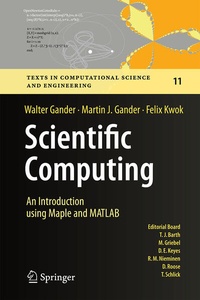
Scientific Computing - An Introduction using Maple and MATLAB
Published on 29. April 2014
Book
Hardback
XVIII, 905 pages
978-3-319-04324-1 (ISBN)
Description
Scientific computing is the study of how to use computers effectively to solve problems that arise from the mathematical modeling of phenomena in science and engineering. It is based on mathematics, numerical and symbolic/algebraic computations and visualization. This book serves as an introduction to both the theory and practice of scientific computing, with each chapter presenting the basic algorithms that serve as the workhorses of many scientific codes; we explain both the theory behind these algorithms and how they must be implemented in order to work reliably in finite-precision arithmetic. The book includes many programs written in Matlab and Maple - Maple is often used to derive numerical algorithms, whereas Matlab is used to implement them. The theory is developed in such a way that students can learn by themselves as they work through the text. Each chapter contains numerous examples and problems to help readers understand the material "hands-on".
Reviews / Votes
From the book reviews:
"This is an elaborate book on fundamental numerical methods including numerical ordinary differential equations and optimization. . All chapters are organized in the same nice way by beginning with an introductary example and ending with a large number of exercises. The presentation of the material is reader orientated such that e.g. a student can learn directly from the book. Many details are given and special attention lies on various numerical calculations which enlight the performance of the respective algorithms." (Rolf Dieter Grigorieff, zbMATH, Vol. 1296, 2014)More details
Series
Edition
2014 ed.
Language
English
Place of publication
Cham
Switzerland
Publishing group
Springer International Publishing
Target group
Upper undergraduate
Illustrations
80 s/w Abbildungen, 53 farbige Abbildungen
XVIII, 905 p. 133 illus., 53 illus. in color.
Dimensions
Height: 241 mm
Width: 160 mm
Thickness: 52 mm
Weight
1712 gr
ISBN-13
978-3-319-04324-1 (9783319043241)
DOI
10.1007/978-3-319-04325-8
Schweitzer Classification
Other editions
Additional editions
Walter Gander | Martin J. Gander | Felix Kwok
Scientific Computing - An Introduction using Maple and MATLAB
Book
10/2016
Springer
€96.29
Shipment within 10-15 days
Walter Gander | Martin J. Gander | Felix Kwok
Scientific Computing - An Introduction using Maple and MATLAB
E-Book
04/2014
Springer
€96.29
Available for download
Persons
Walter Gander, born May 24, 1944, from Saanen (BE), Switzerland. Education: Diploma in mathematics ETH Zürich 1968. Then assistant of H. Rutishauser in his new institute of computer science. Ph.D. in mathematics 1973, supervisor P.Henrici.
From 1973 to 1987: Professor for numerical analysis and computer science at the University of Applied Sciences Neu-Technikum Buchs. 1977/78 Visiting Scientist at Stanford University. 1979 Habilitation and Privatdozent for numerical analysis at ETHZ. 1984, 1993 and 2006 sabbatical leaves again at Stanford University. From 1987 to 1991 associate, since 1991 full professor for computer science at ETH Zürich. From 1989 to 1997 head of the Institute of Scientific Computing. 1990 - 1992: chairmen of the faculty of computer science. 1989 -1991 head of the Swiss Supercomputer Initiative for acquiring the national supercomputer in Manno. From Fall 1997 to Fall 2001 chairman of the department and director of education of computer science. After his retirement from ETH in 2009, he became a guest professor at HKBU (Baptist University Hong Kong).
Content
Why Study Scientific Computing?.- Finite Precision Arithmetic.- Linear Systems of Equations.- Interpolation.- Nonlinear Equations.-Least Squares Problems.- Eigenvalue Problems.- Differentiation.- Quadrature.- Numerical Ordinary Differential Equations.- Iterative Methods for Linear Systems.- Optimization.- Bibliography.- Index.