

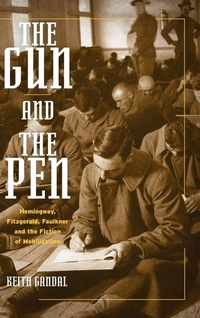
The Gun and the Pen
Hemingway, Fitzgerald, Faulkner and the Fiction of Mobilization
Published on 14. August 2008
Book
Hardback
288 pages
978-0-19-533891-1 (ISBN)
Description
Gandal contends that The Great Gatsby, The Sun Also Rises and The Sound and the Fury were all written by men who were greatly influenced by their shared frustration of not serving in the American military's colossal war effort. At the same time, these same authors also observed, among other startling developments, the Army's first egalitarian treatment of ethnic or hyphenated-Americans in regard to officer selection. The Great War mobilization shaped large-scale shifts in American life, including the meritocratic assignment of recruits to military rank based on intelligence testing, rather than Anglo-social and family background; an unprecedented military propaganda campaign aimed at fighting venereal disease and the redefinition of masculinity as chaste, chivalrous and athletic; the incarceration of tens of thousands of prostitutes as well as "promiscuous" women in an effort to police American female sexual behavior; and a dramatic but failed effort to ban sexual contact between American troops and French prostitutes. Mobilization Fiction involves a fundamental rethinking of these three novels, as well as other modernist postwar prose of the 1920s and 30s, in view of this essential history of the Great War mobilization.
Reviews / Votes
The major point...is that Gandal is the first person to see the relevance of the experience of mobilization to American fiction and that he has - with great brilliance as well as originality - demonstrated exactly the kind of difference it made to some of the central texts of the 20s and beyond. I learned a great deal from this book, and I am confident that it will, when published, make an important difference to our understanding of American modernism. I recommend publication in the strongest possible terms. * Walter Benn Michaels, Professor of English, University of Illinois, Chicago *More details
Language
English
Place of publication
New York
United States
Target group
College/higher education
Illustrations
9 black-and-white halftones
Dimensions
Height: 235 mm
Width: 157 mm
Thickness: 21 mm
Weight
615 gr
ISBN-13
978-0-19-533891-1 (9780195338911)
Copyright in bibliographic data and cover images is held by Nielsen Book Services Limited or by the publishers or by their respective licensors: all rights reserved.
Schweitzer Classification
Other editions
Additional editions
Book
07/2010
Oxford University Press Inc
€54.10
Shipment within 15-20 days
E-Book
05/2010
1st Edition
OUP eBook
€14.49
Available for download
E-Book
07/2008
1st Edition
OUP eBook
€19.99
Available for download
Person
Keith Gandal is professor of English at Northern Illinois University outside of Chicago. He is the author of The Virtues of the Vicious: Jacob Riis, Stephen Crane and the Spectacle of the Slum (Oxford University Press, 1997) and Class Representation in Modern Fiction and Film (Palgrave Macmillan, 2007). He is also the author of a novel, Cleveland Anonymous (North Atlantic Books, 2002). He holds a Ph.D. from the University of California-Berkeley.
Content
Part I: Introduction ; Chapter 1 The Argument ; Chapter 2 Methodology and Scholarly Context ; Part II: ; Fitzgerald, Hemingway, Faulkner and the 1920s ; Chapter 3 The Great Gatsby and The Great War: ; Intelligence Testing, The Militarys New Man, and The Charity Girl ; Chapter 4 The Sun Also Rises and Mobilization Wounds: ; Joke Fronts, Military-School Wannabes, and Postwar Jewish Quotas ; Chapter 5 The Sound and the Fury and the Feebleminded ; Chapter 6 Post-Mobilization Romance: ; From Military Rejection to Modernist Tragedy and Symbolism ; Part III: ; The 1930s and After ; Chapter 7 Post-Mobilization Kinkiness: ; Barnes, West, Miller and the Militarys Frankness about Sex and Venereal Disease ; Chapter 8 The Sound and the Fury Redux and the End of the WWI Mobilization Novel ; Chapter 9 Afterword: Here We Go Again: ; WWII Mobilization Blues in William Burroughss Junky