

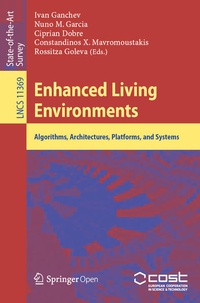
Enhanced Living Environments
Description
The aim of this book is to become a state-of-the-art reference, discussing progress made, as well as prompting future directions on theories, practices, standards, and strategies related to the ELE area. The book contains 12 chapters and can serveas a valuable reference for undergraduate students, post-graduate students, educators, faculty members, researchers, engineers, medical doctors, healthcare organizations, insurance companies, and research strategists working in this area.
More details
Content
Automation in systematic, scoping and rapid reviews by an NLP toolkit: a case study in Enhanced Living Environments.- RDF stores for enhanced living environments: an overview.- Combining Machine Learning and Metaheuristics Algorithms for Multicriteria Classification Method PROAFTN.- Development and Evaluation of Methodology for Personal Recommendations Applicable in Connected Health.- "Touchscreen Assessment Tool" (TATOO), an assessment tool based on the expanded conceptual model of frailty.- Towards a deeper understanding of the behavioural implications of bidirectional activity-based ambient displays in ambient assisted living environments.- Towards Truly Affective AAL Systems.- Maintaining Mental Well-being of Elderly at Home.- System Development for Monitoring Physiological Parameters in Living Environment.- Healthcare Sensing and Monitoring.- Semantic Middleware Architectures for IoT Healthcare Application.- The Role of Drones in Ambient Assisted Living Systems for the Elderly.