

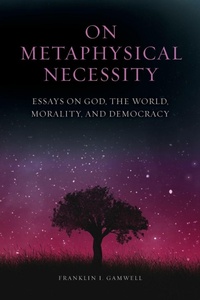
On Metaphysical Necessity
Essays on God, the World, Morality, and Democracy
Published on 2. January 2021
Book
Paperback/Softback
269 pages
978-1-4384-7930-9 (ISBN)
Description
Emphasizes the importance of metaphysical necessity to both philosophical theology and, through it, to moral and political theory.
In this collection of essays, Franklin I. Gamwell offers a defense of transcendental metaphysics, especially in its neoclassical form, and builds a case for its importance as a tool for addressing abiding problems in philosophical theology and morality-including talk about God, human fault, moral decision, and the relationship of politics and religious freedom.
In Part I, Gamwell argues against Kant and a wide range of contemporary philosophers, for the validity of transcendental metaphysics designated in the strict sense. He engages with Aquinas, Schleiermacher, Augustine, and Reinhold Niebuhr to argue that neoclassical metaphysics, for which the divine whole is itself temporal or forever self-surpassing, provides a more coherent account of God than does classical metaphysics, for which the divine whole is completely eternal. In Part II, Gamwell looks at transcendental metaphysics designated in the broad sense. In particular, he takes up the moral opportunity with which humans are presented, and argues that the moral law depends on a comprehensive good, that is, a good defined metaphysically in the strict sense. He then offers an extended discussion of the relation between transcendental metaphysics and morality, and explores Ronald Dworkin's view of the relationship between democracy and religion, the question of whether religious activities are properly exempted from generally applicable laws, and the constitutional debate about national and states' rights.
In this collection of essays, Franklin I. Gamwell offers a defense of transcendental metaphysics, especially in its neoclassical form, and builds a case for its importance as a tool for addressing abiding problems in philosophical theology and morality-including talk about God, human fault, moral decision, and the relationship of politics and religious freedom.
In Part I, Gamwell argues against Kant and a wide range of contemporary philosophers, for the validity of transcendental metaphysics designated in the strict sense. He engages with Aquinas, Schleiermacher, Augustine, and Reinhold Niebuhr to argue that neoclassical metaphysics, for which the divine whole is itself temporal or forever self-surpassing, provides a more coherent account of God than does classical metaphysics, for which the divine whole is completely eternal. In Part II, Gamwell looks at transcendental metaphysics designated in the broad sense. In particular, he takes up the moral opportunity with which humans are presented, and argues that the moral law depends on a comprehensive good, that is, a good defined metaphysically in the strict sense. He then offers an extended discussion of the relation between transcendental metaphysics and morality, and explores Ronald Dworkin's view of the relationship between democracy and religion, the question of whether religious activities are properly exempted from generally applicable laws, and the constitutional debate about national and states' rights.
Reviews / Votes
"No one else has argued in as much detail as Gamwell for the metaphysical necessity of the foundations of political thought. He has an amazing grasp of the Western tradition in philosophy and theology, as well as an impressive knowledge of contemporary trends." - Daniel A. Dombrowski, author of Whitehead's Religious Thought: From Mechanism to Organism, From Force to PersuasionMore details
Language
English
Place of publication
Albany, NY
United States
Target group
Professional and scholarly
US School Grade: College Graduate Student and over
Product notice
Paperback (trade)
Dimensions
Height: 229 mm
Width: 152 mm
Thickness: 16 mm
Weight
443 gr
ISBN-13
978-1-4384-7930-9 (9781438479309)
Copyright in bibliographic data and cover images is held by Nielsen Book Services Limited or by the publishers or by their respective licensors: all rights reserved.
Schweitzer Classification
Other editions
Additional editions
E-Book
08/2020
1st Edition
De Gruyter
€36.49
Available for download
Person
Franklin I. Gamwell is Shailer Mathews Distinguished Service Professor Emeritus of Religious Ethics, Theology, and Philosophy of Religion at the Divinity School of the University of Chicago. His many books include Religion among We the People: Conversations on Democracy and the Divine Good; Existence and the Good: Metaphysical Necessity in Morals and Politics; and The Meaning of Religious Freedom: Modern Politics and the Democratic Resolution, all published by SUNY Press.
Content
Introduction: On Transcendental Metaphysics
Metaphysics
Transcendental
The Following Chapters
Part One: God And The World: Metaphysics In The Strict Sense
1. A Defense Of Metaphysical Necessity
Recent Thinkers
The Pragmatic Self- Refutation
Recent Thinkers Revisited
Metaphysical Necessity
2. Speaking Of God After Aquinas
A Reading Of Aquinas
Analogical And Purely Equivocal Names
Theistic Arguments
Burrell's Alternative
The Principle Of Prior Actuality
3. Schleiermacher And Transcendental Philosophy
Schleiermacher's Introduction To Dogmatics
An Assessment Of Schleiermacher's Achievement
4. The Source Of Temptation
Augustine: Through Adam To The Devil
Reinhold Niebuhr: Sin Posits Itself
Another Account: Human Fragmentariness
Conclusion
Part Two: Morality And Democracy: Metaphysics In The Broad Sense
5. Moral Creatures And Their Decisions
Neoclassical Metaphysics In The Strict Sense
Moral Understanding
The Strictly Metaphysical Definition Of Good
Moral Creatures As Subjects
The Transcendental Moral Principles
6. On The Interpretation Of Religious Freedom: A Conversation With Ronald Dworkin
Dworkin's Interpretation
Dworkin's Interpretation: A Critique
Toward An Alternative Interpretation
7. On Religious Freedom And Its Free Exercise
Recent Theories
Politics By The Way Of Reason
Free Exercise Exemptions
Convictions And Confessions
8. The Revolution's Promise
Popular Sovereignty
The States' Rights View
The National View
Consequences Of The Revolution
Notes
Works Cited
Index
Metaphysics
Transcendental
The Following Chapters
Part One: God And The World: Metaphysics In The Strict Sense
1. A Defense Of Metaphysical Necessity
Recent Thinkers
The Pragmatic Self- Refutation
Recent Thinkers Revisited
Metaphysical Necessity
2. Speaking Of God After Aquinas
A Reading Of Aquinas
Analogical And Purely Equivocal Names
Theistic Arguments
Burrell's Alternative
The Principle Of Prior Actuality
3. Schleiermacher And Transcendental Philosophy
Schleiermacher's Introduction To Dogmatics
An Assessment Of Schleiermacher's Achievement
4. The Source Of Temptation
Augustine: Through Adam To The Devil
Reinhold Niebuhr: Sin Posits Itself
Another Account: Human Fragmentariness
Conclusion
Part Two: Morality And Democracy: Metaphysics In The Broad Sense
5. Moral Creatures And Their Decisions
Neoclassical Metaphysics In The Strict Sense
Moral Understanding
The Strictly Metaphysical Definition Of Good
Moral Creatures As Subjects
The Transcendental Moral Principles
6. On The Interpretation Of Religious Freedom: A Conversation With Ronald Dworkin
Dworkin's Interpretation
Dworkin's Interpretation: A Critique
Toward An Alternative Interpretation
7. On Religious Freedom And Its Free Exercise
Recent Theories
Politics By The Way Of Reason
Free Exercise Exemptions
Convictions And Confessions
8. The Revolution's Promise
Popular Sovereignty
The States' Rights View
The National View
Consequences Of The Revolution
Notes
Works Cited
Index