

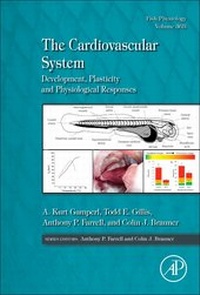
The Cardiovascular System: Volume 36B
Development, Plasticity and Physiological Responses
Published on 21. November 2017
Book
Hardback
512 pages
978-0-12-804164-2 (ISBN)
Description
The Cardiovascular System: Phenotypic and Physiological Responses, Volume 37, part of a two-volume set, provides comprehensive coverage of the current state of knowledge in this very active and growing field of research, also highlighting the tremendous diversity in cardiovascular morphology and function among the various fish taxa and the anatomical and physiological plasticity shown by this system when faced with various abiotic and biotic challenges. Specific chapters in this updated book include Research Technologies/Methodology for Studying Fish Cardiovascular Function, Cardiovascular Development in Embryonic and Larval Fishes, Cardiovascular Responses to Limiting Oxygen Levels, and Temperature and the Cardiovascular System.
The book's chapters integrate molecular and cellular data with the growing body of knowledge on heart and in vivo cardiovascular function, and as a result, provide insights into some of the most interesting, and important, questions that still need to be answered in this field.
The book's chapters integrate molecular and cellular data with the growing body of knowledge on heart and in vivo cardiovascular function, and as a result, provide insights into some of the most interesting, and important, questions that still need to be answered in this field.
More details
Series
Language
English
Place of publication
San Diego
United States
Publishing group
Elsevier Science Publishing Co Inc
Target group
Professional and scholarly
College/higher education
Dimensions
Height: 229 mm
Width: 152 mm
Weight
970 gr
ISBN-13
978-0-12-804164-2 (9780128041642)
Copyright in bibliographic data and cover images is held by Nielsen Book Services Limited or by the publishers or by their respective licensors: all rights reserved.
Schweitzer Classification
Other editions
Additional editions
A. Kurt Gamperl | Todd E. Gillis of Comparative Physiology | Anthony P. Farrell
The Cardiovascular System
Development, Plasticity and Physiological Responses
E-Book
11/2017
Academic Press
€85.95
Available for download
Persons
Dr. A. Kurt Gamperl is a comparative physiologist whose main research interest is to understand how environmental and physiological variables interact to affect fish biology. Central to this research are the role that blood oxygen transport, cardiac function, stress and humoral and/or biochemical factors play in mediating fish "performance" under varied environmental conditions. Dr. Todd Gillis was educated in Canada at the University of Guelph (BSc, MSc) and Simon Fraser University (PhD). His PhD thesis focused on the mechanisms that enable cardiac function in rainbow trout at their comparatively low physiological temperature. As a Natural Sciences and Engineering Research Council (NSERC) Post-Doctoral Fellow at the University of Washington, he studied the role of the thin filament in controlling cardiac function. Dr Gillis' research program, funded by NSERC, and Fisheries and Oceans Canada is focused on the vertebrate heart and the mechanisms that regulate its function, and capacity to respond to environmental and pathological stressors including temperature change, hypoxia, injury, and oil exposure. This work utilizes an integrative approach that is linking changes in gene and protein expression to cellular and tissue function to whole animal responses. Dr. Gillis is an Associate Editor of the Journal of Comparative Physiology B and on the Editorial Boards of the Journal of Thermal Biology, Comparative Biochemistry and Physiology A, and Current Research in Physiology.
Dr. Tony Farrell is a Professor Emeritus in the Department of Zoology & Faculty of Land and Food Systems at the University of British Columbia and a Fellow of the Royal Society of Canada. His research had provided an understanding of fish cardiorespiratory systems and has applied this knowledge to salmon migratory passage, fish stress handling and their recovery, sustainable aquaculture and aquatic toxicology. He has over 490 research publications in peer-reviewed scientific journals and an h-factor of 92. He has co-edited of 30 volumes of the Fish Physiology series, as well as an award-winning Encyclopedia of Fish Physiology. As part of his application of physiology to aquaculture, he has studied the sub-lethal impacts of sea lice and piscine orthoreovirus on the physiology of juvenile salmon. Dr. Farrell has received multiple awards, including the Fry Medal, which is the highest honour to a scientist from the Canadian Society of Zoologists, the Beverton Medal, which is the highest honour to a scientist from the Fisheries Society of the British Isles, the Award of Excellence, which is the highest honour of the American Fisheries Society and the Murray A. Newman Awards both for Research and for Conservation from the Vancouver Marine Sciences Centre. He is a former President of the Society of Experimental Biologists and a former Editor-in-Chief for the Journal of Fish Biology. He served as a member of the Minister's Aquaculture Advisory Committee on Finfish Aquaculture for British Columbia and was a member of the Federal Independent Expert Panel on Aquaculture Science. Dr. Colin Brauner was educated in Canada at the University of British Columbia (Ph D), followed by a Post-doctoral fellowship at Aarhus University and the University of Southern Denmark, and was a Research Associate at McMaster University. He is a Professor of Zoology, UBC and Director of the UBC Aquatics Facility. He has been a Co-Editor of the Fish Physiology series since 2006. His research investigates environmental adaptations (both mechanistic and evolutionary) in relation to gas-exchange, acid-base balance and ion regulation in fish, integrating responses from the molecular, cellular and organismal level. The ultimate goal is to understand how evolutionary pressures have shaped physiological systems among vertebrates and to determine the degree to which physiological systems can adapt/acclimate to natural and anthropogenic environmental changes. This information is crucial for basic biology and understanding the diversity of biological systems, but much of his research conducted to date can also be applied to issues of aquaculture, toxicology and water quality criteria development, as well as fisheries management. His achievements have been recognized by the Society for Experimental Biology, UK (President's medal) and the Canadian Conference for Fisheries Research (J.C. Stevenson Memorial Lecturer) and the Vancouver Marine Sciences Centre (Murray A. Newman Award for Aquatic Research). He is a former President of the Canadian Society of Zoologists.
Dr. Tony Farrell is a Professor Emeritus in the Department of Zoology & Faculty of Land and Food Systems at the University of British Columbia and a Fellow of the Royal Society of Canada. His research had provided an understanding of fish cardiorespiratory systems and has applied this knowledge to salmon migratory passage, fish stress handling and their recovery, sustainable aquaculture and aquatic toxicology. He has over 490 research publications in peer-reviewed scientific journals and an h-factor of 92. He has co-edited of 30 volumes of the Fish Physiology series, as well as an award-winning Encyclopedia of Fish Physiology. As part of his application of physiology to aquaculture, he has studied the sub-lethal impacts of sea lice and piscine orthoreovirus on the physiology of juvenile salmon. Dr. Farrell has received multiple awards, including the Fry Medal, which is the highest honour to a scientist from the Canadian Society of Zoologists, the Beverton Medal, which is the highest honour to a scientist from the Fisheries Society of the British Isles, the Award of Excellence, which is the highest honour of the American Fisheries Society and the Murray A. Newman Awards both for Research and for Conservation from the Vancouver Marine Sciences Centre. He is a former President of the Society of Experimental Biologists and a former Editor-in-Chief for the Journal of Fish Biology. He served as a member of the Minister's Aquaculture Advisory Committee on Finfish Aquaculture for British Columbia and was a member of the Federal Independent Expert Panel on Aquaculture Science. Dr. Colin Brauner was educated in Canada at the University of British Columbia (Ph D), followed by a Post-doctoral fellowship at Aarhus University and the University of Southern Denmark, and was a Research Associate at McMaster University. He is a Professor of Zoology, UBC and Director of the UBC Aquatics Facility. He has been a Co-Editor of the Fish Physiology series since 2006. His research investigates environmental adaptations (both mechanistic and evolutionary) in relation to gas-exchange, acid-base balance and ion regulation in fish, integrating responses from the molecular, cellular and organismal level. The ultimate goal is to understand how evolutionary pressures have shaped physiological systems among vertebrates and to determine the degree to which physiological systems can adapt/acclimate to natural and anthropogenic environmental changes. This information is crucial for basic biology and understanding the diversity of biological systems, but much of his research conducted to date can also be applied to issues of aquaculture, toxicology and water quality criteria development, as well as fisheries management. His achievements have been recognized by the Society for Experimental Biology, UK (President's medal) and the Canadian Conference for Fisheries Research (J.C. Stevenson Memorial Lecturer) and the Vancouver Marine Sciences Centre (Murray A. Newman Award for Aquatic Research). He is a former President of the Canadian Society of Zoologists.
Content
1. The O2 and CO2 Transport System in Teleosts and the Specialized Mechanisms That Enhance Hb-O2 Unloading to Tissues
Till S. Harter and Colin J. Brauner
2. Cardiovascular Development in Embryonic and Larval Fishes
Warren Burggren, Benjamin Dubansky, and Naim M. Bautista
3. Cardiac Preconditioning, Remodeling, and Regeneration
Todd E. Gillis and Elizabeth F. Johnston
4. Temperature and the Cardiovascular System
Erika J. Eliason and Katja Anttila
5. Cardiovascular Responses to Limiting Oxygen Levels
Jonathan A.W. Stecyk
6. Environmental Pollution and the Fish Heart
John P. Incardona and Nathaniel L. Scholz
7. Cardiovascular Effects of Disease: Parasites and Pathogens
Mark D. Powell and Muhammad N. Yousaf
Till S. Harter and Colin J. Brauner
2. Cardiovascular Development in Embryonic and Larval Fishes
Warren Burggren, Benjamin Dubansky, and Naim M. Bautista
3. Cardiac Preconditioning, Remodeling, and Regeneration
Todd E. Gillis and Elizabeth F. Johnston
4. Temperature and the Cardiovascular System
Erika J. Eliason and Katja Anttila
5. Cardiovascular Responses to Limiting Oxygen Levels
Jonathan A.W. Stecyk
6. Environmental Pollution and the Fish Heart
John P. Incardona and Nathaniel L. Scholz
7. Cardiovascular Effects of Disease: Parasites and Pathogens
Mark D. Powell and Muhammad N. Yousaf