

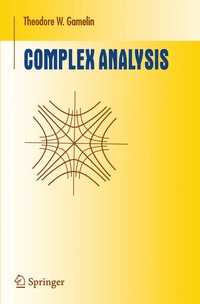
Complex Analysis
Published on 18. May 2001
Book
Paperback/Softback
XVIII, 480 pages
978-0-387-95069-3 (ISBN)
Description
The book provides an introduction to complex analysis for students with some familiarity with complex numbers from high school. It conists of sixteen chapters. The first eleven chapters are aimed at an Upper Division undergraduate audience. The remaining five chapters are designed to complete the coverage of all background necessary for passing PhD qualifying exams in complex analysis. Topics studied in the book include Julia sets and the Mandelbrot set, Dirichlet series and the prime number theorem, and the uniformization theorem for Riemann surfaces. The three geometries, spherical, euclidean, and hyperbolic, are stressed. Exercises range from the very simple to the quite challenging, in all chapters. The book is based on lectures given over the years by the author at several places, including UCLA, Brown University, the universities at La Plata and Buenos Aires, Argentina; and the Universidad Autonomo de Valencia, Spain.
Reviews / Votes
From the reviews: "More than 800 well-chosen exercises with 20 pages of hints and solutions, together with clear and concise expositions of many results, makes this book enjoyable even for specialists in the field. The book is recommended for libraries, students, and teachers of both undergraduate and graduate courses."Newsletter of the EMS, Issue 42, December 2001 "This is a wonderful book about the fundamentals of complex analysis. It touches all essential parts of complex function theory, and very often goes deeper into the subject than most elementary texts. a ] I find the pace, style and didactics in the presentation perfect. a ] All in all, this is one of the best if not the best book on the elementary theory of complex functions, and it can serve as a textbook as well as a reference book." (V. Totik, Mathematical Reviews, Issue 2002 h) "This is a well organized textbook on complex analysis a ] . Each part of the book contains some interesting exercises which give many new insights into further developments and enhance the usefulness of the book. At the end of the book there are hints and solutions for selected exercises." (F. Haslinger, Internationale Mathematische Nachrichten, Vol. 56 (191), 2002) "As the book begins with the rudiments of the subject and goes upto an advanced level, it will be equally useful to the undergraduates and to students at the pre Ph. D. level. The numerous applications to Physics found in the book redound to its value in the hands of students of Mathematics, Physics and Engineering alike." (K. S. Padmanabhan, Journal of the Indian Academy of Mathematics, Vol. 24 (1), 2002) "This is a beautiful book which provides a very goodintroduction to complex analysis for students with some familiarity with complex numbers. a ] The book is clearly written, with rigorous proofs, in a pleasant and accessible style. It is warmly recommended to students and all researchers in complex analysis." (Gabriela Kohr, The Mathematical Gazette, Vol. 86 (506), 2002) "The author of this fine textbook is a prominent function theorist. He leads the reader in a careful but far-sighted way from the elements of complex analysis to advanced topics in function theory and at some points to topics of modern research. a ] We found, however, that a special feature of the book is the wealth of exercises at the end of each section a ] . Altogether, the author has given us a wonderful textbook for use in classroom and in seminars." (Dieter Gaier, Zentralblatt MATH, Vol. 978, 2002) "The author wishes to provide beginners with standard material in a rather flexible course. a ] The preface contains useful hints for both instructors and students. More than 800 well-chosen exercises with 20 pages of hints and solutions, together with clear and concise expositions of many results, make this book enjoyable even for specialists in the field. The book is recommended for libraries, students, and teachers of both undergraduate and graduate courses." (Acta Scientiarum Mathematicarum, Vol. 68, 2002) "This book has the somewhat unusual aim of providing a primer in complex analysis at three different levels - a basic undergraduate introduction, a course for those who have decided to specialise as part of their first degree and a more demanding treatment of postgraduate topics. a ] I can certainly recommend this book to all those who wish to experience(in the authora (TM)s own words) the a ~fascinating and wonderful worlda (TM) of complex analysis, a ~filled with broad avenues and narrow backstreets leading to intellectual excitement.a (TM)" (Gerry Leversha, European Mathematical Society Newsletter, Issue 42, December 2001)More details
Series
Edition
1st ed. 2001 corr. 2nd printing 2001
Language
English
Place of publication
New York
United States
Target group
Lower undergraduate
Illustrations
XVIII, 480 p.
Dimensions
Height: 235 mm
Width: 155 mm
Thickness: 27 mm
Weight
750 gr
ISBN-13
978-0-387-95069-3 (9780387950693)
DOI
10.1007/978-0-387-21607-2
Schweitzer Classification
Other editions
Additional editions
Person
Content
First Part.- I The Complex Plane and Elementary Functions.- II Analytic Functions.- III Line Integrals and Harmonic Functions.- IV Complex Integration and Analyticity.- V Power Series.- VI Laurent Series and Isolated Singularities.- VII The Residue Calculus.- Second Part.- VIII The Logarithmic Integral.- IX The Schwarz Lemma and Hyperbolic Geometry.- X Harmonic Functions and the Reflection Principle.- XI Conformal Mapping.- Third Part.- XII Compact Families of Meromorphic Functions.- XIII Approximation Theorems.- XIV Some Special Functions.- XV The Dirichlet Problem.- XVI Riemann Surfaces.- Hints and Solutions for Selected Exercises.- References.- List of Symbols.