

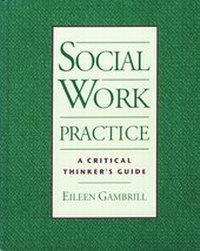
Social Work Practice
A Critical Thinker's Guide
Published in January 1999
Book
Hardback
688 pages
978-0-19-511332-7 (ISBN)
Description
Social Work Practice suggests that practice decisions based on weak criteria such as popularity of specific techniques in the profession may harm rather than help clients; it illustrates how social workers can make use of empirical data to achieve a greater understanding of client problems and provide the best and most appropriate services. Gambrill offers a contextual framework in which both clients and their problems are viewed in relation to their environments. Each chapter contains case illustrations, study questions, check lists, and boxes and charts which summarize the material.
More details
Language
English
Place of publication
New York
United States
Target group
Professional and scholarly
Illustrations
tabl.
tables
ISBN-13
978-0-19-511332-7 (9780195113327)
Copyright in bibliographic data and cover images is held by Nielsen Book Services Limited or by the publishers or by their respective licensors: all rights reserved.
Schweitzer Classification
Other editions
New editions
Book
02/2006
2nd Edition
Oxford University Press Inc
€68.09
Article exhausted; check for reprint
Content
PROLOGUE; PART I: GETTING ORIENTED; 1. Social Work: A Profession of Contradictions; 2. About Clients and Services; 3. Values, Ethics and Obligations; PART II: BACKGROUND KNOWLEDGE; 4. Thinking About Knowledge and How To Get It; 5. Helping Clients as a Problem-Solving Process; 6. Critical Thinking as a Guide to Practice Decisions; 7. Competing Views of Problems and Causes; 8. Behavior: Background Knowledge; PART III: GETTING STARTED; 9. Contextual Assessment; 10. Beginning: A Procedural Guideline; 11. Involving Clients: Increasing Participation; PART IV: RELATIONSHIP SKILLS; 12. Basic Interpersonal Skills; 13. Handling Difficult Situations; PART V: GATHERING AND ORGANIZING INFORMATION; 14. Sources of Information; 15. Observation: Learning to See; 16. Identifying Resources and Obstacles; 17. Putting It All Together; PART VI: SELECTING PLANS AND ASSESSING PROGRESS; 18. Selecting and Implementing Service Plans; 19. Evaluation: Finding Out What is Happening; 20. Planning for Endings; PART VII: INTERVENTION OPTIONS; 21. Education and Skill Building; 22. Helping Clients Learn Positive Behavior Change Skills; 23. Working With Groups and Families; 24. Working With Organizations and Communities; PART VIII: THE LONG RUN; 25. Maintaining Skills and Staying Happy in Your Work