

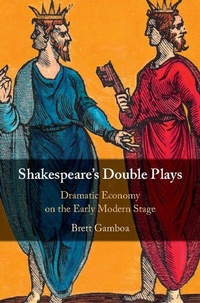
Shakespeare's Double Plays
Dramatic Economy on the Early Modern Stage
Published on 3. May 2018
Book
Hardback
300 pages
978-1-108-41743-3 (ISBN)
Description
In the first comprehensive study of how Shakespeare designed his plays to suit his playing company, Brett Gamboa demonstrates how Shakespeare turned his limitations to creative advantage, and how doubling roles suited his unique sense of the dramatic. By attending closely to their dramaturgical structures, Gamboa analyses casting requirements for the plays Shakespeare wrote for the company between 1594 and 1610, and describes how using the embedded casting patterns can enhance their thematic and theatrical potential. Drawing on historical records, dramatic theory, and contemporary performance this innovative work questions received ideas about early modern staging and provides scholars and contemporary theatre practitioners with a valuable guide to understanding how casting can help facilitate audience engagement. Supported by an appendix of speculative doubling charts for plays, illustrations, and online resources, this is a major contribution to the understanding of Shakespeare's dramatic craft.
Reviews / Votes
'With its entirely new sense of Shakespeare's combined poetic and practical craft, this bold and elegant book has far-reaching consequences for the worlds of performance, editing and interpretation.' Tiffany Stern, Shakespeare Institute, University of Birmingham 'Brett Gamboa's book represents a highly original contribution to the study of Shakespeare's working practices which challenges orthodox views on the casting of his plays in early performance. The work of a scholar who is also a practitioner, it demands to be considered by anyone with an interest in Shakespeare's dramatic craftsmanship.' Sir Stanley Wells, CBE, FRSL, Honorary President, The Shakespeare Birthplace Trust 'Brett Gamboa's Shakespeare's Double Plays investigates this now-taken-for-granted aspect of Shakespearean dramaturgy with fresh eyes.' Colin S. MacDonald, The Times Literary Supplement 'Shakespeare's Double Plays is essential reading for scholars and students of theater history and early modern performance ... Gamboa has written an important book for theater historians, students of theater, actors, and directors.' Farah Karim-Cooper, Renaissance QuarterlyMore details
Language
English
Place of publication
Cambridge
United Kingdom
Target group
Professional and scholarly
College/higher education
Illustrations
Worked examples or Exercises; 40 Tables, black and white; 8 Halftones, black and white; 2 Line drawings, black and white
Dimensions
Height: 235 mm
Width: 157 mm
Thickness: 21 mm
Weight
591 gr
ISBN-13
978-1-108-41743-3 (9781108417433)
Copyright in bibliographic data and cover images is held by Nielsen Book Services Limited or by the publishers or by their respective licensors: all rights reserved.
Schweitzer Classification
Other editions
Additional editions

Book
06/2022
Cambridge University Press
€36.90
Shipment within 15-20 days

E-Book
05/2018
Cambridge University Press
€73.99
Available for download

E-Book
04/2018
Cambridge University Press
€88.99
Available for download
Person
Brett Gamboa is Assistant Professor of English at Dartmouth College, New Hampshire. He received his M.A. and Ph.D. from Harvard University, Massachusetts. His teaching and research focus on Shakespeare's plays in performance, although he teaches courses that explore a range of artistic media, from lyric poetry to contemporary television. His essays and reviews on Shakespeare and other dramatists appear in several journals and books, and he has published performance-oriented introductions and commentaries for the forty plays collected in The Norton Shakespeare. Gamboa's scholarship is informed by his work as a theatre director, having mounted productions for professional companies and on campuses, including ten plays by Shakespeare.
Content
Introduction; 1. 'Improbable fictions': Shakespeare's plays without the plays; 2. Versatility and verisimilitude on sixteenth-century stages; 3. Doubling in The Winter's Tale; 4. Dramaturgical directives and Shakespeare's cast size; 5. Doubling in A Midsummer Night's Dream and Romeo and Juliet; 6. 'What, are they children?': Reconsidering Shakespeare's boy actors; 7. Doubling in Twelfth Night and Othello; Epilogue: ragozine and Shakespearean substitution; Appendix: doubling roles in Shakespeare's plays.