

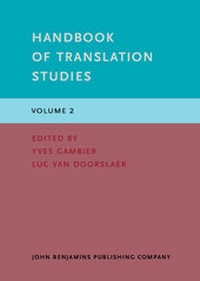
Handbook of Translation Studies
Volume 2
Published on 21. December 2011
Book
Hardback
197 pages
978-90-272-0332-8 (ISBN)
Description
As a meaningful manifestation of how institutionalized the discipline has become, the new Handbook of Translation Studies is most welcome. It joins the other signs of maturation such as Summer Schools, the development of academic curricula, historical surveys, journals, book series, textbooks, terminologies, bibliographies and encyclopedias.
The HTS aims at disseminating knowledge about translation and interpreting and providing easy access to a large range of topics, traditions, and methods to a relatively broad audience: not only students who often adamantly prefer such user-friendliness, researchers and lecturers in Translation Studies, Translation & Interpreting professionals; but also scholars and experts from other disciplines (among which linguistics, sociology, history, psychology). In addition the HTS addresses any of those with a professional or personal interest in the problems of translation, interpreting, localization, editing, etc., such as communication specialists, journalists, literary critics, editors, public servants, business managers, (intercultural) organization specialists, media specialists, marketing professionals.
The usability, accessibility and flexibility of the HTS depend on the commitment of people who agree that Translation Studies does matter. All users are therefore invited to share their feedback. Any questions, remarks and suggestions for improvement can be sent to the editorial team at hts@kuleuven.be.
Next to the book edition (in printed and electronic, PDF, format), HTS is also available as an online resource, connected with the Translation Studies Bibliography. For access to the Handbook of Translation Studies Online, please visit http://www.benjamins.com/online/hts/
The HTS aims at disseminating knowledge about translation and interpreting and providing easy access to a large range of topics, traditions, and methods to a relatively broad audience: not only students who often adamantly prefer such user-friendliness, researchers and lecturers in Translation Studies, Translation & Interpreting professionals; but also scholars and experts from other disciplines (among which linguistics, sociology, history, psychology). In addition the HTS addresses any of those with a professional or personal interest in the problems of translation, interpreting, localization, editing, etc., such as communication specialists, journalists, literary critics, editors, public servants, business managers, (intercultural) organization specialists, media specialists, marketing professionals.
The usability, accessibility and flexibility of the HTS depend on the commitment of people who agree that Translation Studies does matter. All users are therefore invited to share their feedback. Any questions, remarks and suggestions for improvement can be sent to the editorial team at hts@kuleuven.be.
Next to the book edition (in printed and electronic, PDF, format), HTS is also available as an online resource, connected with the Translation Studies Bibliography. For access to the Handbook of Translation Studies Online, please visit http://www.benjamins.com/online/hts/
More details
Series
Language
English
Place of publication
Amsterdam
Netherlands
Target group
Professional and scholarly
College/higher education
Dimensions
Height: 245 mm
Width: 174 mm
Weight
560 gr
ISBN-13
978-90-272-0332-8 (9789027203328)
Copyright in bibliographic data and cover images is held by Nielsen Book Services Limited or by the publishers or by their respective licensors: all rights reserved.
Schweitzer Classification
Other editions
Additional editions
E-Book
12/2011
1st Edition
John Benjamins Publishing Company
€112.99
Available for download
Persons
Content
1. Introduction; 2. Advertising translation (by Valdes, Cristina); 3. Agents of translation (by Buzelin, Helene); 4. Bibliographies of translation studies (by van Doorslaer, Luc); 5. Collaborative translation (by O'Brien, Sharon); 6. Comparative approaches to translation (by Koster, Cees); 7. Cultural approaches (by Marinetti, Cristina); 8. Deconstruction (by Dizdar, Dilek); 9. Directionality (by Pokorn, Nike K.); 10. Domestication and foreignization (by Paloposki, Outi); 11. Evaluation/Assessment (by Colina, Sonia); 12. Hybridity and translation (by Simon, Sherry); 13. Institutional translation (by Koskinen, Kaisa); 14. Linguistics and translation (by Malmkjaer, Kirsten); 15. Literary translation (by Delabastita, Dirk); 16. Medical translation and interpreting (by Montalt, Vicent); 17. Metaphors for translation (by St. Andre, James); 18. Methodology in Translation Studies (by Flynn, Peter); 19. Minority languages and translation (by Branchadell, Albert); 20. Natural translator and interpreter (by Antonini, Rachele); 21. Neurolinguistics and interpreting (by Ahrens, Barbara); 22. Orality and translation (by Bandia, Paul); 23. Paratexts (by Tahir Gurcaglar, Sehnaz); 24. Poetry translation (by Jones, Francis R.); 25. Pseudotranslation (by O'Sullivan, Carol); 26. Realia (by Leppihalme, Ritva); 27. Remote interpreting (by Moser-Mercer, Barbara); 28. Revision (by Mossop, Brian); 29. Status of interpreters (by Wadensjo, Cecilia); 30. Status of translators (by Katan, David); 31. Stylistics and translation (by Boase-Beier, Jean); 32. Theory of translatorial action (by Schaffner, Christina); 33. Translation policy (by Meylaerts, Reine); 34. Translation problem (by Toury, Gideon); 35. Translation universals (by Chesterman, Andrew); 36. Wordplay in translation (by Vandaele, Jeroen); 37. Subject index