

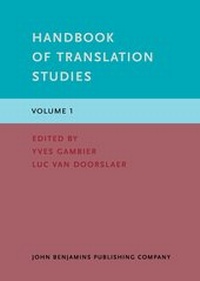
Handbook of Translation Studies
Volume 1
Published on 28. October 2010
Book
Hardback
468 pages
978-90-272-0331-1 (ISBN)
Description
As a meaningful manifestation of how institutionalized the discipline has become, the new Handbook of Translation Studies is most welcome. It joins the other signs of maturation such as Summer Schools, the development of academic curricula, historical surveys, journals, book series, textbooks, terminologies, bibliographies and encyclopedias.
The HTS aims at disseminating knowledge about translation and interpreting and providing easy access to a large range of topics, traditions, and methods to a relatively broad audience: not only students who often adamantly prefer such user-friendliness, researchers and lecturers in Translation Studies, Translation & Interpreting professionals; but also scholars and experts from other disciplines (among which linguistics, sociology, history, psychology). In addition the HTS addresses any of those with a professional or personal interest in the problems of translation, interpreting, localization, editing, etc., such as communication specialists, journalists, literary critics, editors, public servants, business managers, (intercultural) organization specialists, media specialists, marketing professionals.
The usability, accessibility and flexibility of the HTS depend on the commitment of people who agree that Translation Studies does matter. All users are therefore invited to share their feedback. Any questions, remarks and suggestions for improvement can be sent to the editorial team at hts@kuleuven.be.
Next to the book edition (in printed and electronic, PDF, format), HTS is also available as an online resource, connected with the Translation Studies Bibliography. For access to the Handbook of Translation Studies Online, please visit http://www.benjamins.com/online/hts/ .
The HTS aims at disseminating knowledge about translation and interpreting and providing easy access to a large range of topics, traditions, and methods to a relatively broad audience: not only students who often adamantly prefer such user-friendliness, researchers and lecturers in Translation Studies, Translation & Interpreting professionals; but also scholars and experts from other disciplines (among which linguistics, sociology, history, psychology). In addition the HTS addresses any of those with a professional or personal interest in the problems of translation, interpreting, localization, editing, etc., such as communication specialists, journalists, literary critics, editors, public servants, business managers, (intercultural) organization specialists, media specialists, marketing professionals.
The usability, accessibility and flexibility of the HTS depend on the commitment of people who agree that Translation Studies does matter. All users are therefore invited to share their feedback. Any questions, remarks and suggestions for improvement can be sent to the editorial team at hts@kuleuven.be.
Next to the book edition (in printed and electronic, PDF, format), HTS is also available as an online resource, connected with the Translation Studies Bibliography. For access to the Handbook of Translation Studies Online, please visit http://www.benjamins.com/online/hts/ .
More details
Series
Language
English
Place of publication
Amsterdam
Netherlands
Target group
Professional and scholarly
Dimensions
Height: 245 mm
Width: 174 mm
Weight
1055 gr
ISBN-13
978-90-272-0331-1 (9789027203311)
Copyright in bibliographic data and cover images is held by Nielsen Book Services Limited or by the publishers or by their respective licensors: all rights reserved.
Schweitzer Classification
Other editions
Additional editions
E-Book
10/2010
1st Edition
John Benjamins Publishing Company
€130.99
Available for download
Persons
Content
1. Introduction; 2. Adaptation (by Milton, John); 3. Applied Translation Studies (by Rabadan, Rosa); 4. Audiovisual translation (by Remael, Aline); 5. Censorship (by Merkle, Denise); 6. Children's literature and translation (by Alvstad, Cecilia); 7. Cognitive approaches (by Alves, Fabio); 8. Comics in translation (by Kaindl, Klaus); 9. Commercial translation (by Olohan, Maeve); 10. Committed approaches and activism (by Brownlie, Siobhan); 11. Community interpreting (by Hertog, Erik); 12. Competence (by Hurtado Albir, Amparo); 13. Computer-aided translation (by Bowker, Lynne); 14. Conference interpreting (by Setton, Robin); 15. Consecutive interpreting (by Dam, Helle V.); 16. Corpora (by Laviosa, Sara); 17. Curriculum (by Kelly, Dorothy); 18. Descriptive Translation Studies (DTS) (by Assis Rosa, Alexandra); 19. Drama translation (by Aaltonen, Sirkku); 20. Ethics and translation (by Wyke, Ben Van); 21. Ethnographic approaches (by Flynn, Peter); 22. Functionalist approaches (by Nord, Christiane); 23. Gender in translation (by Flotow, Luise von); 24. Globalization and translation (by Cronin, Michael); 25. Hermeneutics and translation (by Stolze, Radegundis); 26. Humor in translation (by Vandaele, Jeroen); 27. Interpreting (by Pochhacker, Franz); 28. Interpreting Studies (by Pochhacker, Franz); 29. Interpretive approach (by Lederer, Marianne); 30. Journalism and translation (by van Doorslaer, Luc); 31. Language learning and translation (by Malmkjaer, Kirsten); 32. Legal translation (by Cao, Deborah); 33. Literary Studies and Translation Studies (by Delabastita, Dirk); 34. Localization and translation (by Schaler, Reinhard); 35. Machine translation today (by Forcada, Mikel L.); 36. Media interpreting (by Pochhacker, Franz); 37. Multilingualism and translation (by Meylaerts, Reine); 38. Networking and volunteer translators (by Folaron, Deborah A.); 39. Norms of translation (by Schaffner, Christina); 40. Overt and covert translation (by House, Juliane); 41. Philosophy and translation (by Arrojo, Rosemary); 42. Political translation (by Gagnon, Chantal); 43. Polysystem theory and translation (by Chang, Nam Fung); 44. Post-colonial literatures and translation (by Bandia, Paul); 45. Quality in translation (by Gouadec, Daniel); 46. Relay interpreting (by Shlesinger, Miriam); 47. Relevance and translation (by Alves, Fabio); 48. Religious translation (by Naude, Jacobus A.); 49. Retranslation (by Koskinen, Kaisa); 50. Scientific translation (by Montgomery, Scott L.); 51. Self-translation (by Montini, Chiara); 52. Semantic models and translation (by Kussmaul, Paul); 53. Semiotics and translation (by Stecconi, Ubaldo); 54. Sight translation (by Cenkova, Ivana); 55. Sign language interpreting and translating (by Leeson, Lorraine); 56. Simultaneous conference interpreting and technology (by Diriker, Ebru); 57. Simultaneous interpreting (by Russo, Mariachiara); 58. Sociology of translation (by Wolf, Michaela); 59. Subtitling (by Diaz Cintas, Jorge); 60. Technical translation (by Schubert, Klaus); 61. Terminology and translation (by Cabre Castellvi, M. Teresa); 62. The turns of Translation Studies (by Snell-Hornby, Mary); 63. Think-aloud protocol (by Jaaskelainen, Riitta); 64. Transfer and Transfer Studies (by Gopferich, Susanne); 65. Translation (by Halverson, Sandra L.); 66. Translation 'errors' (by Hansen, Gyde); 67. Translation didactics (by Kelly, Dorothy); 68. Translation history (by D'hulst, Lieven); 69. Translation process (by Englund Dimitrova, Birgitta); 70. Translation strategies and tactics (by Gambier, Yves); 71. Translation Studies (by Munday, Jeremy); 72. Translation tools (by Folaron, Deborah A.); 73. Unit of translation (by Ballard, Michel); 74. Voiceover and dubbing (by Diaz Cintas, Jorge); 75. Web and translation (by Folaron, Deborah A.)