

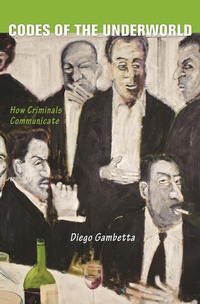
Codes of the Underworld
How Criminals Communicate
Published on 7. August 2011
Book
Paperback/Softback
368 pages
978-0-691-15247-9 (ISBN)
Description
How do criminals communicate with each other? Unlike the rest of us, people planning crimes can't freely advertise their goods and services, nor can they rely on formal institutions to settle disputes and certify quality. They face uniquely intense dilemmas as they grapple with the basic problems of whom to trust, how to make themselves trusted, and how to handle information without being detected by rivals or police. In this book, one of the world's leading scholars of the mafia ranges from ancient Rome to the gangs of modern Japan, from the prisons of Western countries to terrorist and pedophile rings, to explain how despite these constraints, many criminals successfully stay in business. Diego Gambetta shows that as villains balance the lure of criminal reward against the fear of dire punishment, they are inspired to unexpected feats of subtlety and ingenuity in communication.
He uncovers the logic of the often bizarre ways in which inveterate and occasional criminals solve their dilemmas, such as why the tattoos and scars etched on a criminal's body function as lines on a professional resume, why inmates resort to violence to establish their position in the prison pecking order, and why mobsters are partial to nicknames and imitate the behavior they see in mafia movies. Even deliberate self-harm and the disclosure of their crimes are strategically employed by criminals to convey important messages. By deciphering how criminals signal to each other in a lawless universe, this gruesomely entertaining and incisive book provides a quantum leap in our ability to make sense of their actions.
He uncovers the logic of the often bizarre ways in which inveterate and occasional criminals solve their dilemmas, such as why the tattoos and scars etched on a criminal's body function as lines on a professional resume, why inmates resort to violence to establish their position in the prison pecking order, and why mobsters are partial to nicknames and imitate the behavior they see in mafia movies. Even deliberate self-harm and the disclosure of their crimes are strategically employed by criminals to convey important messages. By deciphering how criminals signal to each other in a lawless universe, this gruesomely entertaining and incisive book provides a quantum leap in our ability to make sense of their actions.
Reviews / Votes
Winner of the 2010 Dorothy Lee Award for Outstanding Scholarship in the Ecology of Culture, Media Ecology Association One of New Scientist blog's Best Books for 2009 Winner of the 2009 PROSE Award in Sociology and Social Work, Association of American Publishers "Criminals can't advertise their products on QVC, yet the mafia and the yakuza have prospered longer than most Fortune 500 companies. In Codes of the Underworld, sociologist Diego Gambetta examines how criminals communicate without being caught, how they build trust in a world where everyone is crooked... odes of the Underworld is colourful and engrossing: it could appeal to policymakers, academics, laymen or, God forbid, criminals looking to improve their game."--Spectator "[A]n absolutely fascinating look at the unique problems criminals face when trying to communicate with one another... Fans of crime fiction will love this."--Graham Lawton, NewScientist.com's CultureLab blog "'A wiseguy sees things if there are wiseguy things to see,' wrote Joe Pistone, the FBI agent better known as Donnie Brasco--the name under which he managed to infiltrate the mob. But what are the wiseguy things to see? And how is a wiseguy to know he isn't dealing with the likes of Joe Pistone? Such questions are among those that fascinate Diego Gambetta. Professor Gambetta, an Italian sociologist based at Oxford University, has managed to wrap himself in the language of economics as capably as Pistone wrapped himself in the language of organised crime. Gambetta is an authority on the Sicilian mafia, but deploys the tools of an economist to understand them and other criminals."--Tim Harford, Financial Times "Criminals are in constant fear of being duped, says Diego Gambetta, even as they are busy duping others. Yet hoodlums often seek a literal partner in crime. This, he notes, creates a need for both identification and verification of trust in what is generally an untrustworthy milieu. Lacking a miscreants' yellow page, the question becomes, well, how to find an honest crook? Such concerns pervade Codes of the Underworld, a new book by Gambetta, a professor of sociology at the University of Oxford."--Nina Ayoub, Chronicle of Higher Education "[T]he best applied book on signaling theory to date."--Tyler Cowen, Marginal Revolution "In Codes of the Underworld, the Oxford sociologist Diego Gambetta uses colorful stories and a minimum of jargon in his quest to analyze how people advertise when their business happens to be illegal... Gambettta sets out to illuminate the world inhabited by these face-tattooed, duel-scarred, razor-brandishing inmates. The result is a book that explains the hidden logic of their behavior in language intelligible to those of us who make it a point to seer clear of both well-armed dictators and well-decorated Mafiosi."--Katherine Mangu-Ward, Reason "[A]n absolutely fascinating look at the unique problems criminals face when trying to communicate with one another--how, for example, do you advertise for a partner in crime, or win trust in an inherently untrustworthy world?--and the ingenious ways they solve them... Fans of crime fiction will love this."--Graham Lawton, NewScientist.com's CultureLab blog "[I]lluminating."--The AgeMore details
Language
English
Place of publication
New Jersey
United States
Target group
Professional and scholarly
Product notice
Paperback (trade)
Illustrations
5 line illus. 3 tables.
Dimensions
Height: 233 mm
Width: 156 mm
Thickness: 25 mm
Weight
528 gr
ISBN-13
978-0-691-15247-9 (9780691152479)
Copyright in bibliographic data and cover images is held by Nielsen Book Services Limited or by the publishers or by their respective licensors: all rights reserved.
Schweitzer Classification
Other editions
Additional editions
E-Book
05/2019
1st Edition
Princeton University Press
€26.99
Available for download

Book
08/2009
Princeton University Press
€47.04
Article exhausted; check different version
Person
Diego Gambetta is Official Fellow of Nuffield College and professor of sociology at the University of Oxford. He is the author of "The Sicilian Mafia: The Business of Private Protection" and editor of "Making Sense of Suicide Missions".
Content
Acknowledgments vii Introduction ix Abbreviations xxiii PART I: costly signals Chapter 1: Criminal Credentials 3 Chapter 2: The Power of Limits 30 Chapter 3: Information as Hostage 54 Chapter 4: Why Prisoners Fight (and Signal) 78 Chapter 5: Self-harm as a Signal 111 PART II: conventional signals Chapter 6: Conventional and Iconic Signals 149 Chapter 7: Protecting Easy-to-Fake Signals 174 Chapter 8: Criminal Trademarks 195 Chapter 9: Nicknames 230 Chapter 10: Why (Low) Life Imitates Art 251 Notes 275 Bibliography 313 Index 327