

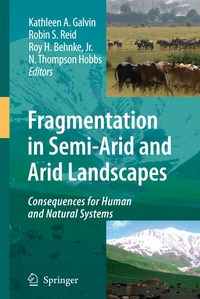
Fragmentation in Semi-Arid and Arid Landscapes
Consequences for Human and Natural Systems
Published on 19. October 2010
Book
Paperback/Softback
XVII, 411 pages
978-90-481-7223-8 (ISBN)
Description
Casual readers of the title of this book might be forgiven for thinking that it is a little esoteric, far-removed from the pressing day-to-day concerns of humans and wildlife in the drylands of the world. But they could not be more wrong. It addresses an issue of the utmost practical importance in the world today, yet does so on the basis of exciting new theory about how the world operates. Of the billion or so human beings who now live in the world's arid and semi-arid lands, a majority depend on natural resources for their livelihoods. These natural resources include livestock and their forage, as well as the wild biota that creates opportunities for tourism or subsistence harvesting. Arid and semi-arid lands are spread over a third of the world's land surface, from Colorado to the Kalahari, the Sahel to the Simpson, the Altai Steppe to Amboseli. Notwithstanding their diversity, these lands are broadly cha- cterised by low productivity, management at large scales, and great climate variability - in short, by high spatial and temporal heterogeneity. This book is about the implications of that high spatial and temporal heterogeneity for life, management and policy in arid and semi-arid lands.
More details
Edition
1st ed. Softcover of orig. ed. 2008
Language
English
Place of publication
Dordrecht
Netherlands
Target group
Professional and scholarly
Professional/practitioner
Illustrations
XVII, 411 p.
Dimensions
Height: 235 mm
Width: 155 mm
Thickness: 24 mm
Weight
657 gr
ISBN-13
978-90-481-7223-8 (9789048172238)
DOI
10.1007/978-1-4020-4906-4
Schweitzer Classification
Other editions
Additional editions
Kathleen A. Galvin | Robin S. Reid | Jr. Behnke
Fragmentation in Semi-Arid and Arid Landscapes
Consequences for Human and Natural Systems
Book
10/2007
Springer
€160.49
Shipment within 15-20 days
Kathleen A. Galvin | Robin S. Reid | Roy H. Behnke, Jr.
Fragmentation in Semi-Arid and Arid Landscapes
Consequences for Human and Natural Systems
E-Book
10/2007
Springer
€149.79
Available for download
Content
and Framework.- Global Significance of Extensive Grazing Lands and Pastoral Societies: An Introduction.- Fragmentation of Arid and Semi-Arid Ecosystems: Implications for People and Animals.- Causes and Consequences of Herbivore Movement in Landscape Ecosystems.- Case Studies.- Changing Patterns of Land Use and Tenure in the Dalrymple Shire, Australia.- From Fragmentation to Reaggregation of Rangelands in the Northern Great Plains, USA.- Land Use, Fragmentation, and Impacts on Wildlife in Jackson Valley, Wyoming, USA.- Ideology, Land Tenure and Livestock Mobility in Kazakhstan.- Policy Changes in Mongolia: Implications for Land Use and Landscapes.- Fragmentation of a Peri-Urban Savanna, Athi-Kaputiei Plains, Kenya.- Processes of Fragmentation in the Amboseli Ecosystem, Southern Kajiado District, Kenya.- Ngorongoro Conservation Area, Tanzania: Fragmentation of a Unique Region of the Greater Serengeti Ecosystem.- North-West Province, South Africa: Communal and Commercial Livestock Systems in Transition.- Issues Of Fragmentation And Complexity: A Synthetic Perspective.- The Drivers of Fragmentation in Arid and Semi-Arid Landscapes.- Comparing Landscape and Infrastructural Heterogeneity within and between Ecosystems.- Responses of Pastoralists to Land Fragmentation: Social Capital, Connectivity and Resilience.