

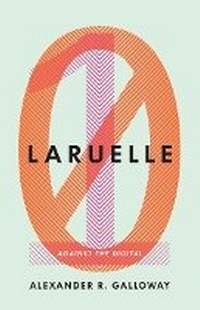
Laruelle
Against the Digital
Will be published approx. on 1. October 2014
Book
Hardback
304 pages
978-0-8166-9212-5 (ISBN)
Description
Laruelle is one of the first books in English to undertake in an extended critical survey of the work of the idiosyncratic French thinker FranCois Laruelle, the promulgator of non-standard philosophy. Laruelle, who was born in 1937, has recently gained widespread recognition, and Alexander R. Galloway suggests that readers may benefit from colliding Laruelle's concept of the One with its binary counterpart, the Zero, to explore more fully the relationship between philosophy and the digital.
In Laruelle, Galloway argues that the digital is a philosophical concept and not simply a technical one, employing a detailed analysis of Laruelle to build this case while referencing other thinkers in the French and Continental traditions, including Alain Badiou, Gilles Deleuze, Martin Heidegger, and Immanuel Kant. In order to explain clearly Laruelle's concepts such as the philosophical decision and the principle of sufficient philosophy, Galloway lays a broad foundation with his discussions of "the One" as it has developed in continental philosophy, the standard model of philosophy, and how philosophers view "the digital."
Digital machines dominate today's world, while so-called digital thinking-that is, binary thinking such as presence and absence or self and world-is often synonymous with what it means to think at all. In examining Laruelle and digitality together, Galloway shows how Laruelle remains a profoundly non-digital thinker-perhaps the only non-digital thinker today-and engages in an extensive discussion on the interconnections between media, philosophy, and technology.
In Laruelle, Galloway argues that the digital is a philosophical concept and not simply a technical one, employing a detailed analysis of Laruelle to build this case while referencing other thinkers in the French and Continental traditions, including Alain Badiou, Gilles Deleuze, Martin Heidegger, and Immanuel Kant. In order to explain clearly Laruelle's concepts such as the philosophical decision and the principle of sufficient philosophy, Galloway lays a broad foundation with his discussions of "the One" as it has developed in continental philosophy, the standard model of philosophy, and how philosophers view "the digital."
Digital machines dominate today's world, while so-called digital thinking-that is, binary thinking such as presence and absence or self and world-is often synonymous with what it means to think at all. In examining Laruelle and digitality together, Galloway shows how Laruelle remains a profoundly non-digital thinker-perhaps the only non-digital thinker today-and engages in an extensive discussion on the interconnections between media, philosophy, and technology.
Reviews / Votes
"Laruelle: Against the Digital is a compelling read for any form of investigations in today's conditions of power, aesthetics, and thought. Alexander R. Galloway's lucid writing takes us on a thrilling journey into the details of Laruelle's uncompromising thought of the One. It offers us challengingly fresh material for developing a non-representational view of computers, capitalism, art and ethics. Galloway's profound critique of the discrete is an unmissable intervention into the thought of the digital today." -Luciana Parisi, Goldsmiths University of London "This daring and original treatise outlines an anti-dialectical, analog, generic, utopian, and static 'last philosophy' that affirms a new ethic of the one against a logic of capital and of the digital. Galloway positions his stunning synthesis of Laruelle's thought provocatively alongside yet at odds with Deleuze, Badiou, Heidegger, Levinas, and Henry." -Eleanor Kaufman, UCLAMore details
Series
Language
English
Place of publication
Minnesota
United States
Target group
Professional and scholarly
Illustrations
17
Dimensions
Height: 216 mm
Width: 140 mm
Thickness: 38 mm
ISBN-13
978-0-8166-9212-5 (9780816692125)
Copyright in bibliographic data and cover images is held by Nielsen Book Services Limited or by the publishers or by their respective licensors: all rights reserved.
Schweitzer Classification
Person
Alexander Galloway is professor of media, culture, and communication at New York University. His many books include The Interface Effect and The Exploit: A Theory of Networks (Minnesota, 2007).
Content
Contents
Preface
Introduction: The Oldest Prejudice
Part I. Laruelle and the Digital
1. The One Divides in Two
2. The Standard Model
3. The Digital
4. Events
Part II. Withdrawing from the Standard Model
5. Computers
6. Capitalism
7. The Black Universe
8. Art and Utopia
9. Ethics
10. The Generic
Conclusion: From Digitality to Destiny
Acknowledgments
Notes
Index
Preface
Introduction: The Oldest Prejudice
Part I. Laruelle and the Digital
1. The One Divides in Two
2. The Standard Model
3. The Digital
4. Events
Part II. Withdrawing from the Standard Model
5. Computers
6. Capitalism
7. The Black Universe
8. Art and Utopia
9. Ethics
10. The Generic
Conclusion: From Digitality to Destiny
Acknowledgments
Notes
Index