

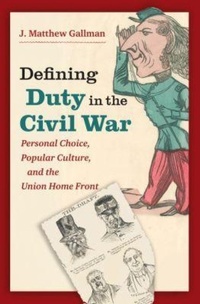
Defining Duty in the Civil War
Personal Choice, Popular Culture, and the Union Home Front
Will be published approx. on 1. February 2017
Book
Paperback/Softback
336 pages
978-1-4696-3341-1 (ISBN)
Description
The Civil War thrust Americans onto unfamiliar terrain, as two competing societies mobilized for four years of bloody conflict. Concerned Northerners turned to the print media for guidance on how to be good citizens in a war that hit close to home but was fought hundreds of miles away. They read novels, short stories, poems, songs, editorials, and newspaper stories. They laughed at cartoons and satirical essays. Their spirits were stirred in response to recruiting broadsides and patriotic envelopes. This massive cultural outpouring offered a path for ordinary Americans casting around for direction.
Examining the breadth of Northern popular culture, J. Matthew Gallman offers a dramatic reconsideration of how the Union's civilians understood the meaning of duty and citizenship in wartime. Although a huge percentage of military-aged men served in the Union army, a larger group chose to stay home, even while they supported the war. This pathbreaking study investigates how men and women, both white and black, understood their roles in the People's Conflict. Wartime culture created humorous and angry stereotypes ridiculing the nation's cowards, crooks, and fools, while wrestling with the challenges faced by ordinary Americans. Gallman shows how thousands of authors, artists, and readers together created a new set of rules for navigating life in a nation at war.
Examining the breadth of Northern popular culture, J. Matthew Gallman offers a dramatic reconsideration of how the Union's civilians understood the meaning of duty and citizenship in wartime. Although a huge percentage of military-aged men served in the Union army, a larger group chose to stay home, even while they supported the war. This pathbreaking study investigates how men and women, both white and black, understood their roles in the People's Conflict. Wartime culture created humorous and angry stereotypes ridiculing the nation's cowards, crooks, and fools, while wrestling with the challenges faced by ordinary Americans. Gallman shows how thousands of authors, artists, and readers together created a new set of rules for navigating life in a nation at war.
Reviews / Votes
I highly recommend this book to anyone interested in the American Civil War. I say that because this book handles some of the issues of the home front unlike any book I have read before. . . . His research is phenomenal, his writing is engaging, and the reader is never left confused."" - Matthew Bartlett, Gettysburg ChronicleInvestigates how the folks back home . . . came to understand their proper social roles in the 'People's Conflict' through the print media. . . . Well-researched and well-presented.- Journal of American History
Both an enjoyable read and one that expands our understanding of the public discourses occurring on the Union home front. - Journal of Military History
A splendid book. Gallman is a shrewd historian. - Civil War Monitor
Recommended. - Choice
A lavishly illustrated, persuasively argued treatment of Northern popular culture during the Civil War. - The Annals of Iowa
More details
Series
Language
English
Place of publication
Chapel Hill
United States
Product notice
Paperback (trade)
Unsewn / adhesive bound
Illustrations
69 halftones
Dimensions
Height: 236 mm
Width: 160 mm
Thickness: 19 mm
Weight
485 gr
ISBN-13
978-1-4696-3341-1 (9781469633411)
Copyright in bibliographic data and cover images is held by Nielsen Book Services Limited or by the publishers or by their respective licensors: all rights reserved.
Schweitzer Classification
Other editions
Additional editions
J. Matthew Gallman
Defining Duty in the Civil War
Personal Choice, Popular Culture, and the Union Home Front
E-Book
05/2015
The University of North Carolina Press
€19.49
Available for download
Person
J. Matthew Gallman is a professor of history at the University of Florida and the author of Receiving Erin's Children: Philadelphia, Liverpool and the Irish Famine Migration, 1845-1855.