

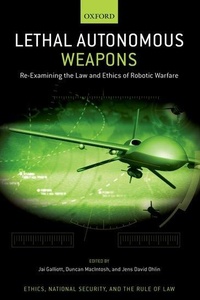
Lethal Autonomous Weapons
Re-Examining the Law and Ethics of Robotic Warfare
Published on 15. April 2021
Book
Hardback
320 pages
978-0-19-754604-8 (ISBN)
Description
The question of whether new rules or regulations are required to govern, restrict, or even prohibit the use of autonomous weapon systems has been the subject of debate for the better part of a decade. Despite the claims of advocacy groups, the way ahead remains unclear since the international community has yet to agree on a specific definition of Lethal Autonomous Weapon Systems and the great powers have largely refused to support an effective ban. In this vacuum, the public has been presented with a heavily one-sided view of Killer Robots.
This volume presents a more nuanced approach to autonomous weapon systems that recognizes the need to progress beyond a discourse framed by the Terminator and HAL 9000. Re-shaping the discussion around this emerging military innovation requires a new line of thought and a willingness to challenge the orthodoxy.
Lethal Autonomous Weapons focuses on exploring the moral and legal issues associated with the design, development and deployment of lethal autonomous weapons. In this volume, we bring together some of the most prominent academics and academic-practitioners in the lethal autonomous weapons space and seek to return some balance to the debate. As part of this effort, we recognize that society needs to invest in hard conversations that tackle the ethics, morality, and law of these new digital technologies and understand the human role in their creation and operation.
This volume presents a more nuanced approach to autonomous weapon systems that recognizes the need to progress beyond a discourse framed by the Terminator and HAL 9000. Re-shaping the discussion around this emerging military innovation requires a new line of thought and a willingness to challenge the orthodoxy.
Lethal Autonomous Weapons focuses on exploring the moral and legal issues associated with the design, development and deployment of lethal autonomous weapons. In this volume, we bring together some of the most prominent academics and academic-practitioners in the lethal autonomous weapons space and seek to return some balance to the debate. As part of this effort, we recognize that society needs to invest in hard conversations that tackle the ethics, morality, and law of these new digital technologies and understand the human role in their creation and operation.
More details
Series
Language
English
Place of publication
New York
United States
Target group
College/higher education
Product notice
sewn/stitched
Cloth over boards
Dimensions
Height: 236 mm
Width: 155 mm
Thickness: 28 mm
Weight
612 gr
ISBN-13
978-0-19-754604-8 (9780197546048)
Copyright in bibliographic data and cover images is held by Nielsen Book Services Limited or by the publishers or by their respective licensors: all rights reserved.
Schweitzer Classification
Other editions
Additional editions
Jai Galliott | Duncan MacIntosh | Jens David Ohlin
Lethal Autonomous Weapons
Re-Examining the Law and Ethics of Robotic Warfare
E-Book
11/2020
1st Edition
OUP eBook
€73.99
Available for download
Jai Galliott | Duncan MacIntosh | Jens David Ohlin
Lethal Autonomous Weapons
Re-Examining the Law and Ethics of Robotic Warfare
E-Book
11/2020
1st Edition
OUP eBook
€73.99
Available for download
Persons
Jai Galliott is Director of the Values in Defence & Security Technology Group at the Australian Defence Force Academy, Non-Residential Fellow at the Modern War Institute at the United States Military Academy, West Point and Visiting Fellow in The Centre for Technology and Global Affairs at the University of Oxford. Dr Galliott has developed a reputation as one of the foremost experts on the socio-ethical implications of artificial intelligence (AI) and is regarded as an internationally respected scholar on the ethical, legal and strategic issues associated with the employment of emerging technologies, including cyber systems, autonomous vehicles and soldier augmentation
Duncan MacIntosh is a Professor of Philosophy and Department Chair at Dalhousie University. Professor MacIntosh works in metaethics, decision and action theory, metaphysics, philosophy of language, epistemology, and philosophy of science. He has written on desire-based theories of rationality, the relationship between
rationality and time, the reducibility of morality to rationality, modeling morality and rationality with the tools of action and game theory, scientific realism, and a number of other topics.
Jens David Ohlin is Professor of Law and Associate Dean for Academic Affairs at Cornell Law School. He specializes in international law and criminal law. He specifically focuses on the laws of war with special emphasis on the effects of new technology on the waging of warfare, including unmanned drones in the strategy of targeted killings, cyber-warfare, and the role of non-state actors in armed conflicts. He authored The Assault on International Law (2015).
Duncan MacIntosh is a Professor of Philosophy and Department Chair at Dalhousie University. Professor MacIntosh works in metaethics, decision and action theory, metaphysics, philosophy of language, epistemology, and philosophy of science. He has written on desire-based theories of rationality, the relationship between
rationality and time, the reducibility of morality to rationality, modeling morality and rationality with the tools of action and game theory, scientific realism, and a number of other topics.
Jens David Ohlin is Professor of Law and Associate Dean for Academic Affairs at Cornell Law School. He specializes in international law and criminal law. He specifically focuses on the laws of war with special emphasis on the effects of new technology on the waging of warfare, including unmanned drones in the strategy of targeted killings, cyber-warfare, and the role of non-state actors in armed conflicts. He authored The Assault on International Law (2015).
Editor
Senior Lecturer and Research Leader, Values in Defense & Security Technology GroupSenior Lecturer and Research Leader, Values in Defense & Security Technology Group, Australian Defence Force Academy
Professor of PhilosophyProfessor of Philosophy, Dalhousie University
Vice Dean, Professor of LawVice Dean, Professor of Law, Cornell Law School
Content
Introduction
List of Contributors The Case for Lethal Autonomous Weapons Chapter One: Fire and Forget: A Moral Defense of the Use of Autonomous Weapons Systems in War and Peace
Duncan MacIntosh
Chapter Two: The Robot Dogs of War
Deane-Peter Baker
Chapter Three: Understanding AI & Autonomy: Problematizing the Meaningful Human Control Argument Against Killer Robots
Tim McFarland & Jai Galliott
Chapter Four: The Humanitarian Imperative For Minimally-Just AI In Weapons
Jason Scholz and Jai Galliott Humans, Robots & Values Chapter Five: Programming Precision? Requiring Robust Transparency for AWS
Steven J. Barela & Avery Plaw
Chapter Six: May Machines Take Lives to Save Lives? Human Perceptions of Autonomous Robots (with the Capacity to Kill)
Matthias Scheutz and Bertram F. Malle
Chapter Seven: The Better Instincts of Humanity: Humanitarian Arguments in Defense of International Arms Control Natalia Jevglevskaja and Rain Liivoja
Chapter Eight: Toward a Positive Statement of Ethical Principles for Military AI
Jai Galliott
Chapter Nine: Empirical Data on Attitudes Towards Autonomous Systems
Jai Galliott, Bianca Baggiarini, Sean Rupka The Rationality of Automaticity Chapter Ten: The Automation of Authority: Discrepancies with Jus Ad Bellum Principles
Donovan Phillips
Chapter Eleven: Autonomous Weapons and the Future of Armed Conflict Alex Leveringhaus Chapter Twelve: Autonomous Weapons and Reactive Attitudes
Jens David Ohlin
Chapter Thirteen: Blind brains and moral machines: neuroscience and autonomous weapon systems
Nicholas G. Evans Developing Meaningful Human Control Chapter Fourteen: Enforced Transparency: A Solution to Autonomous Weapons as Potentially Uncontrollable Weapons Similar to Bioweapons
Armin Krishnan
Chapter 15: Normative Epistemology for Lethal Autonomous Weapons Systems
Kate Devitt
Chapter Sixteen: Proposing a regional normative framework for limiting the potential for unintentional or escalatory engagements with increasingly autonomous weapon systems.
Austin Wyatt and Jai Galliott
Chapter Seventeen: The Human Role in Autonomous Weapon Design and Deployment
M.L. Cummings
List of Contributors The Case for Lethal Autonomous Weapons Chapter One: Fire and Forget: A Moral Defense of the Use of Autonomous Weapons Systems in War and Peace
Duncan MacIntosh
Chapter Two: The Robot Dogs of War
Deane-Peter Baker
Chapter Three: Understanding AI & Autonomy: Problematizing the Meaningful Human Control Argument Against Killer Robots
Tim McFarland & Jai Galliott
Chapter Four: The Humanitarian Imperative For Minimally-Just AI In Weapons
Jason Scholz and Jai Galliott Humans, Robots & Values Chapter Five: Programming Precision? Requiring Robust Transparency for AWS
Steven J. Barela & Avery Plaw
Chapter Six: May Machines Take Lives to Save Lives? Human Perceptions of Autonomous Robots (with the Capacity to Kill)
Matthias Scheutz and Bertram F. Malle
Chapter Seven: The Better Instincts of Humanity: Humanitarian Arguments in Defense of International Arms Control Natalia Jevglevskaja and Rain Liivoja
Chapter Eight: Toward a Positive Statement of Ethical Principles for Military AI
Jai Galliott
Chapter Nine: Empirical Data on Attitudes Towards Autonomous Systems
Jai Galliott, Bianca Baggiarini, Sean Rupka The Rationality of Automaticity Chapter Ten: The Automation of Authority: Discrepancies with Jus Ad Bellum Principles
Donovan Phillips
Chapter Eleven: Autonomous Weapons and the Future of Armed Conflict Alex Leveringhaus Chapter Twelve: Autonomous Weapons and Reactive Attitudes
Jens David Ohlin
Chapter Thirteen: Blind brains and moral machines: neuroscience and autonomous weapon systems
Nicholas G. Evans Developing Meaningful Human Control Chapter Fourteen: Enforced Transparency: A Solution to Autonomous Weapons as Potentially Uncontrollable Weapons Similar to Bioweapons
Armin Krishnan
Chapter 15: Normative Epistemology for Lethal Autonomous Weapons Systems
Kate Devitt
Chapter Sixteen: Proposing a regional normative framework for limiting the potential for unintentional or escalatory engagements with increasingly autonomous weapon systems.
Austin Wyatt and Jai Galliott
Chapter Seventeen: The Human Role in Autonomous Weapon Design and Deployment
M.L. Cummings