

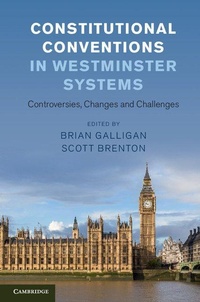
Constitutional Conventions in Westminster Systems
Controversies, Changes and Challenges
Published on 4. August 2015
Book
Hardback
288 pages
978-1-107-10024-4 (ISBN)
Description
Conventions are fundamental to the constitutional systems of parliamentary democracies. Unlike the United States which adopted a republican form of government, with a full separation of powers, codified constitutional structures and limitations for executive and legislative institutions and actors, Britain and subsequently Canada, Australia and New Zealand have relied on conventions to perform similar functions. The rise of new political actors has disrupted the stability of the two-party system, and in seeking power the new players are challenging existing practices. Conventions that govern constitutional arrangements in Britain and New Zealand, and the executive in Canada and Australia, are changing to accommodate these and other challenges of modern governance. In Westminster democracies, constitutional conventions provide the rules for forming government; they precede law and make law-making possible. This prior and more fundamental realm of government formation and law making is shaped and structured by conventions.
Reviews / Votes
'... the scope and terrain of the material covered in the book is impressive (for example, the caretaker conventions chapter) and should provide a useful steer to further research using other cases across the subject terrains discussed (as well as possibly some that are not discussed such as conventions and courts).' Mark Shephard, Parliaments, Estates and RepresentationMore details
Language
English
Place of publication
Cambridge
United Kingdom
Target group
Professional and scholarly
Illustrations
2 Tables, black and white; 1 Line drawings, unspecified
Dimensions
Height: 235 mm
Width: 157 mm
Thickness: 20 mm
Weight
571 gr
ISBN-13
978-1-107-10024-4 (9781107100244)
Copyright in bibliographic data and cover images is held by Nielsen Book Services Limited or by the publishers or by their respective licensors: all rights reserved.
Schweitzer Classification
Other editions
Additional editions
Brian Galligan | Scott Brenton
Constitutional Conventions in Westminster Systems
Controversies, Changes and Challenges
E-Book
08/2016
Cambridge University Press
€94.99
Available for download
Brian Galligan
Constitutional Conventions in Westminster Systems
Controversies, Changes and Challenges
E-Book
08/2015
Cambridge University Press
€79.99
Available for download
Persons
Brian Galligan is a Professor of Political Science at the University of Melbourne. He is the author or co-author of eight books on Australian politics and political economy, including: Beyond the Protective State (1992), A Federal Republic (1995), Citizens without Rights (1997) and Australians and Globalisation (2001). He is joint author of Australian Citizenship (2004) and Becoming Australian (2014) and co-editor of The Oxford Companion to Australian Politics (2007) and Human Rights in Asia (2011). Scott Brenton is a Lecturer in Political Science and the Director of the Doctoral Academy at the Melbourne School of Government. He has published extensively on Australian politics, particularly on altering traditional forms of governance and challenging, or rather adapting, existing conventions. He has contributed to several major Australian Research Council projects, including the Parliamentary Accountability Project, the Democratic Audit of Australia and Strengthening Parliamentary Institutions.
Content
Introduction Brian Galligan and Scott Brenton; 1. Constitutional conventions Brian Galligan and Scott Brenton; 2. Law and convention Nicholas Aroney; 3. Executive conventions Brian Galligan; 4. Cabinet government Patrick Weller; 5. Caretaker conventions Jenny Menzies and Anne Tiernan; 6. Minority and multi-party government Scott Brenton; 7. Parliament J. R. Nethercote; 8. Upper houses Campbell Sharman; 9. The United Kingdom Robert Hazell; 10. Canada Andrew C. Banfield; 11. Australia Nicholas Barry and Narelle Miragliotta; 12. New Zealand Grant Duncan; 13. Codifying conventions Peter H. Russell; 14. Constitutional reform Andrew Blick; Conclusion Brian Galligan and Scott Brenton.