

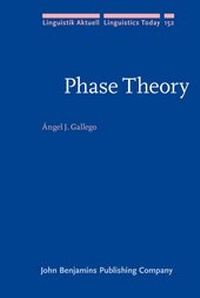
Phase Theory
Published on 8. April 2010
Book
Hardback
365 pages
978-90-272-5535-8 (ISBN)
Description
This book provides a detailed and up to date review of the framework of phases (Chomsky 2000 and subsequent work). It explores the interaction between the narrow syntactic computation and the external systems from a minimalist perspective. As has sometimes been noted, Phase Theory is the current way to study the cyclic nature of the system, and 'phases' are therefore the natural locality hallmark, being directly relevant for phenomena such as binding, agreement, movement, islands, reconstruction, or stress assignment. This work discusses the different approaches to phases that have been proposed in the recent literature, arguing in favor of the thesis that the points of cyclic transfer are to be related to uninterpretable morphology (the ?-features on the heads C and v*). This take on phases is adopted in order to investigate raising structures, binding, subjunctive dependents, and object shift (word order) in Romance languages, as well as the nature of islands.
Reviews / Votes
Phase Theory makes a valuable contribution to the theoretical literature, and Mininalis syntacticians of all levels of expertise will benefit from reading it. -- Luis Vicente, University of Potsdam, in Journal of Linguistics 47: 719-724, 2011More details
Series
Language
English
Place of publication
Amsterdam
Netherlands
Target group
Professional and scholarly
Dimensions
Height: 245 mm
Width: 164 mm
Weight
840 gr
ISBN-13
978-90-272-5535-8 (9789027255358)
Copyright in bibliographic data and cover images is held by Nielsen Book Services Limited or by the publishers or by their respective licensors: all rights reserved.
Schweitzer Classification
Other editions
Additional editions
Ángel J. Gallego
Phase Theory
E-Book
04/2010
1st Edition
John Benjamins Publishing Company
€130.99
Available for download
Person
Content
1. Preface; 2. Introduction; 3. The framework: Operations and cyclic architecture; 4. Phase Theory and Phase Sliding; 5. Microvariation in null subject languages; 6. Phases and islands; 7. Beyond phases; 8. References; 9. Language index; 10. Subject index