

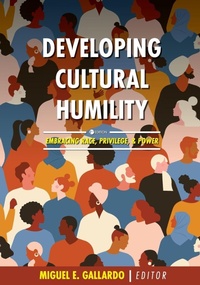
Developing Cultural Humility
Embracing Race, Privilege, and Power
2nd Edition
Published on 30. June 2021
Book
Paperback/Softback
370 pages
978-1-5165-3916-1 (ISBN)
Description
In Developing Cultural Humility: Embracing Race, Privilege, and Power, Editor Miguel Gallardo invites a group of psychologists who represent various cultural backgrounds but identify as "White" to share their individual journeys toward recognizing, understanding, and embracing their unique cultural identities and experiences. Contributing authors discuss the challenges and triumphs involved in the pursuit of integration of multicultural and social justice concerns in their personal and professional lives. They share how they remain engaged in the continual practice of self-discovery while remaining culturally responsive and humble.
Each chapter centers on a journey of self-discovery by a White psychologist with a reflective commentary from a BIPOC psychologist. The commentaries give voice to the personal journeys of individuals from historically dehumanized communities and also offer them the opportunity to react to and comment on the stories of White psychologists. Together, the chapters provide a model for pushing discussions, re-centering dialogues, and building stronger, more respectful relationships.
An exemplary resource to stimulate meaningful dialogue about race, privilege, power, and intentional self-reflection, Developing Cultural Humility is well suited for graduate-level courses in psychology, especially those with emphasis on multiculturalism and culturally responsive practice.
Check out the accompanying video! Hosted by Alexander Street, a ProQuest Company, the Developing Cultural Humility: Understanding How to Engage in Difficult Dialogues video demonstrates how to generate more authentic and genuine multicultural conversations and relationships. Preview a sample of the video.
Each chapter centers on a journey of self-discovery by a White psychologist with a reflective commentary from a BIPOC psychologist. The commentaries give voice to the personal journeys of individuals from historically dehumanized communities and also offer them the opportunity to react to and comment on the stories of White psychologists. Together, the chapters provide a model for pushing discussions, re-centering dialogues, and building stronger, more respectful relationships.
An exemplary resource to stimulate meaningful dialogue about race, privilege, power, and intentional self-reflection, Developing Cultural Humility is well suited for graduate-level courses in psychology, especially those with emphasis on multiculturalism and culturally responsive practice.
Check out the accompanying video! Hosted by Alexander Street, a ProQuest Company, the Developing Cultural Humility: Understanding How to Engage in Difficult Dialogues video demonstrates how to generate more authentic and genuine multicultural conversations and relationships. Preview a sample of the video.
More details
Edition
Second Edition
Language
English
Place of publication
San Diego
United States
Target group
Professional and scholarly
Edition type
New edition
Dimensions
Height: 254 mm
Width: 178 mm
Thickness: 20 mm
Weight
695 gr
ISBN-13
978-1-5165-3916-1 (9781516539161)
Copyright in bibliographic data and cover images is held by Nielsen Book Services Limited or by the publishers or by their respective licensors: all rights reserved.
Schweitzer Classification
Person
Miguel E. Gallardo is a professor of psychology and program director of Aliento, the Center for Latina/o Communities at Pepperdine University. He is a licensed psychologist and maintains an independent/consultation practice where he conducts therapy, forensic/legal psychological assessments, and consults with organizations and universities on developing culturally responsive systems. He teaches courses on multicultural and social justice, advocacy, and professional practice issues. Dr. Gallardo is also Director of Research and Evaluation for the Multiethnic Collaborative of Community Agencies (MECCA), a non-profit organization dedicated to serving monolingual Arab, Farsi, Korean, Vietnamese, and Spanish-speaking communities. He has published refereed journal articles, books, and book chapters in the areas of multicultural psychology, Latina/o psychology, ethics and evidence-based practices, cultural humility, and racial colorblindness.