

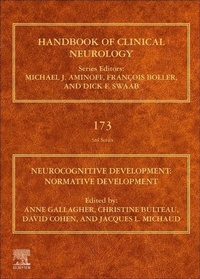
Neurocognitive Development: Normative Development: Volume 173
Volume 173
Published on 2. November 2020
Book
Hardback
532 pages
978-0-444-64150-2 (ISBN)
Description
This is one of a two-volume work on neurocognitive development, focusing separately on normative and non-normative development. The normative volume focuses on neurology, biology, genetics, and psychology of normative cognitive development. It covers the development of intellectual abilities, visual perception, motor function, language, memory, attention, executive function, social cognition, learning abilities, and affect and behavior. The book identifies when and how these functions develop, the genetics and neurophysiology of their operation, and their evaluation and assessment in clinical practice.
This book will serve as a comprehensive reference to researchers in cognitive development in neuroscience, psychology, and medicine, as well as to clinicians and allied health professionals focused on developmental disabilities (child neurologists, pediatric neuropsychologists, child psychiatrists, speech and language therapists, and occupational therapists.)
This book will serve as a comprehensive reference to researchers in cognitive development in neuroscience, psychology, and medicine, as well as to clinicians and allied health professionals focused on developmental disabilities (child neurologists, pediatric neuropsychologists, child psychiatrists, speech and language therapists, and occupational therapists.)
More details
Series
Language
English
Place of publication
Oxford
United Kingdom
Publishing group
Elsevier Science & Technology
Target group
Professional and scholarly
Researchers in neuroscience and neurology, psychology, psychiatry, and medical neurologists, health allied professionals, medical and health allied students
Product notice
sewn/stitched
Cloth over boards
Dimensions
Height: 266 mm
Width: 201 mm
Thickness: 35 mm
Weight
1419 gr
ISBN-13
978-0-444-64150-2 (9780444641502)
Copyright in bibliographic data and cover images is held by Nielsen Book Services Limited or by the publishers or by their respective licensors: all rights reserved.
Schweitzer Classification
Other editions
Additional editions

E-Book
09/2019
Elsevier
€255.00
Available for download
Persons
Dr. Anne Gallagher, pediatric neuropsychologist, holds a Canada Research Chair in Child Neuropsychology and Brain Imaging. She is an Associate Professor at the Universite de Montreal and the head of the Neurodevelopmental Optical Imaging Lab (LIONlab) at CHU Sainte-Justine. She conducts translational and interdisciplinary research work on language development and multimodal neuroimaging aiming to improve neurodevelopmental outcomes of infants and children born prematurely or with various clinical conditions including epilepsy and congenital heart disease. Using NIRS-EEG, her research has pioneered the development of innovative presurgical imaging techniques that are now routinely used in young patients. Dr. Christine BULTEAU-PEYRIE is pediatric neurologist and child neuropsychologist and associated member at the Memory, Brain and Cognition Laboratory (MC2Lab, EA 7536), Institute of Psychology Sorbonne Paris Cite University, France. She graduated in 1991 as Pediatrican with Honors after which she moved to Paris and did a residency in Pediatric Neurology with Pr Olivier DULAC at Saint Vincent de Paul hospital, Paris Descartes University. During her neuropediatric training she made clinical research in childhood epilepsy (Pr DULAC, Dr CHIRON), child neuropsychology (Pr JAMBAQUE) and child psychiatry (Pr MARCELLI). She obtained a Master Degree in Cognitive Sciences from the Ecole des Hautes Etudes en Sciences Sociales (EHESS/Paris) and a PhD in Cognitive Psychology at the Institute of Psychology, Paris Descartes University. Since 2000, she is working at Rothschild Foundation Hospital in Paris in the pediatric neurosurgery department and she is head of the comprehensive program for neuropsychological assessment in pediatric epilepsy surgery. Her research activity is about the patients who are candidate for hemispherotomy. Since 2003, she has worked actively in the pediatric epilepsy surgery task force (ILAE) and was member of the Commission Surgical Therapy (ILAE: 2013-2017) and participate to national training in childhod epilepsy and child neuropsychology as well as international training in pediatric epilepsy surgery. David Cohen is Professor at Sorbonne University and head of the department of Child and Adolescent Psychiatry at La Salpetriere hospital in Paris. He is also member of the lab Institut des Systemes Intelligents et de Robotiques - ISIR (CNRS UMR 7222) within the team Perception, Interaction and Social Robotics. His group runs research programs in the field of autism spectrum disorder and learning disabilities, childhood onset schizophrenia, catatonia and severe mood disorder. He supports a developmental and plastic view of child psychopathology, at the level of both understanding and treatment (see http://speapsl.aphp.fr). He was President of the International Association of Child and Adolescent Psychiatry and Allied Professions (IACAPAP) 2012 congress. Besides his work as child psychiatrist, he also has artistic activities (see http://www.dcohen.biz/). Jacques L. Michaud is a medical geneticist and scientist at CHU Sainte-Justine and Professor of Pediatrics and Neurosciences at Universite de Montreal. He has developed a research program on neuro-developmental disorders that integrates the discovery of their genetic causes, Dthe functional study of the associated genes and the development of therapeutic strategies. Dr. Michaud is the Director of the Quebec Center for Clinical Genomics, which provides genomic testing for the Quebec health care system, and Director the CHU Sainte-Justine Research Center.
Volume editor
Associate Professor, Department of Psychology, Universite de Montreal; Director, Laboratoire d'Imagerie Optique en Neurodeveloppement (LIONLAB), CHU Sainte-Justine Research Center, Montreal, Quebec, Canada
Pediatric Neurosurgery Department, Rothschild Foundation Hospital, Paris, France; Memory, Brain and Cognition (MC2 Lab, EA 7536), Institute of Psychology, Sorbonne Paris Cite University, France
Chef du Service de Psychiatrie de l'Enfant et de l'Adolescent, Hopital de la Pitie-Salpetriere, APHP Sorbonne Universite, Paris, France
CHU Sainte-Justine Research Center, Montreal, QC, Canada
Content
Section I. Introduction to Neurodevelopmental Disabilities
1. Description and classification of neurodevelopmental disabilities
2. Neurodevelopmental and cognitive disabilities: Historical overview
3. Ethical views and considerations
Section II. Biological Basis of Typical Neurodevelopment
4. Neurogenesis, neuronal migration and axon guidance
5. Development of neuronal circuits: From synaptogenesis to synapse plasticity
6. Myelination
Section III. Plasticity, Vulnerability and Evolutionary Constraints of the Developing Brain
7. Early brain plasticity: Definitions and theoretical concepts
8. Resilience
9. Critical periods of brain development
10. Vulnerability of immature brain
11. Hemispheric specialization
Section IV. Neuroscientific Basis of Typical Functional Neurodevelopment
12. Intellectual abilities
13. Visual development
14. The development of auditory functions
15. Motor functions
16. Typical language development
17. Literacy acquisition: Reading development
18. Memory: normative development of memory systems
19. Developing attention in typical children related to disabilities
20. Executive functions
21. Learning abilities
22. Social cognition
23. The role of cerebellum in the child neuropsychological functioning
Section V. Etiologies of Neurodevelopmental Disorders
24. Genetic mechanisms of neurodevelopmental disorders
25. The effects of sex on prevalence and mechanisms underlying neurodevelopmental disorders
26. Impact of prematurity on neurodevelopment
27. Pregnant women, prescription and fetal risk
28. Effects of prenatal alcohol and cannabis exposure on neurodevelopmental and cognitive disabilities
29. Maternal infections
30. Environmental toxic agents: The impact of heavy metals and organochlorides on brain development
31. The effects of socio-affective environment
32. Traumatic brain injury and baby shaken syndrome
33. Ischemic sequalae and other vascular diseases
1. Description and classification of neurodevelopmental disabilities
2. Neurodevelopmental and cognitive disabilities: Historical overview
3. Ethical views and considerations
Section II. Biological Basis of Typical Neurodevelopment
4. Neurogenesis, neuronal migration and axon guidance
5. Development of neuronal circuits: From synaptogenesis to synapse plasticity
6. Myelination
Section III. Plasticity, Vulnerability and Evolutionary Constraints of the Developing Brain
7. Early brain plasticity: Definitions and theoretical concepts
8. Resilience
9. Critical periods of brain development
10. Vulnerability of immature brain
11. Hemispheric specialization
Section IV. Neuroscientific Basis of Typical Functional Neurodevelopment
12. Intellectual abilities
13. Visual development
14. The development of auditory functions
15. Motor functions
16. Typical language development
17. Literacy acquisition: Reading development
18. Memory: normative development of memory systems
19. Developing attention in typical children related to disabilities
20. Executive functions
21. Learning abilities
22. Social cognition
23. The role of cerebellum in the child neuropsychological functioning
Section V. Etiologies of Neurodevelopmental Disorders
24. Genetic mechanisms of neurodevelopmental disorders
25. The effects of sex on prevalence and mechanisms underlying neurodevelopmental disorders
26. Impact of prematurity on neurodevelopment
27. Pregnant women, prescription and fetal risk
28. Effects of prenatal alcohol and cannabis exposure on neurodevelopmental and cognitive disabilities
29. Maternal infections
30. Environmental toxic agents: The impact of heavy metals and organochlorides on brain development
31. The effects of socio-affective environment
32. Traumatic brain injury and baby shaken syndrome
33. Ischemic sequalae and other vascular diseases