

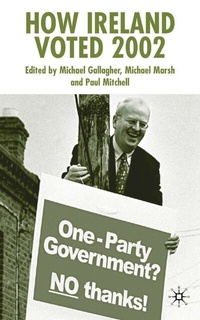
How Ireland Voted 2002
Will be published approx. on 24. January 2003
Book
Hardback
XXXV, 276 pages
978-0-333-96834-5 (ISBN)
Description
How Ireland Voted 2002 provides an in-depth analysis of the Irish general election. Continuing an established series of election studies, it sets out the context of the campaign, assesses the impact of the political parties' marketing strategies, and presents first-hand candidate campaign diaries. It analyzes voting patterns employing both aggregate data and survey evidence, discusses the post-election negotiations leading to the formation of the new government, and considers the implications for the future of the Irish party system.
Reviews / Votes
'The ultimate in authoritative analysis...must not be left unread by any serious student of Irish Politics.' - Irish Independent
'...the regular definitive report on Irish elections.' - Irish Independent (Dublin)
'Like its predecessors, this book offers the definitive account of the Irish general election' - Ian Mcallister, Political Studies Review
More details
Other editions
Additional editions
Michael Gallagher | Michael Marsh | Paul Mitchell
How Ireland Voted 2002
Book
01/2003
Palgrave Macmillan
€42.79
Shipment within 15-20 days
Michael Gallagher | Michael Marsh | Paul Mitchell
How Ireland Voted 2002
E-Book
01/2003
Palgrave Macmillan
€39.99
Available for download
Persons
HEINZ BRANDENBURG Assistant Professor, Department of Sociology and Political Science, Norwegian University of Science and Technology, Trondheim, Norway
JOHN COAKLEY Lecturer in Politics, University College Dublin
STEPHEN COLLINS Political Editor, Sunday Tribune
YVONNE GALLIGAN Reader in Politics, Queen's University Belfast
JOHN GARRY Lecturer, Department of Politics and International Relations, University of Reading, UK
JACQUELINE HAYDEN Lecturer, Department of Political Science, Trinity College Dublin
FIACHRA KENNEDY Department of Political Science, Trinity College Dublin
PAT LYONS Department of Political Science, Trinity College Dublin
GAIL MCELROY Department of Political Science, Trinity College Dublin
GARY MURPHY Senior Lecturer in Government, Dublin City University
RICHARD SINNOTT Associate Professor, Department of Politics, University College Dublin
LIAM WEEKS Department of Political Science, Trinity College Dublin
Content
The Background to the Election; G.Murphy Campaign Strategies; S.Collins Candidate Selection: More Democratic or More Centrally Controlled?; Y.Galligan The Candidates' Perspective; S.Fleming, P.Bradford, J.Burton, F.O'Malley, D.Boyle, A.Ó Snodaigh & L.Twomey Stability and Turmoil: Analysis of the Results; M.Gallagher What Decided the Election?; J.Garry, F.Kennedy, M.Marsh & R.Sinnott Voter Turnout in 2002 and Beyond; P.Lyons & R.Sinnott Why the Opinion Polls got it Wrong in 2002; G.McElroy & M.Marsh The Media and the Campaign; H.Brandenburg & J.Hayden The Subterranean Election of the Seanad; M.Gallagher & L.Weeks Government Formation in 2002; P.Mitchell The Election and the Party System; J.Coakley Appendices; L.Weeks Index