

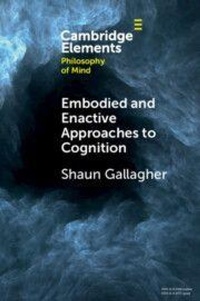
Embodied and Enactive Approaches to Cognition
Published on 3. August 2023
Book
Paperback/Softback
90 pages
978-1-009-20980-9 (ISBN)
Description
This Element discusses contemporary theories of embodied cognition, including what has been termed the '4Es' (embodied, embedded, extended and enactive cognition). It examines diverse approaches to questions about the nature of the mind, the mind's relation to the brain, perceptual experience, mental representation, sense making, the role of the environment, and social cognition, and it considers the strengths and weaknesses of the theories in question. It contrasts embodied and enactive views with classic cognitivism, and discusses major criticisms and their possible resolutions. This element also provides a strong focus on enactive theory and the prospects for integrating enactive approaches with other embodied and extended theories, mediated through recent developments in predictive processing and the free energy principle. It concludes with a brief discussion of the practical applications of embodied cognition. This title is also available as Open Access on Cambridge Core.
More details
Series
Language
English
Place of publication
Cambridge
United Kingdom
Product notice
Paperback (trade)
Illustrations
Worked examples or Exercises
Dimensions
Height: 222 mm
Width: 149 mm
Thickness: 5 mm
Weight
138 gr
ISBN-13
978-1-009-20980-9 (9781009209809)
Copyright in bibliographic data and cover images is held by Nielsen Book Services Limited or by the publishers or by their respective licensors: all rights reserved.
Schweitzer Classification
Other editions
Additional editions
Shaun Gallagher
Embodied and Enactive Approaches to Cognition
E-Book
07/2023
Cambridge University Press
€20.99
Available for download
Shaun Gallagher
Embodied and Enactive Approaches to Cognition
E-Book
07/2023
Cambridge University Press
€22.49
Available for download
Person
Content
1. Introduction: what is embodied cognition?; 2. The field of EC; 3. The first E: embodiment; 4. The second E: embedded cognition; 5. The third E: extended cognition; 6. The fourth E: enactive cognition; 7. Causation, constitution and free energy; 8. Conclusion: come practical implications and applications; References.