

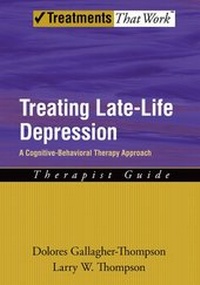
Treating Late Life Depression
A Cognitive-Behavioral Therapy Approach, Therapist Guide
Published on 17. September 2009
Book
Paperback/Softback
256 pages
978-0-19-538369-0 (ISBN)
Description
Depression is a common problem for individuals in their senior years. Conservative estimates suggest that more than five million seniors over 65 are suffering from severe depression. How can you help your older clients manage depressed mood?
This Therapist Guide outlines a three-phase program based on the principles of cognitive-behavioral therapy. Designed specifically for use with older adults, this treatment generally is delivered over the course of 16 - 20 sessions. In Phase 1 of the intervention, clients are introduced to the program and are encouraged to develop goals for therapy. The focus of Phase 2 is on helping the client acquire the cognitive and behavioral skills needed to meet the therapy goals. It is during this
phase that clients learn the benefits of participating in pleasant activities, how to challenge negative thinking, how to manage feelings of anger and frustration through relaxation, and how to improve communication skills. Phase 3 deals with termination and how to maintain the gains obtained in therapy.
Step-by-step instructions for administering therapy are provided in a user-friendly format, along with information on screening and assessment. A separate chapter on age-related issues that may affect treatment guides you through potentially difficult clinical situations. Complete with sample dialogues, at-home assignments, and lists of materials needed, this comprehensive guide includes all the tools necessary for facilitating effective treatment.
This Therapist Guide outlines a three-phase program based on the principles of cognitive-behavioral therapy. Designed specifically for use with older adults, this treatment generally is delivered over the course of 16 - 20 sessions. In Phase 1 of the intervention, clients are introduced to the program and are encouraged to develop goals for therapy. The focus of Phase 2 is on helping the client acquire the cognitive and behavioral skills needed to meet the therapy goals. It is during this
phase that clients learn the benefits of participating in pleasant activities, how to challenge negative thinking, how to manage feelings of anger and frustration through relaxation, and how to improve communication skills. Phase 3 deals with termination and how to maintain the gains obtained in therapy.
Step-by-step instructions for administering therapy are provided in a user-friendly format, along with information on screening and assessment. A separate chapter on age-related issues that may affect treatment guides you through potentially difficult clinical situations. Complete with sample dialogues, at-home assignments, and lists of materials needed, this comprehensive guide includes all the tools necessary for facilitating effective treatment.
Reviews / Votes
The authors' experience of working with this group is evident and their advice invaluable; particularly so for clinicians who may be new to this client group. It is structured such that once familiar with the protocol, the reader can quickly refer to a specific technique detailed in the book. Although the book is written by American authors it lends itself extremely well to UK practice and overall would make an excellent choice for any clinician practising CBT witholder adults. * The Journal of Critical Psychology, Counselling and Psychotherapy, March 2013 * This is one of the most comprehensive descriptions of practical CBT that I have read and, even without the client workbook, it does stand alone as a useful workbook for trainee CBT therapists and as a reference book for the more experienced therapist. * Healthcare Counselling and Psychotherapy Journal *
More details
Series
Language
English
Place of publication
New York
United States
Target group
Professional and scholarly
Dimensions
Height: 249 mm
Width: 174 mm
Thickness: 14 mm
Weight
450 gr
ISBN-13
978-0-19-538369-0 (9780195383690)
Copyright in bibliographic data and cover images is held by Nielsen Book Services Limited or by the publishers or by their respective licensors: all rights reserved.
Schweitzer Classification
Other editions
Additional editions
Ann M. Steffen | Larry W. Thompson | Dolores Gallagher-Thompson
Treating Later-Life Depression
A Cognitive-Behavioral Therapy Approach, Clinician Guide
E-Book
09/2021
2nd Edition
OUP eBook
€40.99
Available for download
Ann M. Steffen | Larry W. Thompson | Dolores Gallagher-Thompson
Treating Later-Life Depression
A Cognitive-Behavioral Therapy Approach, Clinician Guide
E-Book
09/2021
2nd Edition
OUP eBook
€40.99
Available for download
Larry W. Thompson | Leah Dick-Siskin | David W. Coon
Treating Late Life Depression
A Cognitive-Behavioral Therapy Approach, Workbook
Book
09/2009
Oxford University Press Inc
€31.55
Article exhausted; check different version
Persons
Dolores Gallagher-Thompson is Research Professor of Psychiatry and Behavioral Science, Stanford University.
Larry W. Thompson is The Goldman Family Professor of Psychology, Pacific Graduate School; Professor Emeritus, Stanford University.
Larry W. Thompson is The Goldman Family Professor of Psychology, Pacific Graduate School; Professor Emeritus, Stanford University.
Content
1. Introductory Information for Therapists ; 2. Screening and Assessment ; 3. Age-Related Issues that Affect CBT ; Part I. Early Phase of Therapy ; 4. Module 1: Introduction to Cognitive-Behavioral Therapy ; 5. Module 2: Identifying Target Complaints and Setting Goals ; Part II. Middle Phase of Therapy ; 6. Module 3: Doing Tools ; 7. Module 4: Thinking Tools ; 8. Module 5: Feeling Tools ; 9. Module 6: Communication Tools ; Part III. Late Phase of Therapy ; 10. Module 7: Termination