

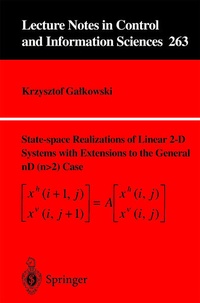
State-space Realisations of Linear 2-D Systems with Extensions to the General nD (n > 2) case
Published on 29. January 2001
Book
Paperback/Softback
XI, 232 pages
978-1-85233-410-9 (ISBN)
Description
This book demonstrates the newly developed Elementary Operations Algorithm (EOA). This is a systematic method for constructing a range of state-space realizations for 2-D systems.
The key achievements of the monograph are as follows:
- It provides a research-level introduction to the general area and undertakes a comparative critical review of previous approaches.
- It gives a thorough coverage of the theoretical basis of the EOA algorithm.
- It demonstrates the effectiveness of the EOA algorithm, for example, through the use of algebraic symbolic computing (using MAPLE), as well as by comparing this method with common alternatives.
The key achievements of the monograph are as follows:
- It provides a research-level introduction to the general area and undertakes a comparative critical review of previous approaches.
- It gives a thorough coverage of the theoretical basis of the EOA algorithm.
- It demonstrates the effectiveness of the EOA algorithm, for example, through the use of algebraic symbolic computing (using MAPLE), as well as by comparing this method with common alternatives.
More details
Series
Edition
2001 ed.
Language
English
Place of publication
London
United Kingdom
Target group
Professional and scholarly
Research
Illustrations
XI, 232 p.
Dimensions
Height: 235 mm
Width: 155 mm
Thickness: 14 mm
Weight
382 gr
ISBN-13
978-1-85233-410-9 (9781852334109)
DOI
10.1007/BFb0110347
Schweitzer Classification
Content
Preliminaries.- The elementary operation algorithm for polynomial matrices.- 2D state-space realizations and the elementary operation algorithm - Single input - Single output (SISO) case.- MIMO systems - the 1D case.- Multiple-input, multiple-output (MIMO) systems - the 2D case.- The elementary operation approach extensions.- State-space realizations for 2D/nD systems revisited - Relations to the EOA.- Conclusions and further work.